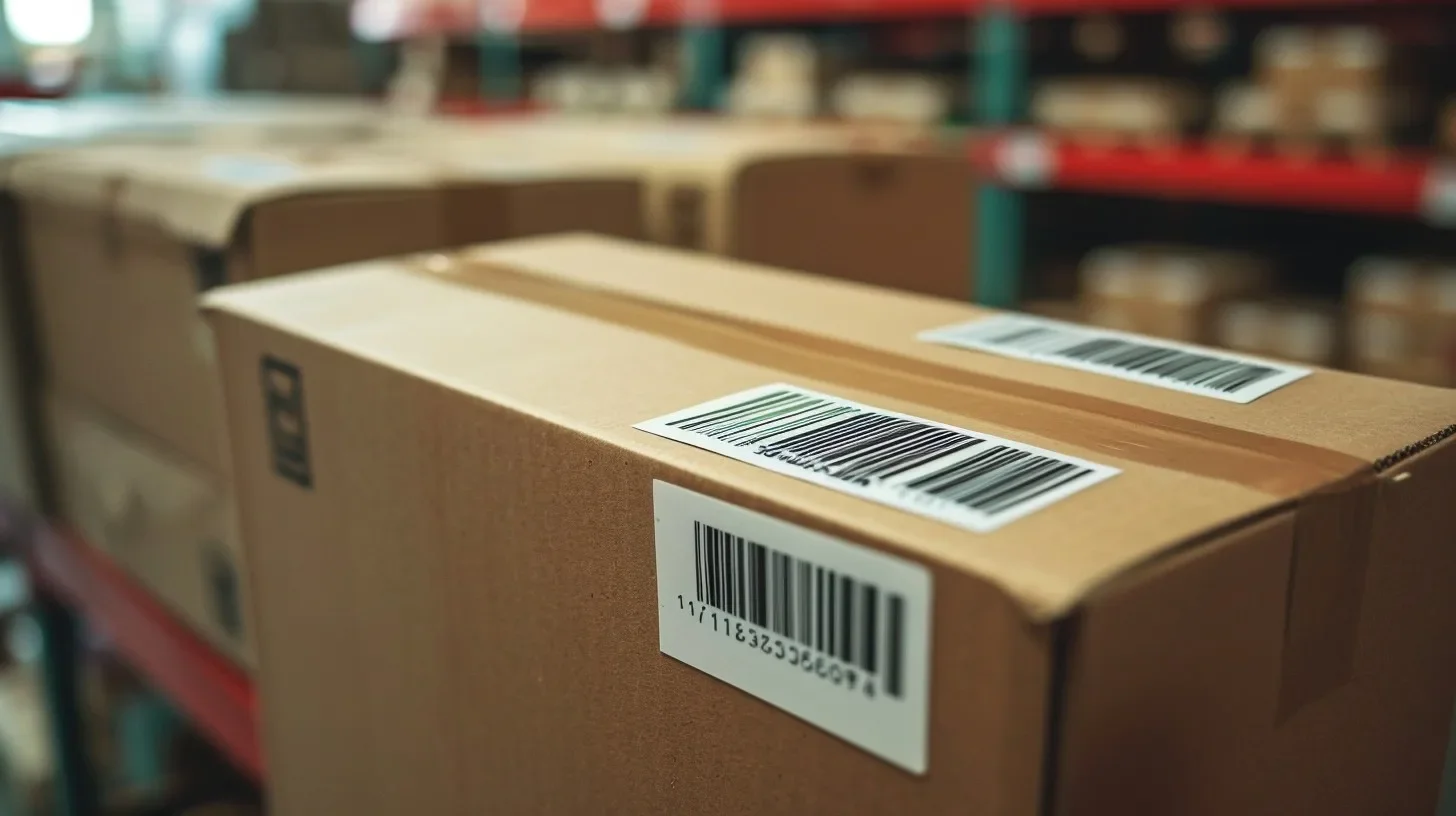
Sealed cartons with barcode shipping labels attached, ready for the next hand-off.
The message from the factory is short: "Cartons are packed. The label rolls are on the table. Can we go ahead?" Slow down here. The success of an FBA shipment is decided long before a single box leaves the factory, and the deciding document is a written scope: labels, cartons, documents, the shipment plan, the appointment and who pays when something fails.
Before you answer yes, get the confirmations below in writing. Amazon's inbound requirements span packaging, prep, labeling, box sizes, shipping modes and delivery windows. Amazon regularly makes subtle and occasionally significant changes to FBA shipping standards and workflow details. Read Amazon's own shipping and routing requirements, then check the current thresholds before the supplier prints labels or seals cartons.
For planning, sea freight remains the primary method for bulk FBA shipments from China, with transit times typically between 25 and 40 days. Total transit from the factory floor to a US FBA center can stretch to 75 days once prep, shipping and processing are counted. Unrealistic transit buffers are a common path to stockouts and lost sales rank, so start the reorder before the last shipment sells.
The confirmation sequence at a glance
Before the factory seals the run, get written answers to seven questions:
- Who generates and applies the FNSKU?
- Which carton weight and size limits, and which stickers, apply to this shipment?
- Who prints and applies the FBA Box ID labels, and does the packing list match every carton?
- Who creates the shipment plan, books the inbound appointment and owns the delivery window?
- Who owns FBA prep, and who pays for rework, rehandling or a rejected shipment?
- What are the final packed weights and dimensions, and when is the inspection?
- Who signs off in writing before the cartons are sealed?
The sections below follow that order. The final packed figures, the inspection and the written go-ahead come last because they cannot be settled until the earlier answers are on paper.
FNSKU labels: who generates them, who applies them?
Every unit sent to FBA needs a unique Amazon barcode, the FNSKU. That requirement is not optional. The FNSKU is how Amazon's systems identify that the product belongs to you, not another seller.
The label must completely cover any other barcode on the product, such as a UPC. If it is missing, peeling or unscannable, Amazon's systems will not know what to do with the item, and significant receiving delays follow. Labels must stay visible and must not be covered up or damaged.
Before the factory prints a single label, settle three things in writing: who supplies the label file, who prints the labels, and who applies them to each unit and checks that every barcode is covered.
Give the supplier the exact UPC or FNSKU labeling you need, and tell them explicitly that the goods will ship directly to Amazon FBA. Send Amazon's packing and labeling requirements as well, so the goods are prepped correctly.
Do not assume the factory can generate an FNSKU. Treat the label file as seller-controlled unless the written scope says the factory has the file and the instructions. A useful proof point is a photo of one finished unit with the label applied, before the full run continues.
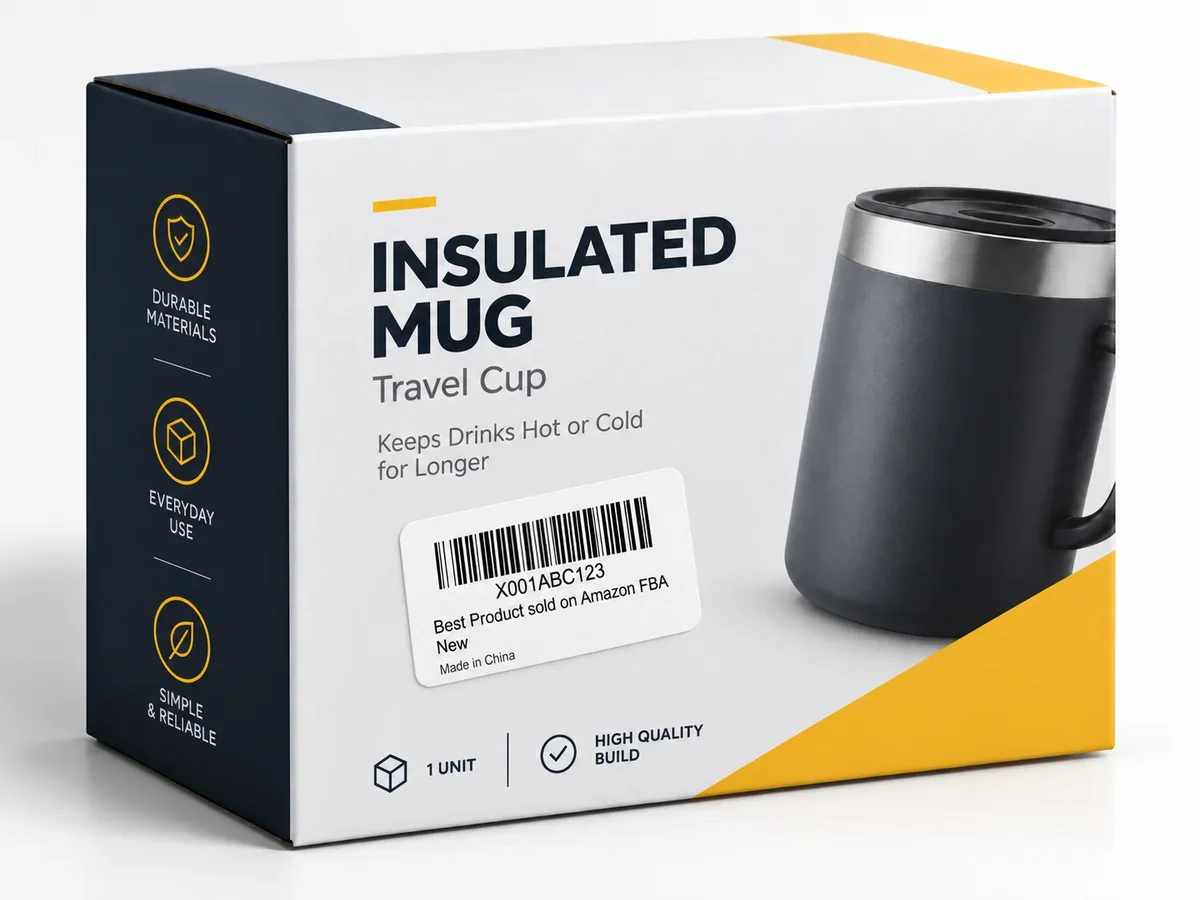
A packaged travel mug with a barcode label applied to the front of the box.
Ask the factory to confirm in one reply: "We will print from your file, apply one FNSKU per unit, cover the UPC completely, and send a photo of the first finished unit before packing the rest." If it cannot confirm that in writing, do not let the run proceed on a verbal assurance.
The FNSKU file, the carton list and the shipment plan all have to agree on quantities. If the label run covers 1,200 units and the shipment plan says 1,150, you will find out at receiving, not at the factory.
Carton limits: put weight, dimensions and packing in writing
Amazon enforces strict master-carton rules to protect warehouse staff and keep its conveyor belts moving. Your supplier should not guess at them, and "standard export carton" is not an answer.
One published guide says a single box cannot weigh more than 50 lb (22.7 kg) unless it contains one heavier oversized item. No side of a carton may be longer than 25 inches, with the same exception for a single oversized unit. A carton over 50 lb needs a Team Lift label clearly visible on the top and sides. An overweight box will be flagged instantly, and you will be billed a fee for Amazon to handle it.
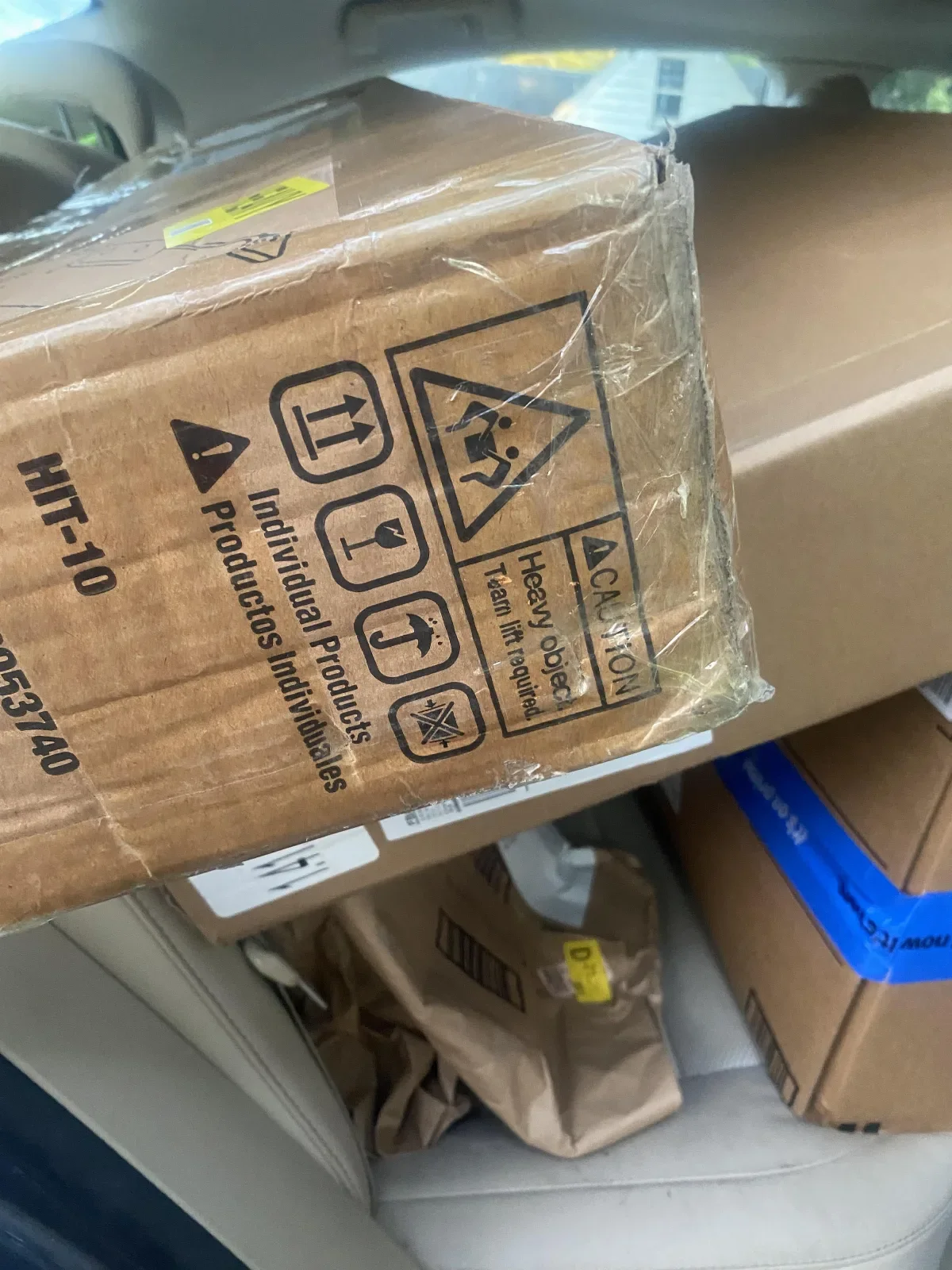
The carton is sealed in clear wrap and marked “Heavy object — Team lift required,” with handling icons visible on the side.
The sticker threshold is not consistent across published guidance. One published guide calls for a heavyweight sticker above 30 pounds. Boxes larger than 25 inches on a side are described as too big for Amazon's conveyor belts. Do not print either sticker as a universal rule until you have checked the current Amazon requirement in Seller Central.
Packing details belong in the written scope too. Leave about 2 inches of padding around each product. Do not use loose fill such as shredded paper or foam peanuts. Tape along the entire seam on the top and bottom. Reused boxes are acceptable only if any old labels or markings are removed or covered.
A simple factory check is to ask for the packed weight and dimensions of one finished master carton, plus a photo of the sealed box with any required sticker in place. If the carton is over the limit, the time to fix it is before the full run is taped, not after the forwarder has quoted the shipment.
Ask the factory which limit it is packing to and which sticker it will apply, in the same reply that covers the FNSKU. If the answer is a range rather than a number, ask for the number.
Box ID labels and the packing list: match every carton
Every master carton needs a unique FBA Box ID label. The Box ID carries the information Amazon needs to identify a specific carton's contents without opening it. Put it on the outside of each carton, away from the box seam and separate from carrier labels. Without that label, the carton is set aside for a slow, manual check-in.
Your packing list records each carton's contents, weights and dimensions, and it must match the commercial invoice and the physical goods. The commercial invoice is the most critical document for customs. If the packing list says 24 units and the carton holds 20, the problem is already in the documents, even if the goods are fine.
Before shipping from China, match carton references to SKU quantities. Check mixed cartons, partial cartons, label approval and the records kept after repacking. A mixed carton has to be described accurately and linked to the correct Box ID.
Ask for the draft carton list and a photo of one sealed carton with the Box ID in place before the full run is sealed.
Repacking changes the carton records. If the factory repacks or consolidates cartons, the Box ID labels have to be reissued and the carton list re-matched before anyone trusts the quantities in the shipment plan. Ask who does that rework, and ask for the updated carton list as a written deliverable, not a verbal update.
Shipment plan and inbound appointment: who actually books it?
Create the Shipment Plan in Seller Central before your freight forwarder can move the goods. The plan states what you are sending, how many units of each SKU and how it is packed.
Amazon designates destination fulfillment centers across its network based on inventory volumes and locations. Sellers cannot deliver to an Amazon warehouse themselves. Shipments must go through carriers such as UPS or DHL with labels that let Amazon identify and process the inventory.
A forwarder with genuine FBA experience should know Amazon's appointment system, its labeling rules and the pitfalls that delay or reject shipments. That knowledge is not the same as responsibility. Ask who actually books the appointment, what they need from you, when they will book it and what happens if the factory misses the collection or delivery window.
Vague phrases need names. "The forwarder handles it" names no owner, and "our agent will arrange the appointment after collection" gives no lead time. Ask for the appointment owner, the information they need and the date by which they need it.
If the answer is "we will see after the shipment is ready," treat that as an unresolved item. The factory may still be able to pack, but the shipment is not ready for a clean hand-off until someone has accepted the appointment responsibility in writing.
Who owns FBA prep, and who pays when it fails?
A delivery quote is not a prep scope. The Incoterms rule in your quote decides who clears the goods and who pays the import charges. It does not decide who labels, packs or books anything.
Under DDP, the seller clears the goods and carries the import duties and taxes through to delivery; under DAP, that clearance and those charges fall to the buyer. Delivery itself happens on the arriving means of transport, ready for unloading at the agreed point. The seller is not automatically required to carry the cartons into your stockroom, and any extra unloading arrangement needs to be written into the agreed scope. That unloading question only arises when the goods go to your own warehouse or a 3PL; if the cartons go straight to an Amazon fulfillment center, the receiving rules are Amazon's.
A DDP quote that includes delivery to the FBA warehouse looks convenient, and it can be. DDP can hide inflated shipping costs inside the product price, so ask for the shipping element broken out before you treat the number as your landed cost.
If the delivery point is your own warehouse, give the supplier your postcode, entrance restrictions and receiving hours, and ask for a named delivery point and the applicable Incoterms edition.
Insurance is a separate agreement from the Incoterms rule. Ask the forwarder whether cargo insurance is arranged, what it covers and how damage is reported. DDP on its own does not require the seller to buy cargo insurance for the buyer.
The prep scope is a separate list from the transport quote. Ask who applies FNSKU labels, who packs to Amazon's requirements, who applies Box ID labels, who books the appointment and who handles rework if prep fails. A delivery promise is not an FBA prep promise.
Handling FBA prep in China can be more cost-effective than using a US 3PL, but the quote must name the prep work. One provider publishes warehouse labor at $5 per hour and FNSKU labeling from $0.03. That provider states goods are inspected to AQL 2.5 before dispatch, with 1-by-1 checks available. Findings are supplied in writing, with photos on request. Treat those figures as published rates to verify, not as a market benchmark.
Consolidation can reduce finger-pointing. One facility that receives, stores, inspects, packs and ships replaces separate forwarders, packers and QC vendors. When goods sit with three vendors who have never met, every hand-off becomes a fee and someone else's fault. Consolidation only helps if the written scope names who owns each step.
Incorrect FNSKU or carton labels lead to receiving errors and costly unplanned service fees. A single prep mistake can lead to shipment rejection and leave inventory locked up for weeks. Do not assume the supplier, forwarder or marketplace will absorb those costs. Put the allocation in the order confirmation: who pays for rework, rehandling or a rejected shipment, and what evidence triggers that payment.
One guide quotes inbound placement fees at an average of $0.27 per standard unit and $1.58 per oversized unit. Those figures come from a 2024 update and should be checked against current Amazon fees before you use them in a budget.
Before you release the cartons: packed data, inspection and a written go-ahead
Never estimate product weight and dimensions. Get final, packed dimensions and weight for both the individual unit and the master carton. Those figures drive both the freight quote and Amazon's FBA fees. Ask for final packed volume and gross weight, not only the dimensions of one assembled unit. Nesting, pallet height and protective packing affect the shipment a provider will quote.
Schedule a pre-shipment inspection before loading. Inaccurate labels, packaging and product specifications belong on the check list. Skipping a pre-shipment inspection to save a few hundred dollars often ends with defective inventory at FBA that cannot be sold.
Ask for a collection plan that follows inspection and final packing yet still leaves enough time for the booked departure. Quote validity should say whether it is tied to booking, collection or departure, and what happens if the factory misses that date. A cheap quote that expires before the goods can be collected is not an executable option.
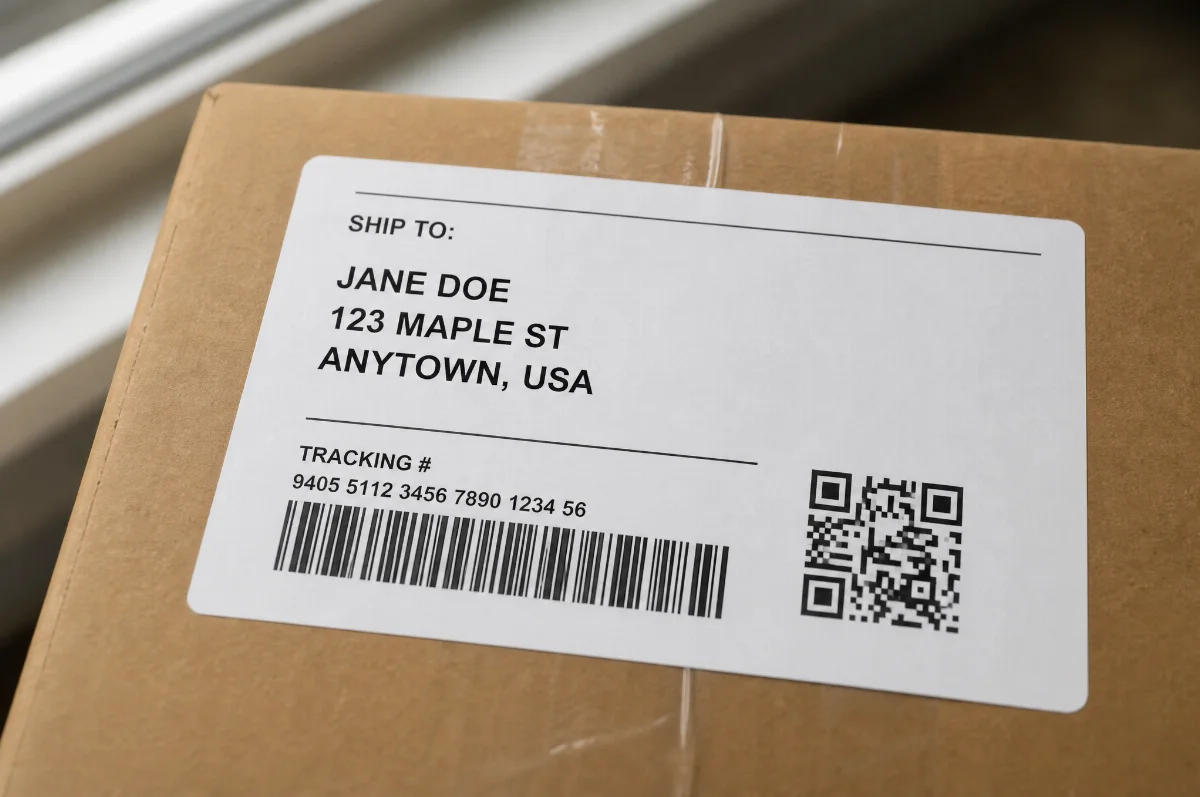
A closed carton with a printed shipping label, barcode and QR code.
Here is the message to send before you answer the factory. Replace the brackets; do not leave a blank that the supplier can fill with an assumption.
Please confirm in writing before you seal the cartons:
- FNSKU: you will print from the file we provide, apply one FNSKU per unit, cover the existing UPC completely, and send a photo of the first finished unit.
- Cartons: final packed weight and dimensions for one unit and one master carton; the weight and size limits you are packing to; and which sticker, if any, you will apply.
- Box ID: you will apply the FBA Box ID label we provide to each master carton, on the outside, away from the seam and separate from the carrier label. If you repack or consolidate, you will reissue the Box ID labels and send the updated carton list before the shipment plan is confirmed.
- Packing list: the carton list matches SKU, quantity, weight and dimensions for every carton, including mixed or partial cartons.
- Shipment plan and appointment: name the person or company that creates the shipment plan, books the inbound appointment and owns the delivery window. State what you need from us and by when.
- Prep and failure costs: state who applies labels, who packs to Amazon's requirements, who handles rework, and who pays for rehandling, unplanned service fees or a rejected shipment.
- Final data and inspection: send the final packed volume and gross weight before collection, and confirm the inspection date before loading.
What you want back is a named, written scope you can check before the cartons leave, not a plain "yes, we can ship." If any line comes back blank, the shipment is not ready for a go-ahead.
The go-ahead is a written scope
Cartons packed, labels on the table, can we go ahead? The answer can be yes once seven things have a name against them: the FNSKU owner, the carton limit and sticker rule, the Box ID and packing list match, the appointment owner, the prep owner, the cost of failure, and the inspection date and packed figures.
If one of those is still open, keep the cartons unsealed or ask for the missing written answer. That costs an afternoon. It is cheaper than a rejected shipment, a manual check-in or a rehandling invoice after the goods have already left the factory.