A supplier quotes "MOQ: 200 pieces." Before you approve the purchase, check what those 200 pieces cover. Can you mix colors? Does the minimum apply to each model? Is the quote for plain packaging only? The answers determine how much stock you have to buy.
Ask for quantities against each version you plan to sell before negotiating a lower minimum. Get that breakdown in writing and check the total. "Mixed colors are possible" still leaves you without the quantities you need to place an order.
Ask for a minimum against each variant
Send the supplier a list with one line for each combination of model, size, color and packaging. Put your requested quantity beside it, with space for the supplier to confirm the minimum. Check whether a minimum order value or a requirement to buy full cartons also applies.
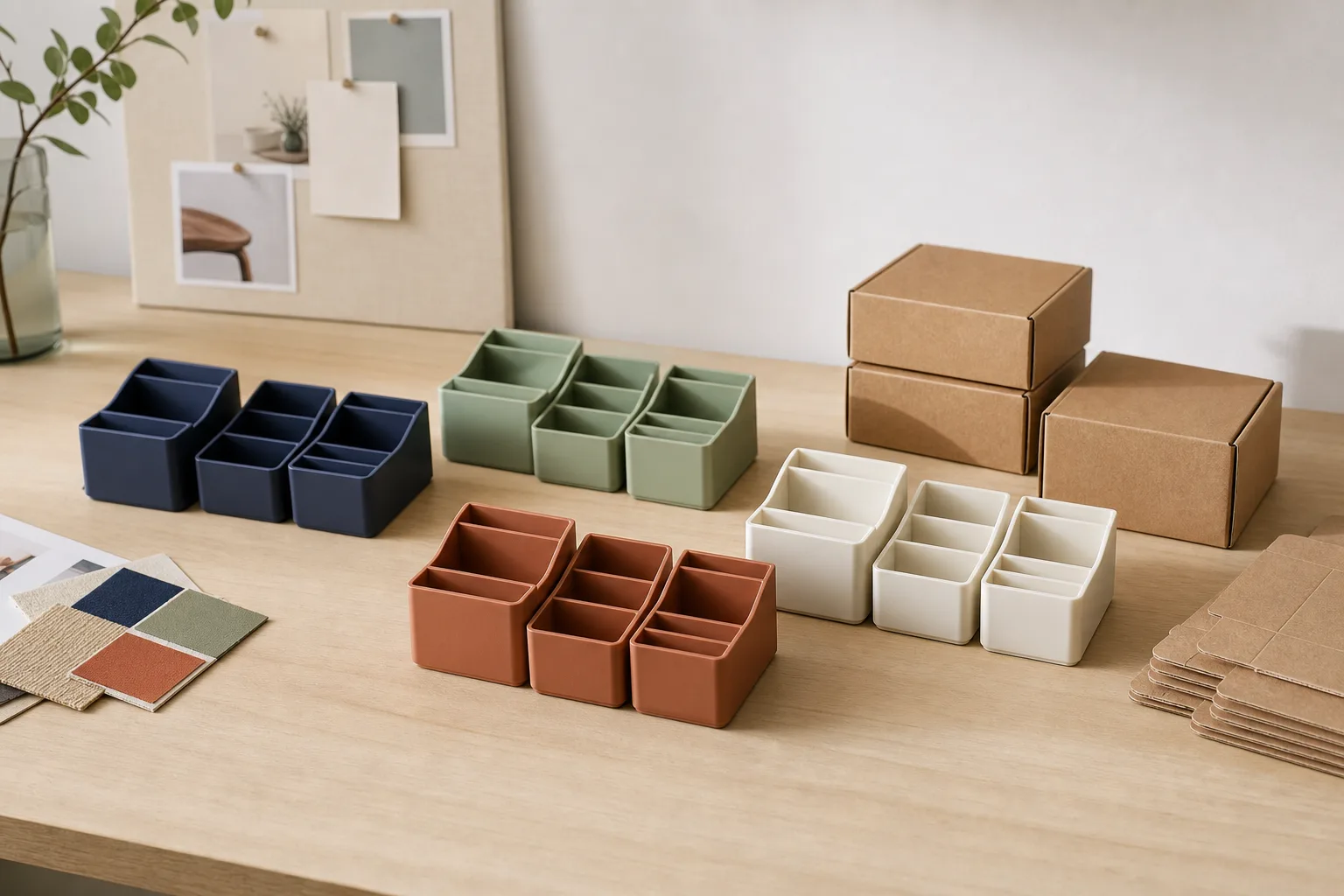
Suppose you want 300 desk organizers in four colors. At 200 pieces per color, you would have to buy 800 to keep all four. These are example quantities, not an industry standard. If the supplier instead allows 200 pieces across approved stock colors, your 300-piece order may work. You still need confirmation of the color mix and available stock.
Have the supplier specify whether the terms are "200 per color" or "200 total, at least 50 per color." Check sizes separately: meeting the color minimum does not necessarily meet the minimum for each size.
Check why the minimum applies
Find out what sets the minimum. It could be available finished stock, the size of a production run, a material purchase, decoration or printed packaging. Ask which component or process prevents the supplier from accepting your requested quantity.
Get a separate quantity for packaging. For example, Packhelp's packaging catalogue lists minimums that depend on the product. Those terms apply to Packhelp's range; you need your own supplier's packaging minimum for an order from China.
Record how many products and packages you are buying, the artwork version and any unused balance. A quote that says "custom packaging included" may leave unclear how many empty boxes you are paying for. If a carton contains several retail units, record the carton and retail-unit quantities separately.
Change one part of the quote at a time
Start with a quote for your original request, then ask the supplier to price one change at a time. Would fewer colors help? Could you use an existing color instead of a custom match, or a stock box with an approved label? Check which options the supplier can actually offer.
Keep your performance requirements the same. If the supplier lowers the minimum by changing the material, dimensions or finish, review and approve that as a separate product proposal. Otherwise, your smaller order may no longer test the product you intend to sell.
Any packaging alternative still needs to protect the product, fit properly, carry the required information and look acceptable to your customer. Approve a representative packed sample before production. A picture of the box cannot tell you whether the product moves around inside it.
Include unused packaging in the cost of the order
Consider another planning example: the supplier accepts an order for 300 products, but you must buy 600 printed boxes. You receive 300 packed products, leaving 300 unused boxes. Before agreeing, ask where those boxes will be stored, who owns them and how their use on later orders will be recorded.
Agree on:
- the item, quantity and specification the supplier will hold;
- the storage location, charges and storage period;
- how the supplier will report damage, shortages and stock counts;
- how later invoices will account for boxes you have already paid for;
- what happens if you change the design, move to another supplier or never reorder.
Include the unused boxes in what you commit to buying on this first order, even if they stay at the factory. You cannot assume you will recover their cost. You may be able to use them later, but that depends on future demand and keeping the same product and design.
Check the total order behind a smaller shipment
If a supplier says, "We can send 300 now," ask how many units the factory will make and how many you are agreeing to buy. It may be a larger order with the rest held in storage. Confirm the total payment and when you must take the remaining stock. Splitting the deliveries alone does not reduce your purchase commitment.
When comparing quotes, add up the cash due before the first shipment, payments still owed, storage and delivery costs. Also consider how much stock you would be left with if sales disappoint. A lower unit price can require more cash than a smaller run at a higher price. Work from actual quotes; there is no break-even quantity that applies to every order.
Put the agreed quantities in the order confirmation
The order confirmation should list each variant and quantity, the mix allowed, product and packaging specifications, extra charges, stock balances and delivery schedule. Check the total against both the invoice and your purchase order.
You can send the supplier this request:
Please confirm whether the minimum applies to the whole order or to each model, size and color. Quote our attached quantity breakdown and identify any full-carton or minimum-value condition.
List product, decoration and packaging quantities separately. If unused materials or packaging must be purchased, state the cost, ownership, storage terms and how the balance will be used. Distinguish the total committed order from the first shipment.
If the total is still more than you can reasonably test, change the assortment or compare another suitable supplier. Adding colors just to reach the minimum leaves you with more variants to find buyers for.
For help comparing sourcing options, send Surmount your product and quantity breakdown. Include your colors, sizes, packaging requirements and first-order budget.