
A printed order document, a physical sample and a caliper laid out beside a laptop showing a factory floor.
9:40 a.m., Tuesday. The agent replies within the hour: "MOQ 200 pieces, $4.85 each, all-in. Deposit today and we start production tomorrow." The specs are still "to be confirmed," the sample is still in transit, and nobody has mentioned an inspection plan. This is a hypothetical buying scenario, not a client case.
Do you pay?
A sourcing agent red flag is not just a strange email or an uncomfortable sales call; it is a missing control that can turn price, quality, payment, documentation, or delivery into the buyer's problem after money has already moved.
The safest warning signs are therefore operational: unclear quote basis, weak product evidence, vague payment records, poor production visibility, and trade terms that do not explain who carries cost and risk.
Money can move in minutes; production recovery can take weeks. So every check below happens before the deposit: what the warning sign looks like, which written evidence settles it, and a short request you can send before any payment moves.
What counts as a red flag (and what does not)
Replace gut feeling with a control you can point to. A red flag is not a strange tone of voice or one slow reply; it is a missing control in identity, quote basis, quality evidence, payment records, production visibility or delivery responsibility.
A practical rule helps: if a red flag cannot be converted into a document, milestone, inspection record, or hold/release decision, it is probably still too vague.
A buyer should pause when the agent cannot explain what evidence will exist before production and before shipment release.
Two things keep the list honest. A low price alone does not prove fraud, and a real business can make mistakes. The pattern matters more than one awkward answer.
One limit up front: these checklists come from practitioner guides and agency experience. We found no measured data on how often agent fraud, double commissions or payment-change scams actually occur, so treat the lists below as screening tools, not statistics.
The standard to hold an agent to is simple. A reliable sourcing agent in China should make your supplier decisions more transparent, not place another opaque layer between you and the factory. The agent's value is visible in the records they produce, the problems they identify and the responsibility they accept.
Red flag 1: the quote looks complete but explains nothing
The biggest red flag is a quote that looks complete but does not explain what is included.
Product version, material, packaging, logo method, carton size, inspection basis, trade term, lead time, and destination assumptions can change the real price. A low number without those assumptions is not a strong offer; it is an unpriced risk transfer.
Ask two things in writing: which exact product version is being quoted, and what would change the price. If the answer stays vague, pause before deposit.
A low or "free" commission is not a saving
Commonly quoted commissions are around 5–10% of order value, but the percentage alone tells you little. Write down the commission base and minimum fee.
A quick arithmetic check with illustrative numbers. On $10,000 of goods, 3% is $300. If the agreement instead applies 3% to $10,000 of goods plus $2,000 of freight, the fee becomes $360. These are illustrative figures, not advertised rates.
Ask whether the minimum applies to each order, each supplier or each shipment. Three small supplier orders consolidated into one shipment could trigger three minimum fees if that is how the service is priced.
Some agents present "free" sourcing services but embed their margin into the factory quote itself. One agency's guide describes the trick in a single line: "You think you are seeing the factory's real price, but the agent has added 10-15% before showing it to you." One sourcing agency reports seeing agents quote $3,500 for a shipment when the actual forwarder invoice was $2,200. Both figures come from that provider's own account; treat them as unverified examples, not measured norms.
Insist on itemisation. Request a quotation structure that separates product cost, agent fee, packaging, inspection, origin handling, freight and other services where they apply. A new mould fee belongs on a different line from the agent's fee for coordinating it. Keep both visible even when one company collects the payment.
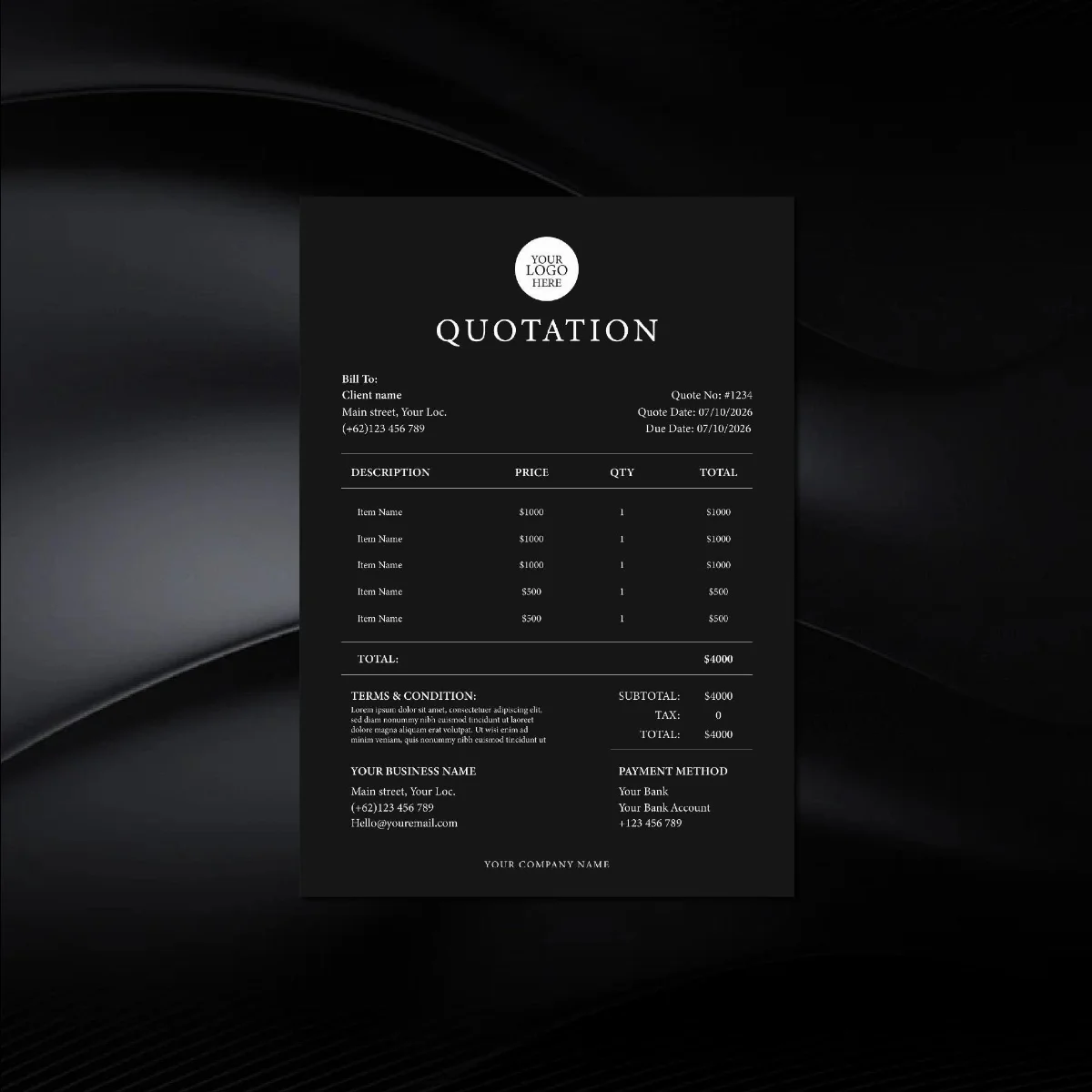
A quotation layout that puts each line into its own description, price, quantity and total column.
Do not assume that the lowest visible agent fee produces the lowest landed cost. A transparent answer is more useful than the smallest headline percentage. Ask for the inclusions and exclusions in writing.
Red flag 2: you cannot verify who you are paying, or who makes the product
Start with identity, before files or funds move. Confirm the legal company name, business registration, operating address, contracting party, invoice issuer and payment beneficiary.
For a mainland China company, the registration record can be checked in the National Enterprise Credit Information Publicity System. The registry is in Chinese, so ask the agent to open their own record with you on a call and compare the names and numbers.
Match the registration record against the contract, invoice and bank details before you send files or funds. A local address or business licence does not prove performance, but identity is the starting point for accountability. If names, payment accounts, invoice entities, or business descriptions do not match, the buyer should slow down. A different name may have a legitimate explanation, but obtain supporting documents and verify the relationship through an independent channel.
General claims such as "ten years of experience" or "thousands of factories" do not show how the agent will manage your order. Place the company website, independently verified contact details, business registration, quote, contract, invoice and beneficiary on one sheet.
Who makes the product, and who else pays the agent
One guide to agent red flags puts it bluntly: if your agent refuses to tell you which factory is making your product, they are protecting their commission, not your interests. The same source names the remedy: The only way to protect yourself is to insist on seeing original factory quotes on the factory's own letterhead, with the factory's contact information.
Ask the money question directly: "Do you receive any payment or commission from the factory?" A trustworthy agent will answer clearly. Some agents collect a fee from you and a referral commission from the factory simultaneously. The factory factors the agent's kickback into your unit price, so you are effectively paying twice. That is one provider's description of a pattern it says it sees; we found no data on how common it is.
Presence is part of identity too. Before hiring one, ask where their office is, how many factories they have visited in the last 12 months, and whether they can provide photos or documentation from recent factory visits.
Missing paperwork is not an automatic verdict. Remember, the absence of documents does not automatically disqualify a supplier, but it raises red flags that require further investigation. Newer companies may still be reliable, but they might require more cautious engagement.
Red flag 3: payment moves faster than product evidence
A deposit request is not automatically suspicious, but payment timing should follow evidence timing.
The warning sign appears when the agent asks the buyer to pay quickly while product specs, sample status, packaging, quality control, or delivery basis remain unclear. If payment is the only urgent item, the agent's priorities may not match the buyer's risk.
Ask three timing questions and write the answers down: what evidence exists before deposit, what evidence exists before production, and what evidence exists before shipment release?
The bank-change trap
One common risk is an impostor using a familiar supplier identity to send a last-minute payment change.
Stop when you receive an urgent "new finance account" or changed payment request. Do not call the number supplied in the new message. Call a previously verified number or one obtained independently, compare the beneficiary with the contract party, and have a second colleague approve the change. An email reply or chat screenshot alone does not authenticate a bank account.
Treat this routine as practitioner practice, not a legal standard.
Keep the record while you investigate. Record who requested each change and when. Save original emails, chat records, invoices, contracts and beneficiary details. Resume only after documenting how the discrepancy was resolved and who approved the decision.
Red flag 4: weak product evidence and late quality control
If an agent discourages you from ordering samples, tells you inspections are unnecessary, or insists their factory "never has quality issues," walk away. No factory is perfect, and experienced sourcing professionals know that.
Quality control should not begin when cartons are already sealed. Quality control should be discussed before deposit or sample approval. The buyer should know what will be checked before production, during production, and before shipment release.
"We check quality" is not an inspection plan. Ask who writes the checklist, which approved sample is the reference, how units are selected and who decides release, rework or reinspection. If the inspection uses sampling, ask which plan applies, such as an AQL plan under ISO 2859-1, and which AQL values are set for critical, major and minor defects.
Photos help, but they cannot replace specifications. The risk is not only that the product is different; it is that the buyer cannot prove what was supposed to be made.
When inspection fails
Agree the next step before booking inspection. If goods fail, who arranges correction, who pays for sorting or rework, and who pays for the inspector to return?
Late inspection can still find defects, but it gives the buyer less leverage and can create schedule pressure, rework cost, or partial-shipment decisions.
Distinguish the cost of conducting an inspection from a promise to compensate for defective goods. Paying an agent to arrange a check does not, by itself, settle liability for every product failure. A sampled inspection is not a check of every unit.
Red flag 5: "we will update you" and blurry shipment terms
"We will update you" is not a production-control system.
Ask for the milestone list in writing: material readiness, production start, mid-production status, packing, final inspection, loading and documents. If the agent cannot say what will be reported and when, the buyer may receive bad news only when the order is already late. Ask for reporting rhythm before the order starts, not after silence becomes a problem. Define the normal update cadence and the events that require immediate escalation. Fast replies are helpful, but accurate written decisions are more important than constant informal messages.
Structured visibility matters most when a launch date, a promotion or a retail program is fixed. A short update delay is harmless on a simple reorder and expensive against a container cutoff.
Where responsibility transfers
Shipment terms can hide margin damage. A quote may look cheaper because it excludes freight, insurance, customs clearance, delivery to warehouse, or documentation work. If the agent cannot explain where responsibility transfers, the buyer may be comparing unlike offers. Compare both agents on the same delivery basis, with the same included limits.
Standard red-flag lists also include an agent with no knowledge of shipping or import requirements for your market. Specific duties, tariffs and Incoterms rules change, so confirm them for your own product and destination before you sign.
The pre-payment checks: what to send before any money moves
Start with three questions before you hire anyone:
- Will you share the factory's original quotes and full contact details?
- What is your fee structure, and are there any additional charges?
- Can you provide references from clients in my product category?
A reliable agent will answer all three without hesitation.
Attach these seven fee questions to any quote:
- What amount is the commission calculated on?
- Does the minimum apply per order, supplier or shipment?
- Which quantities, hours and days are included?
- Which supplier costs and third-party charges are separate?
- Who must approve additional work before it starts?
- Who pays for correction, sorting and reinspection?
- What remains payable if we cancel or reduce the order?
Send the same questions to both agents and attach their answers to the quotation.
Request template (adapt before sending)
Product, quantity and destination: … Number of suppliers and expected shipments: … Tasks required and final deliverable: … Required language support: … Please state the fee model, calculation base, minimum and payment milestones. For samples, inspection, consolidation and storage, list included quantities or days, exclusions and extra rates. Explain approval of changes, cancellation charges and responsibility for rework and reinspection. Separate goods, agency services and third-party costs; state currencies and quote validity. If a cost cannot yet be fixed, give its calculation method and what information will make it firm.
An estimate with clear assumptions is more useful than an unexplained total.
Five questions before paying
- Do contract, invoice and payee identify the same party, or is a different name reliably explained?
- Was any bank change confirmed using a known independent channel?
- Do sample, model, quote and test documents describe the same goods?
- Does delivery or acceptance evidence justify the current payment milestone?
- Is every unresolved discrepancy assigned to an owner with a stop condition?
Match first-order size and payment milestones to evidence that can actually be verified. Put specifications, approved sample, packaging, quantity, lead time, acceptance method, change process and dispute procedure in the order. If an audit, inspection or escrow service is needed, confirm its provider, scope and price; do not assume the platform has performed it. Treat claims without matching evidence as open questions.
Run a controlled trial before you scale
Use a real but contained project to test the agent's process. Agree in advance what a successful trial must produce: a usable brief, credible supplier comparison, clear sample record, inspection output or another defined deliverable. Do not increase order value or scope merely because the first interaction felt friendly. Scale the relationship after the operating process has been demonstrated.
One-page decision summary
| Warning sign | Evidence to demand before paying | Decision |
|---|---|---|
| Quote basis unclear | Written assumptions: version, material, packaging, trade term, lead time | Pause until the assumptions are written |
| Identity inconsistent | Registration record matched to contract, invoice and payee | Slow down; verify through an independent channel |
| Payment pushed early | Evidence staged before deposit, production and shipment | Do not pay ahead of evidence |
| QC treated as late paperwork | Checklist, approved sample, defect classes, release rule | Fix with milestones, or walk away |
| "We will update you" | Agreed milestone list and escalation events | Define reporting rhythm before production |
| Blurry shipment terms | Where cost and responsibility transfer, in writing | Compare both offers on the same delivery basis |
The comparison reveals that most red flags are fixable only before the buyer commits money or time.
Conclusion: fix, pause, or walk away
Once deposit, packaging, tooling, or seasonal delivery is locked, the same warning sign becomes a recovery problem rather than a screening problem.
Your next step is one document. Write the pre-payment brief (product version, materials, packaging, inspection expectations, payment rhythm, delivery term) and send the same questions to every agent on your shortlist, attaching their answers to the quote.
Some warning signs can be fixed with clearer documents, better milestones, or revised payment timing. The buyer should reject or pause when the agent resists clarification, cannot provide consistent records, treats QC as late paperwork, or pressures payment before product evidence is ready.
Fix what documents and milestones can fix. Everything else is a stop signal, and it is cheapest to act on it before the deposit.