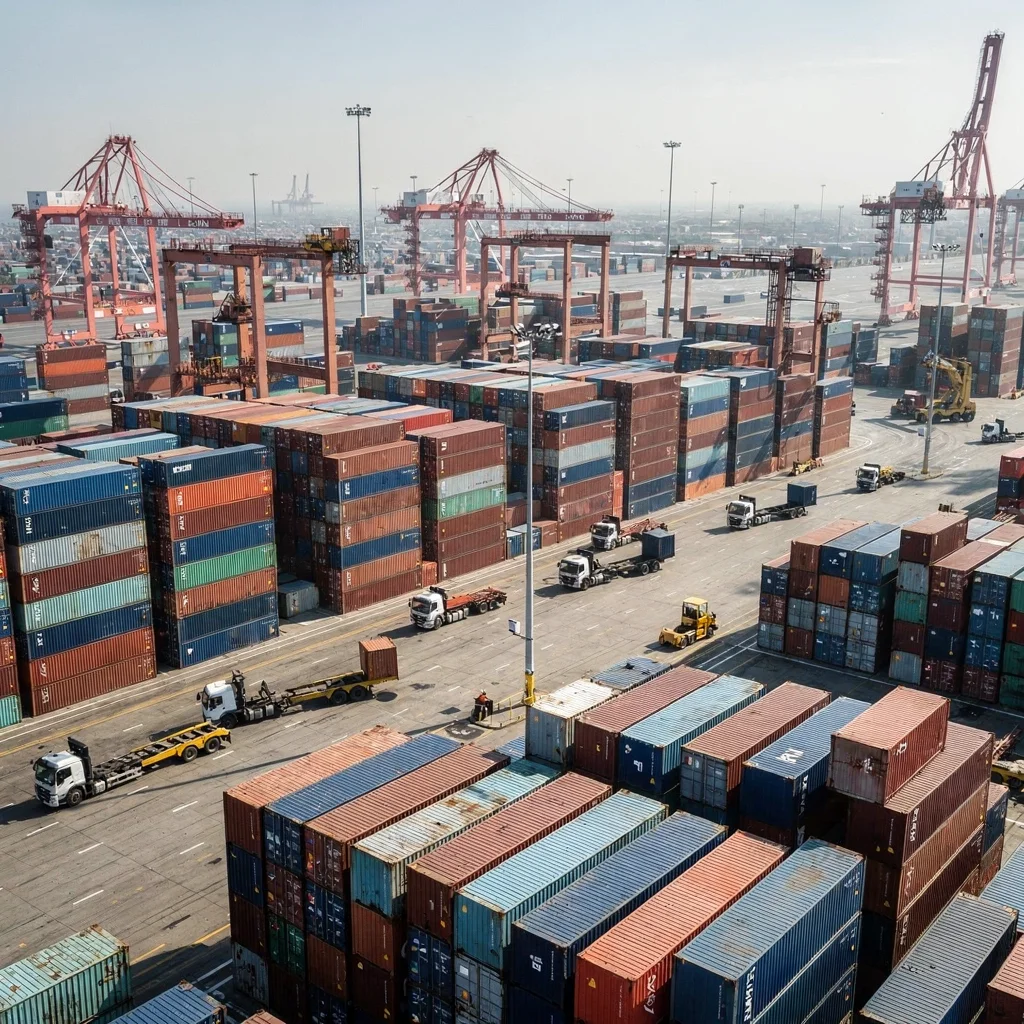
Every cost line in the worksheet pays for one leg of this journey — from the factory door to your destination.
Sample quote, illustrative: $1.80 per unit, MOQ 1,000 pieces.
Do the arithmetic and the goods come to $1,800. Then the freight invoice arrives, the customs entry adds duties, your sourcing agent adds a fee, the bank deducts a transfer charge. The number of units you can actually sell turns out to be smaller than the number you ordered. The quoted unit price covers none of that. What you need before the purchase order goes out is the cost of one saleable unit at your door.
Landed cost is a way to estimate the total cost of bringing purchased goods to a defined location. Quotes that stop at different points cannot be compared directly. Before you compare anyone's price, build one worksheet on which every quote stops at the same place.
This article works through that worksheet in decision order: fix the destination and the cost boundary, read the Incoterm, build the cost one line at a time, surface the costs hiding inside the unit price, add agent fees and payment costs, handle duties and taxes, then run the total down to a cost per saleable unit and stress-test it before the purchase order leaves.
The worked arithmetic throughout is an illustrative scenario with assumed numbers, not a client case, a real quotation or an industry average.
Fix the destination and the cost boundary first
Choose the endpoint before you look at any number: an arrival port, a local warehouse, or your own premises. A warehouse-delivered price and an EXW price are not the same quote. They stop at different points, and a worksheet that mixes endpoints compares labels rather than costs.
Use one currency for the whole estimate and record the exchange rate and date you applied. Write the destination, the currency and the exchange-rate date at the top of the sheet before you fill in a single line; everything below inherits them.
Keep cash required and accounting cost as two separate views, because some taxes may be recoverable for the business yet still affect the funds needed at import. A tax you reclaim later is still cash you must have on hand when the goods clear customs. Confirm the treatment with your accountant or customs broker for your own market.
Read the Incoterm before you read the price
The delivery term decides who pays for which leg of the journey, so read it before you read the number attached to it. A quotation must specify the Incoterms rule being offered, as this defines who is responsible for costs and risks at each stage.
The two terms you will see most often on Chinese supplier quotes:
EXW means the buyer pays for everything from the factory door. With EXW, the buyer must pay for a truck to move the goods from the factory floor to the Chinese port. If the factory is inland, that leg is entirely yours.
FOB means the supplier covers costs to load the goods onto the vessel at the port of origin. Everything from the port onward is yours to arrange and pay.
Incoterms rules allocate certain costs, tasks and risks between seller and buyer, but they do not specify every charge in a freight quote or replace the sales contract.
Quotes must be compared on like-for-like delivery terms. Ask both the supplier and the forwarder to state the term and the named place precisely (FOB Shanghai and FOB Ningbo are not interchangeable lines on your sheet). Treat vague wording as a gap: a quote described only as 'shipping included' may leave destination charges unpaid.
Build the worksheet one cost line at a time
Start with the product price and check whether packaging, customisation or tooling is included. Then add the services you have agreed to purchase (sampling, inspection, laboratory testing) and trace the physical journey from the supplier to the destination you fixed above.
The line skeleton, in the order the goods move:
- Goods, packaging, tooling and any agreed sourcing or inspection fees.
- Collection in China, export handling and origin charges.
- International freight and cargo insurance, where arranged.
- Destination handling, customs clearance, duties and applicable taxes.
- Local delivery, unloading and any foreseeable storage charges.
For each line, note who provided the quote, its currency, validity and exclusions. Mark amounts that are estimates. A spreadsheet listing all potential cost components allows suppliers to be compared on an apples-to-apples basis.
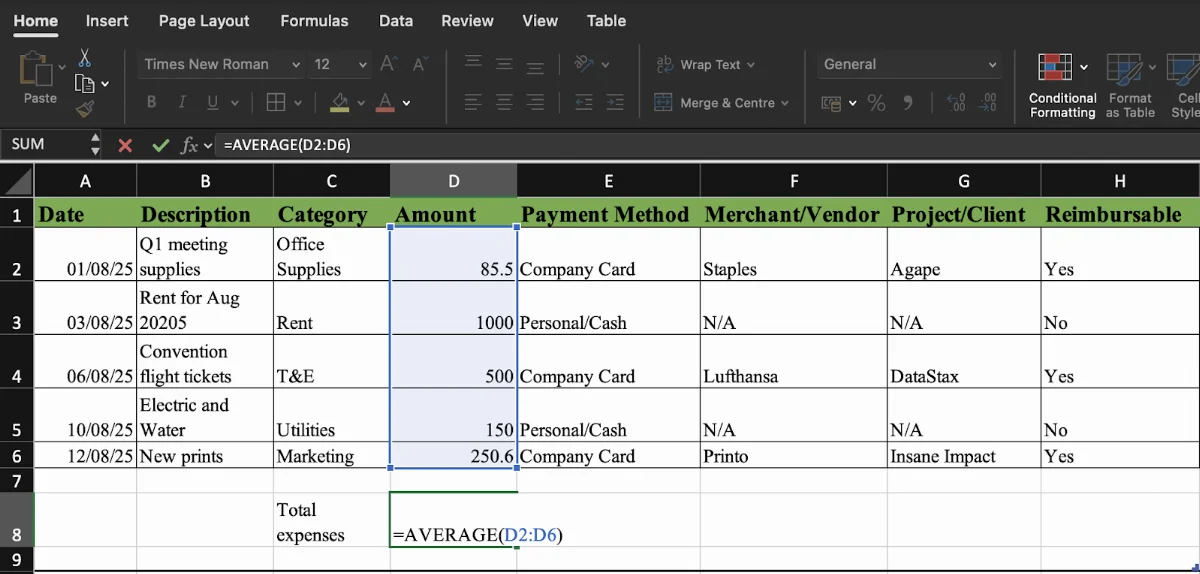
A worksheet that records each charge as its own row, with descriptive columns alongside the amount.
Watch where quotes overlap. A supplier may already include some origin transport or handling; adding the forwarder's full collection quote without checking the overlap can count those costs twice. Write down where one quotation ends and the next begins before you add them together.
The costs hiding inside the unit price
A low unit price can be misleading if it excludes essential costs or comes with unfavourable terms. A responsible quotation should clearly state what is included in the unit price. Where it does not, the missing items become budget lines rather than surprises.
Items such as batteries, cables or user manuals may be charged separately unless the quotation clarifies that they are part of the quoted price. Printing on packaging is often charged per color and per unit. If third-party inspection is required, it is an additional cost to budget for beyond standard factory inspection.

Custom-printed rigid boxes shown with a photo book and USB drive; the lids carry printed images and a multi-color logo.
For custom products, all molds, dies, jigs or fixtures should be quoted as an itemized tooling cost. Ask who owns that tooling, because whether the buyer or the supplier owns the tooling affects the buyer's ability to switch manufacturers later. The cost of pre-production samples may be included in the tooling fee or charged as a separate line. Ask which, and plan at least one follow-up sample after revisions, treating additional sample rounds as a discrete budget item.
For scale only, one public sourcing page gives these figures. Each is that page's own statement, not a market rate to apply to your product:
- Tooling can cost anywhere from $500 to over $10,000 before a single product is made.
- Custom samples are often charged at 3 to 5 times the unit cost, plus express air freight of $50 to $100 or more.
- A standard pre-shipment inspection by a reputable third party usually costs around $300 per man-day.
Verify each figure with your own suppliers and inspection providers before it goes into your budget.
Add agent fees and payment costs to the same sheet
Sourcing agents typically charge either a fixed fee per project or period, or a commission on the order amount. A hybrid may combine a minimum fee with a percentage. Whatever the label, the fee needs a base and a scope.
Write the commission base down. On $10,000 of goods, 3% is $300. If the agreement instead applies 3% to $10,000 of goods plus $2,000 of freight, the fee becomes $360. These are illustrative figures, not advertised rates. The arithmetic is trivial; buyers lose money when the second definition surfaces after they have accepted the first price.
Ask whether the minimum applies to each order, each supplier or each shipment. Three small supplier orders consolidated into one shipment can trigger three minimums if that is how the service is priced.
Keep a separate line for each cost, its payer, its currency and when it becomes due. Supplier charges and agency charges belong on different lines: a mould fee is not the same line as the agent's fee for coordinating it, even when one company collects both payments.
Payment method fees such as wire transfer or PayPal fees can add up, especially on smaller orders. For reference, our own payment page states wire transfer carries the lowest transfer fee at $20 to $40 based on banks for any amount of USD payments, bulk orders paid via PayPal require paying 5% more of the amount, and Alibaba Trade Assurance payments require paying 2% more of the amount. These are our published figures for our own service; confirm current terms for your order. Common terms are a 30% deposit with the balance paid before shipment against a copy of the Bill of Lading.
One boundary to keep explicit: paying an agent to arrange a check does not, by itself, settle liability for every product failure. Quality remedies need their own written agreement.
Duties, taxes and the cash you actually need
Duty and tax calculations depend on the product classification, customs value, and origin and destination rules. Obtain the correct classification and treatment from a customs broker or the relevant authority. Do not use one universal tax percentage for unrelated products or different countries.
On the comparison sheet, add an estimated per-unit duties-and-taxes figure based on the product's HS code, marked as an estimate until a broker confirms it. For scale only, one public sourcing page states import duties can range from 0% to upwards of 25% depending on the product category and current trade agreements. That is a provider's range across unrelated categories, not a rate for your product.
Keep the cash view and the accounting view apart here as well: a recoverable tax still affects the funds needed at import. If your market allows an import VAT or GST reclaim, that changes your accounting cost later, not the cash you need on clearance day.
From total cost to cost per saleable unit (worked example)
One public landed-cost calculator defines landed batch cost as goods plus origin charges plus freight plus import charges plus destination charges plus inspection plus sourcing fee. Do not double count a charge already included in a bundled quote.
Then handle the units you cannot sell. In that calculator's model, saleable units are calculated as ordered units multiplied by (1 minus the unusable share). Dividing the estimated total cost by the quantity expected to be saleable gives the cost per unit you can compare across suppliers.
The example below is an illustrative scenario with assumed numbers. All prefilled values in that calculator are illustrative assumptions, not observed industry averages, and so are the numbers in this table. No real quotation or invoice is behind them.
| Cost line (illustrative) | Assumed amount |
|---|---|
| Goods: 1,000 units × $1.80 | $1,800 |
| Origin: collection, export handling | $150 |
| International freight (placeholder, quote per shipment) | $900 |
| Duties estimate (assumed, HS code pending) | $180 |
| Sourcing fee (assumed 3% of goods) | $90 |
| Inspection (assumed one man-day) | $300 |
| Payment fees | $60 |
| Contingency | $200 |
| Estimated landed batch cost | $3,680 |
Assume a 3% unusable share: 1,000 × (1 − 0.03) = 970 saleable units. $3,680 ÷ 970 = $3.79 per saleable unit, against a quoted unit price of $1.80. Swap in your own numbers; the steps stay the same.
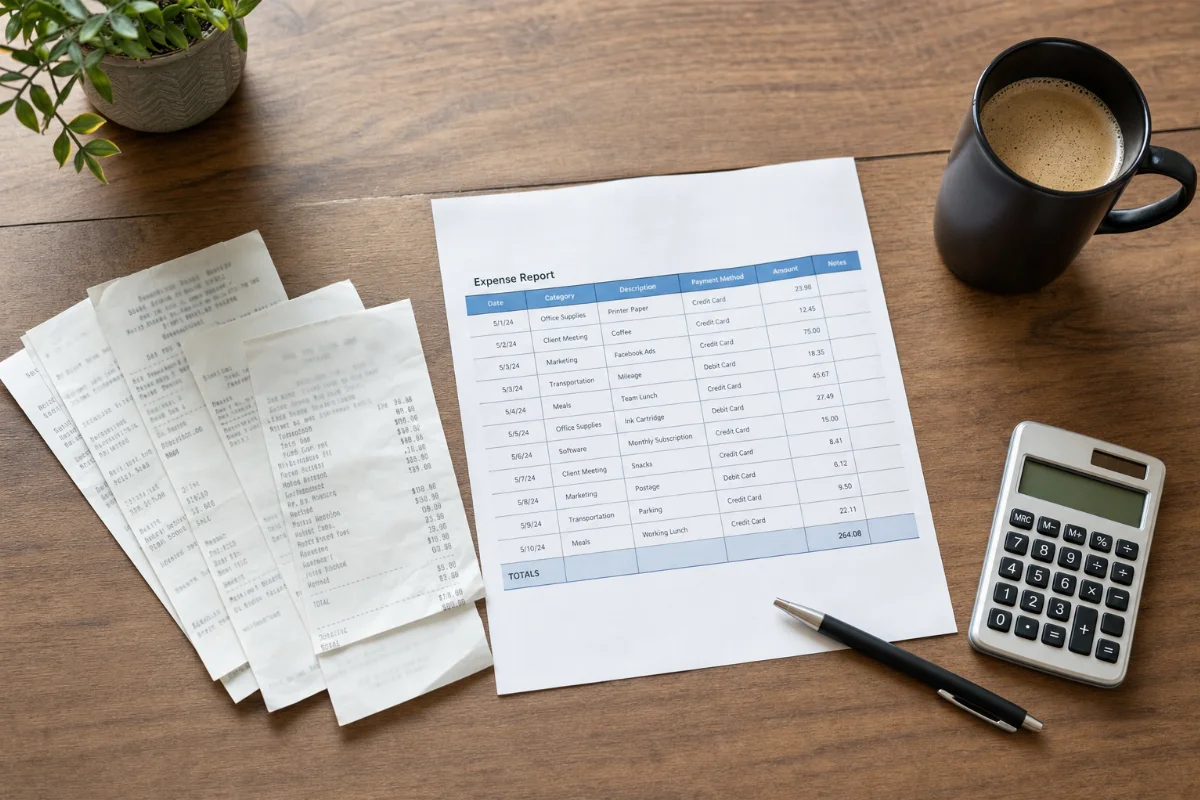
An itemized expense worksheet with a totals row, worked alongside a calculator.
Tooling gets the same treatment: per-unit tooling cost is derived by dividing the total tooling cost by the expected number of units over the tool's life. A $2,000 mould spread over an expected 20,000 units adds $0.10 per unit; spread over 2,000 units, it adds $1.00 (illustrative arithmetic).
Stress-test the estimate before the PO leaves
A static worksheet is a snapshot. Turn it into a decision tool by testing adverse cases: run a less favourable exchange rate, a higher freight quote or a smaller order against your estimate. If the US Dollar weakens against the Chinese Yuan, the final payment could cost significantly more in your local currency than you initially budgeted.
Time limits matter too. Prices for raw materials can fluctuate, so a quote may only be firm for 15–30 days. Note the validity date on each line, and remember the result is a planning estimate, not a guaranteed shipping price. Update it before committing to the order and again before shipment.
Add the lines that only appear when something goes wrong or something sits still:
- A first-order budget should add a contingency line for rework, rejected goods, return shipping or disposal costs.
- Decide whether sample fees are refundable on production or kept separate. Put those terms in the contract.
- With a 3PL or Amazon FBA, receiving fees, long-term storage fees for slow-selling stock and pick-and-pack fees per order apply after the goods arrive.
- Before the ship leaves, origin terminal handling charges, Chinese customs clearance fees, document fees and port security charges can apply in addition to the base ocean freight rate. Ask about them explicitly.
Read the full sheet before you choose: the supplier with the lowest initial quote may not be the most economical choice once all variables are accounted for.
Next step: send the questions before the PO
Do these four things this week:
- Build the worksheet with one line per cost, and write the destination, currency and exchange-rate date at the top.
- Turn every 'included' into quantities and named places in writing: included in what quantity, delivered to which port or warehouse, valid until when.
- Send the same written questions to every supplier or agent, so the answers are comparable.
- Refresh the estimate before the PO goes out and again before shipment.
Copy this request and adapt it to your product:
Product and quantity: … Delivery destination (port, warehouse or premises): … Incoterm and named place requested: … Per-line inclusions and exclusions (goods, packaging, tooling, origin charges, freight, insurance, destination charges): … Currency for each line and quote validity date: … Agent fee model: calculation base, minimum (per order / supplier / shipment), included quantities and days: … Payment terms, deposit percentage and payment-fee handling: … Estimate of per-unit duties and taxes (state HS code and who confirms it): …
For the next stage of the same job, see our guide to comparing supplier quotations for hidden costs and true value, and our breakdown of China sourcing agent commissions, extras and scope. Bring your product, quantity and destination, and the worksheet above becomes a scoped quotation.