
A clipboard checklist, paperwork and a pen on the desk alongside packed boxes in the background.
Supplier message: "Trial order confirmed — 500 units, deposit received, production starts Monday."
You never approved a sample. You never agreed the inspection scope. Nobody wrote down who can change the quantity. That is how a trial order stops being a test and becomes an expensive surprise.
A trial order is an audition, not a formality. This checklist walks you through scoping the trial, locking the written controls before money moves, running the order with checkpoints, and ending in a written go/no-go on scaling. One note up front: no source in this guide gives a recommended trial quantity or percentage. The size is your choice, not an industry standard.
Decide what the trial is testing before you place it
You cannot interview your way to certainty. The only test that counts is a real order, and the smart move is making the first one deliberately small.
A ceremonial trial is a sample request the agent knows is a test. A real trial is a genuine order with a genuine deadline, small enough that failure stings but does not wound. Every first order is an audition anyway, which is exactly the point.
Give the new agent one product, one order and a normal schedule. Before you send anything, write down what you are testing:

Sample review in progress: bottles, color swatches and packaging mock-ups checked against a written sample review checklist.
- Communication: how fast and how clearly they answer when your message is vague
- Gates: whether they stop work at the approval points you set
- Problem handling: whether bad news reaches you early or late
- Documentation: what lands in your inbox without you chasing it
Price is not on that list. A cheap trial that skips every gate tells you nothing you can scale on.
Checkpoint: one product, one order, one deadline, one written list of what the trial is testing.
Lock the written controls before any money moves
Managing a sourcing agent well is about making sure every decision has an owner, a record, and a checkpoint. Set all of this before the deposit.
Hand over a written brief first
Hand over a written brief before a single supplier is contacted: exact specifications, target cost, minimum quality requirements, packaging, quantity, and the date goods must be ready, all in one document with a version number on it. A vague brief comes back as vague quotes, and you pay for that round trip in weeks.

Printed sheets, a measuring rule and a checkbox form laid out on a review table — paperwork checked before work is signed off.
Ask for a written description of what is included, what is handled by a third party, and what remains your responsibility. A written scope makes it clear which result the agent owes you and which decision still requires your approval.
Turn approval limits into a working list
Undefined authority is where buyers lose control of their own order. Put the limits in writing and use the same list on every order:
| Decision | Who decides |
|---|---|
| Supplier selection | You |
| Final unit price | You |
| Specification changes | You |
| Sample rounds and chasing | Agent |
| Booking inspections | Agent |
| Day-to-day factory contact | Agent |
Name the person authorised to approve a sample, change a requirement or advance the purchase. One name, not "the team."
Set three gates
A gate is a point where work stops until you sign off. Name them in advance rather than inventing them while a factory waits. Three gates carry most of the risk:
- Approve the drawings and tooling plan before money goes into tooling
- Approve the first samples that production will be judged against
- Approve the pre-shipment inspection result before the balance is released
Record every approval in writing, because a gate nobody logged is a gate that quietly moved. A verbal yes on a call is the one a factory will remember differently from you.
Separate the money
Split the payment into named parts before the deposit leaves your account: the supplier's product payment, the agent's service fee, and any freight or inspection charges. Each part gets its own amount, its own payee and its own line in the quote, so you can reconcile the total against something other than a single figure.
Payments go to a company account, never personal. Deposits should be proportionate to work performed, not 100% upfront for everything. Never approve a transfer described only as a single unexplained total.
Hold one part of that split back on purpose. The balance payment is the money you release after the pre-shipment inspection result, and it is the only payment in the trial that still buys you a decision. Everything else — deposit, sample fees, freight prepayments — moves on dates you agreed in advance. The balance moves on evidence. If the payment schedule in your quote releases the balance before the inspection report exists, rewrite the schedule before you sign, because once the money is gone the third gate is a formality.
Checkpoint: brief with a version number, decision-rights list, three named gates, payment structure in writing with the balance tied to the inspection report.
Agree the sample gate and the inspection scope in writing
The sample gate
Agree on four points: the selection criteria, sample cost, delivery method and approval standard.
The agent can photograph the sample, record differences and organise questions. The buyer should decide whether the sample is acceptable. Production should not begin because a message was left unanswered or because "looks good" was assumed to mean approval.
When a sample misses the brief, ask who will consolidate your changes, whether a revised quote is needed, whether a second sample creates a new charge and when the next milestone will be reported. "Please adjust it" becomes manageable when it has an owner, a date and a measurable acceptance standard.
The inspection scope
Write the inspection scope down before production starts:
- Is it a sample check or a full inspection?
- Which dimensions, functions, labels, carton marks and quantities are checked?
- Which photos, measurements and defect counts appear in the report?
- Who checks samples, production, packaging and finished goods — the agent, a factory employee, or an independent inspection company?
- What happens if goods fail: who holds the goods, who pays for rework, who decides re-inspection?
- Does the inspection report arrive before the balance payment?
That last question is gate three, asked in plain language. The gate says you approve the pre-shipment inspection result before the balance is released; this question asks when the document actually lands. Score the two answers against each other. If the report is promised "after shipment" or "once payment clears," the gate has quietly moved and you should treat that as a finding about the agent, not a scheduling quirk. A trial buyer who receives the report before releasing the balance has held the leverage the gate was designed to give. A trial buyer who pays first and reads later has run a different process than the one they agreed, and that difference belongs in the written go/no-go at the end.
Ask whether inspection is included or charged separately, what checklist is used, and how defects are recorded. A generic form is a warning; a redacted report with photos, measurements, sampling level and defect counts is the proof.

A checklist form, a caliper and sample boxes laid out on the inspection table.
Checkpoint: four sample points agreed, inspection scope in writing, report timing tied to the balance payment.
Run the order: what to watch while it is live
The change list
List the changes that must be reported before work continues:
- Specification or material substitution
- Quantity change
- Missed lead time
- Packaging change
- Inspection exception
- Request to change the receiving account
The agent should explain the impact first and wait for your decision. A request to change the receiving account mid-order is not a paperwork detail — stop and get it confirmed in writing before anything moves.
It is also a scored event. Put it on the trial scorecard the day it arrives: note the date, how the request reached you, whether the agent flagged it or you found it, and how long verification took. An account-change request that surfaces before you would otherwise have noticed is the agent doing its job. One you discover yourself, or one that arrives with pressure to pay the same day, belongs in the exit-line list at the end of this checklist — alongside an unapproved material substitution, a false factory identity and a payment made without your approval. Either way, the trial produced a decision, which is what a trial is for.
The reporting format
Fix the reporting format before you need it. One format, agreed at the start, in this order, every time:
- Completed work
- Next milestone
- Open risks
- Supplier delays
- Costs awaiting approval
- Decisions needed from you
Scattered messages across three apps are not a report, only noise you have to reassemble. A report you have to chase is already the status.
The supplier trail
Ask for supplier quotes in their original form next to the agent's summary. Translation gaps, swapped specifications, and quiet markups only show up when the two sit side by side, and a good agent has no reason to object.

A ticked checklist on a desk next to labelled audit binders — a reminder to track live-order checkpoints in writing.
If the agent also coordinates freight, separate domestic pickup, warehouse receiving, consolidation, repacking, export documents, international transport and destination charges. The quote should name the route, Incoterm, chargeable weight, duties and destination responsibilities. A general promise that "shipping is easy" cannot replace a route- and cargo-specific review.
Be a fair client
Most of what breaks these controls comes from your side, not the agent's. Send your brief in one piece, answer questions promptly, pay on the agreed terms, and keep the trial on a realistic timeline rather than a rush job designed to make anyone fail. An audition you fail as a buyer tells you nothing about the agent.
Checkpoint: change list circulated, reporting format agreed, original supplier quotes requested, freight broken out.
Score the trial on evidence, not on price
Treat the trial as a paid audition and score it the same way you would score a full project. Three things, and none of them is the price:
Speed when your message is unclear. Anyone answers a clear question. Watch what happens when you send a vague one and they have to ask back.
Bad news, early or late. Something will wobble in a first order — a delayed sample, a colour that came out wrong. An agent who tells you the day it happens is an asset. An agent who tells you after the container is loaded is the story you are trying to avoid.
How specific the inspection report is. Dates, counts, findings, photos. Not a paragraph of reassurance.
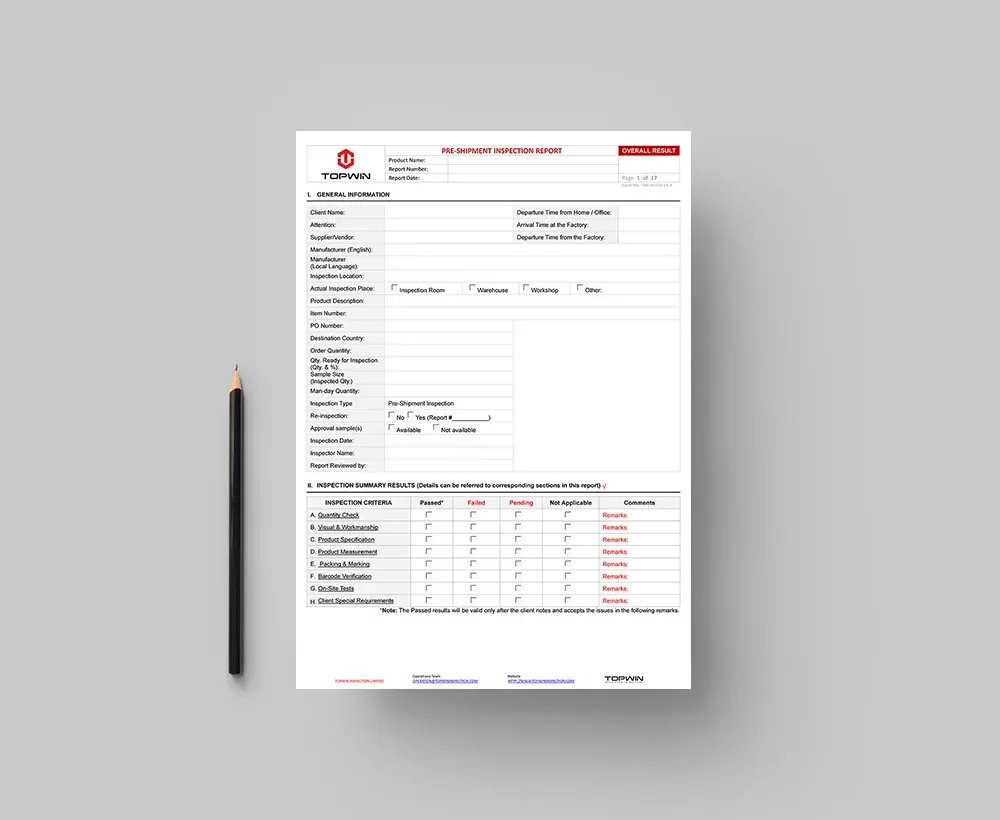
A pre-shipment inspection report page listing order details and summary inspection criteria.
Alongside those three, watch two more measures:
- Whether the sample arrives with test data
- Whether the inspection report arrives before the balance payment
- Whether problems are reported to you before you find them yourself
An agent who surfaces a defect you would never have seen has demonstrated the only thing that matters. The most useful measure is how early problems surface: an issue caught before shipment is cheap, and the same issue found after arrival is slow and expensive.
Collect the documentation trail
A partner worth keeping produces a documentation trail you can hand to an auditor:
- The specification you agreed
- The sample record
- The inspection report
- The packing list
- The loading photographs
All filed against the order. Ask to see an example before you commit, with the names removed.
Check continuity
Continuity matters as much as capability. Ask who will handle your account, how long that person has been with the company, and what happens when they are on leave. An account that changes hands every few months loses the accumulated knowledge of your product, and that knowledge is most of what you are buying.
Read the pattern, not the incident
A single red flag does not necessarily mean an agent is unreliable. The concern is usually a pattern of unclear fees, hidden relationships, weak documentation, or poor accountability.
Checkpoint: three measures scored, documentation trail filed, account contact named, pattern reviewed.
Make the go/no-go decision in writing
If it goes well
Scale up gradually, with a slightly bigger commitment, and keep the checks running: invoice visibility, inspection reports, response speed. Trust in stages: a trial order first, then production with inspection on every lot, then scaled cooperation. Trust that grows with evidence protects both sides.
If it goes badly
Salvage what you can, document what failed, and treat the loss as the cheapest lesson in sourcing. Most buyers who import well for years had one bad small order at the start and learned from it while the numbers were small and the habits were forming.
The exit line
One mistake is noise, but a repeating pattern is a decision. Name the specific gap rather than hinting at it. A few things do not get a warning at all:

Write the go/no-go decision down: check each item against the evidence and date the sheet.
- An unapproved material substitution
- A factory identity that turns out to be false
- A payment made without your approval
Those are exit signals rather than coaching moments. Everything else gets one written warning and a deadline.
Keep forecasts separate from measured results; a small pilot does not establish a long-term failure rate.
Checkpoint: decision recorded in writing, with the evidence you scored and the date.
A written request template you can send before the trial
This is a template. Replace the product, quantity and destination with your own before you send it. Ask the agent to mark each answer as confirmed, conditional or not included.

A paper checklist with each item ticked off, ready to be reviewed point by point.
I am sourcing [product] at approximately [quantity] for delivery to [country/city]. Before I place a trial order, please confirm:
- Which steps do you handle, and which steps are quoted separately?
- Who is the contracting party, receiving party and payee for each cost?
- What company, product and quote evidence will I receive for each supplier?
- How are samples selected, shipped, compared and approved by me?
- What do production follow-up and pre-shipment inspection cover, and what does the report contain?
- How will domestic receiving, consolidation and international freight connect after the goods are ready?
- Who contacts me first if the specification, price, quantity or lead time changes?
- Please list inclusions, exclusions, payment milestones and the next deliverable in the quote.
- Which approval gates will stop work until I sign off, and how will each approval be recorded?
- Does the inspection report arrive before the balance payment?
A specific unanswered item is easier to resolve than a general assurance that everything will be handled.
Next step
Assemble four things before the deposit leaves your account: the brief with a version number, the scope list, the gate list, and the template message above. Send them together. After the trial, record the go/no-go decision in writing against the evidence you collected.
One caution on a smooth trial: if nothing surfaces at all, check the documentation trail rather than assuming perfection. A trial with no problems and no report is not the same as a trial with no problems.
For the money side, see how to compare agent fees and scope. For the quality side, see what a pre-shipment inspection should cover. For everything agreed before the deposit, see written terms with a sourcing agent.