
For a small first order, the listing is only the starting point — the checking, sampling and inspection work still has to land somewhere.
A buyer has a product link, a quote for 300 to 500 units, and a budget in the low thousands. This is a hypothetical buying situation, not a customer case. The listing looks professional. The supplier replies fast. Then questions start: Is this a factory? Does the price include packaging? Who checks unit fifty? Who calls the supplier if the shipment is wrong, and in what language?
Order size alone says little. Ecommerce sellers testing a product often order 300 to 500 units, and two orders of that size can carry very different risk. A small customized order can expose tooling costs or a missed launch. A larger repeat purchase may sit on a well-documented production process. So compare the jobs each route leaves with you: supplier verification, specification, sample follow-up, pre-shipment inspection, and problem resolution. Fees only mean something against that list. Neither route guarantees a lower landed cost, and a refund depends on what the order says.
Start with the order, not the platform label
Three parties get called the supplier. A marketplace-direct supplier is a manufacturer or trading company you found on a platform. You transact with them, and discovery, communication, specification, inspection and logistics stay with you. A trading company buys from factories and resells to you, often presenting itself as the factory. That is not automatically bad, but know which one you are buying from. A sourcing agent is contracted to act in your interest across discovery, verification, negotiation, quality gates and problem handling, usually for a commission or project fee.
Alibaba and similar platforms work best as research and discovery, one step in a broader sourcing process. The platform hands you names. Whether those names fit your order is settled offline.
What Alibaba gives you, and what stays on your desk
For almost any category the platform returns dozens or hundreds of candidates quickly. Listings show what is available and give indicative pricing. Messaging opens conversations and tests responsiveness.
A profile cannot tell you whether the company is a genuine manufacturer or a trading company, whether the factory photographs are its own, or whether the products shown are made in-house. It says nothing about equipment, skills and capacity to make your product to your specification. A shop that presses simple metal parts is not automatically set up for precision CNC work. Many suppliers subcontract some or all production, and without a visit or audit you may not know who is making your goods.
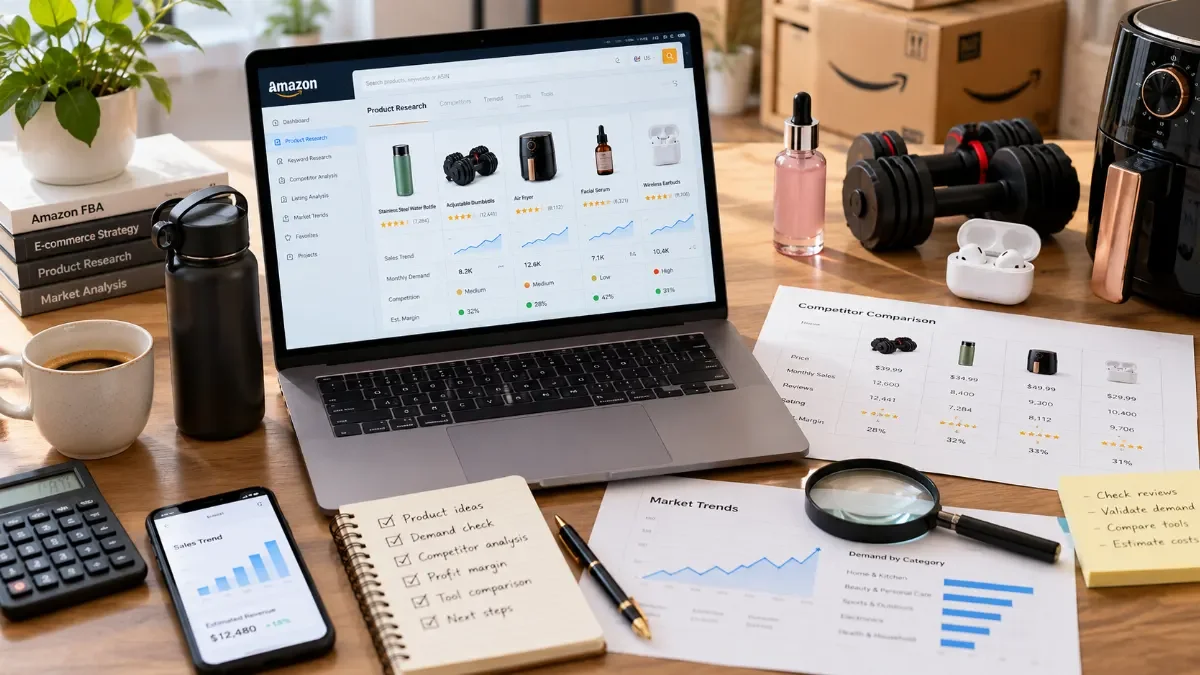
Product listings on screen while a handwritten research checklist and comparison sheets sit beside the laptop.
After the introduction, the same limits appear. A messaging tool is not an experienced person who can read drawings and flag manufacturing problems before production. Once the order is placed, the platform has no role inside the factory. Inspection needs someone physically present, checking goods against the specification. A production problem means direct contact with the factory, often in Mandarin or Cantonese, sometimes a visit. Several suppliers means consolidating shipments and managing freight.
| Task | Buying direct on Alibaba | Through a sourcing agent |
|---|---|---|
| Finding candidates | You search and message sellers | Agent shortlists and compares |
| Verifying the supplier | You check licence, scope and records | Agent checks licence, production scope and export records, and visits the floor |
| Specification review | You write it | Agent turns your brief into something a factory can quote against |
| Sample follow-up | You order and compare | Agent requests samples from several suppliers and keeps a signed golden sample |
| Production monitoring | You | Agent visits during production |
| Pre-shipment inspection | You book a third party | Agent arranges and acts on the findings |
| Problem resolution | You, across the time zone and language gap | Agent, in the local language |
| Consolidation | You, per supplier | Agent combines into one shipment |
Quality control is the row buyers most often have to arrange themselves. On Alibaba it is your responsibility unless you hire a third-party inspector or negotiate inspection with the supplier. Supplier photos are not independent checks.
What a sourcing agent actually takes over
Verification comes first: business licence, production scope, export records and a floor visit, used to filter out trading companies posing as factories and workshops that cannot handle your order.
Then the product work: turning your brief into a specification, comparing supplier quotations, requesting samples from several suppliers at once, and holding a signed golden sample as the reference.
Then the quality gates. Agent programmes typically cover pre-production, in-process and pre-shipment inspections, with authority to reject goods before they ship. Monitoring means visiting the factory while the order runs. After shipment the coordination continues: combining multiple suppliers into one container, booking freight, and handling after-sales work such as negotiating rework, replacement or credit, documenting the issue for a claim, and mediating with a supplier who has already been paid.
Fee structures, and what they cover
Most China sourcing agents charge a percentage of order value, commonly 5 to 10%; a flat fee per project; or a monthly retainer. Inspections, audits and warehouse storage are usually quoted separately, per job. Some agents also take a commission from the supplier. That is not automatically wrong, but ask about it in writing.
Treat every figure here as a provider statement. One sourcing company publishes a 5 to 15% range on its own site. That is its advertised number, not a market benchmark.
A published plan shows what a real quote looks like. One sourcing company's plan for managing a buyer's existing suppliers runs at 6% of product value with a $100 minimum. The same company says mixed orders should average $500 or more per product, with low-value items carrying a $25 handling fee each. On its Alibaba Trade Assurance payment route the buyer pays 2% more, because Alibaba charges the agent's side, and each payment must stay under $5,000 or be split. Those are one provider's terms.
Supplier verification: badge or factory check?
Alibaba's supplier badges are often read as proof of reliability. One verification provider describes them as a floor of basic screening, with no answer to whether the company actually manufactures products, has a history of contract disputes, or can deliver at the quality level you need.
- Verified Supplier: a third party checked the business licence and confirmed a physical address exists. The company may not manufacture anything, and the address could be an office rather than a factory.
- Gold Supplier: a paid premium placement, $2,999 to $5,999 a year. It says nothing about trustworthiness, experience or manufacturing.
- Assessed Supplier: an Alibaba-contracted inspector did an on-site assessment, which may not be comprehensive, recent, or available for you to review in full.
- Trade Assurance: orders placed through Alibaba's system are eligible for dispute resolution, with recovery depending on the contract terms. It is payment protection, not a supplier quality certification. One account says a supplier can sign up regardless of financial health, legal history or manufacturing capability; another says participation depends on sales volume, track record and legal-status verification, and that offering it signals some proven reliability.
An independent factory audit asks different questions: financial and licensing information, whether the factory exists at all, production area, equipment, quality controls, overall manufacturing capability. For certainty about a supplier's physical reality there is no substitute for an on-site inspection.

A production floor with enclosed machinery and a worker recording checks on a tablet.
What it costs is genuinely unclear, and published figures conflict:
| Source type | Quoted range |
|---|---|
| Verification guide, factory audit | $300 to $500, with photos, floor plans and an inspector's assessment |
| Alibaba's seller-facing guide, video or remote audit | $800 to $2,000, and it cannot fully verify physical conditions |
| Same guide, third-party on-site audit | $2,500 to $6,000 |
Those ranges are indicative and move with region, factory size and audit scope. Alibaba's seller-facing guide makes the same arithmetic point from the supplier side: where average order value is below $5,000, audit costs may exceed potential profit margins.
The choice follows risk. For a simple, low-risk small order a visual check may be enough. For higher-risk, custom, regulated or defect-sensitive goods, write a detailed checklist and book a third-party inspection. Consider a factory check before you commit to production.
What Trade Assurance will and will not do when an order goes wrong
Trade Assurance is the buyer protection built into Alibaba.com. Pay through the platform and, if the supplier breaches the order terms, you can claim a refund; if Alibaba's dispute team rules for you, Alibaba can pay it on the supplier's behalf. How much it can pay is capped by the order's coverage, and where that ceiling sits is disputed.
For a mainland-China supplier, the covered breaches are late or no shipment, quality below the order, missing title documents or required certificates, and another serious breach of the order. Quality, paperwork and other breaches count only when they cause a major loss in the value of the goods, or defeat the main commercial purpose of the deal that both sides knew or should have known. On a sample order the listed breaches are late shipment, no shipment or a short shipment, and other serious breaches.
Where the accounts disagree
One account says a successful claim is capped at the order's Trade Assurance amount plus any frozen funds, which together cover what you paid in plus the inspection fee if an inspection was done, and adds that the limit shown on a supplier's profile is for reference only. Others say the supplier's coverage limit caps the refund. One illustrates it with a $200,000 order against $80,000 of coverage, which leaves $80,000 protected at best, and one of those accounts adds that the coverage is shared across all of the supplier's active Trade Assurance orders.
Until you read the current rules on your own order page, assume the lower figure and plan around it.
Deadlines and exclusions that decide small claims
You must apply for a refund no later than 30 days after the confirmed receipt date, or 60 days for higher-tier buyers. Receipt is confirmed when you click to confirm it, or automatically once a shipment passes the longest transit time for its logistics method, and the order page shows that countdown.
Only money paid into the order counts toward what Alibaba can refund, so a deposit paid through Trade Assurance with the balance wired to the factory's own account leaves the balance unprotected. Offline orders get thinner service: the dispute team handles only non-delivery after payment or non-payment after delivery, not product quality, damage or short quantities.
Not covered, in short: lost sales and the air freight you pay to replace bad stock; intellectual property theft; force majeure such as natural disasters, government policy changes, port closures and pandemics; and defects that only appear after weeks or months of use. Trade Assurance is not a product warranty.
Quality is measured against what was written in the order contract, not against your expectations, and vague wording loses claims. One account says quality claims must be examined by a third-party inspector approved by Alibaba. A pre-shipment report is evidence you already hold when a claim becomes necessary; defects found only after the goods reach your warehouse are much harder to dispute.
Two smaller guarantees sit on top, and both are easy to over-read. A separate on-time delivery guarantee offers 5% delay compensation, up to $100, only on eligible orders shipped through Alibaba.com Logistics; a container booked through your own forwarder is outside it. Easy Return lets buyers in 46 countries send defective or wrong goods back to a local warehouse at no cost within 30 days of delivery, on eligible products and orders under $3,000. That fits samples rather than production runs.
One unresolved point matters for a small order. The sample-order breaches above describe what is covered if a sample order qualifies, but one guide says very small or sample orders may not qualify for Trade Assurance at all, depending on platform minimum order thresholds. The threshold is not stated, so treat sample protection as unconfirmed and ask before you rely on it.
Compare the fee on the same scope, not the headline percentage
A commission rate on its own is not a quotation. Take the same hypothetical $10,000 of goods, in USD, and price one identical job two ways. Agent A applies 3% to the goods ($300), then adds $250 for inspection and $150 for consolidation, for a comparable service total of $700. Agent B quotes a flat $650 for the same tasks. B is $50 cheaper, and A's 3% looked like the bargain.
Comparing quotes means lining up the same tasks and line items side by side before checking the totals on a calculator.
Samples, domestic delivery, international freight, insurance, destination charges and taxes sit outside both figures. Put the same line items, the same inspection days and the same delivery point into both columns before you compare budgets.
Three checks that move the number:
-
What is the percentage applied to? On $10,000 of goods, 3% is $300. Apply the same 3% to $10,000 of goods plus $2,000 of freight and the fee is $360. Ask whether the base includes freight, packaging or anything else, and get the definition before you agree the price.
-
Does the minimum stack? If a minimum applies per supplier or per shipment rather than per order, three small supplier orders consolidated into one shipment can trigger three minimum fees. Have the unit written into the quote.
-
Is the order big enough to be served at all? One guide states that most professional agents will not take on an order under $5,000 on a commission model, and suggests a flat fee of $500 to $1,500 for basic supplier identification or a service specialising in smaller buyers. Another company advises skipping an agent where the order is under roughly $2,000 and the fee would be a large share of it.
The one worked example available compares 1,000 custom Bluetooth speakers at $8.00 per unit: $9,650 factory-direct against $8,720 with an agent. That is a 1,000-unit order, not a small Alibaba purchase, and the vendor who sells agent services authored it. The arithmetic is worth repeating with your own numbers.
Build your own landed-cost comparison: product, samples, inspection days, domestic handling, freight, duties, taxes, payment fees, and the cost of the defects you fail to catch.
A first-order test that costs one message
Run the cheapest test available before deciding anything. Send one product link or photo and judge the response.
A useful reply asks smart questions. It explains MOQ, sample cost, shipping concerns and next steps, separates product cost from shipping cost, and warns you about risks instead of reassuring you that everything is fine.
Red flags worth acting on:
- Refusal to provide a sample. Some factories and sellers claim they only work in bulk. You are allowed to see what you are buying first.
- A great sample and an unexplained production gap. A high-quality sample does not guarantee the production order, which can come out at an entirely different level of quality. That is why the pre-shipment check exists.
- An agent who says yes to every product. Freight can be too high, goods too fragile, the market inconsistent, or the destination restrictive. A reliable partner should say so.
Scale the inspection to the risk, and write it down. Instead of writing 'check quality', list what needs checking: colour and variant, quantity and SKU, logo position, material and finish, visible damage, function, accessories, packaging condition, labels and barcodes. For small, simple orders a visual check may be enough; higher-risk products need the fuller checklist.
Then answer eight yes/no questions honestly:
- Do I know the exact product specification?
- Can I compare supplier quotes myself?
- Do I understand MOQ, sample cost and packaging cost?
- Do I need custom branding or inserts?
- Do I need the goods checked before shipping?
- Do I know my landed cost and target margin?
- Do I have the hours each week to manage supplier messages?
- Do I need single customer orders fulfilled from China?
If most answers are yes, the platform route may be enough for early supplier research. If many are no, a sourcing partner can reduce risk and save time.
The decision rule, and the next action
For straightforward, low-risk purchases of standard products, the overhead of a sourcing agent may not be justified. Hiring one makes more sense when you are new to importing, buying custom or private-label goods, sourcing from several suppliers at once, working without Mandarin, or scaling faster than you can personally supervise.
So do this next:
- Write the brief. Product, materials, dimensions with tolerances, colours with references, packaging, quantity, destination, target cost, delivery date.
- Ask both routes to price the same work. Same number of suppliers, same delivery point, same inspection days. Otherwise you are comparing labels rather than costs.
- Request the breakdown in writing. Travel charges, time on site, reporting, specialist checks, revisit costs, and exclusions stated explicitly.
- Keep a list of what remains unchecked. If you skip the factory audit, write down that the manufacturing capability question is still open. If you skip the inspection, write down that the lot is unverified. A skipped check leaves the uncertainty in place and moves the risk to whoever signs off.
If the order is simple and you can carry the checks yourself, buy direct and spend the saved fee on an inspection. If verification, sample follow-up, inspection or problem resolution is the real gap, pay for exactly that scope, priced against the same task list.