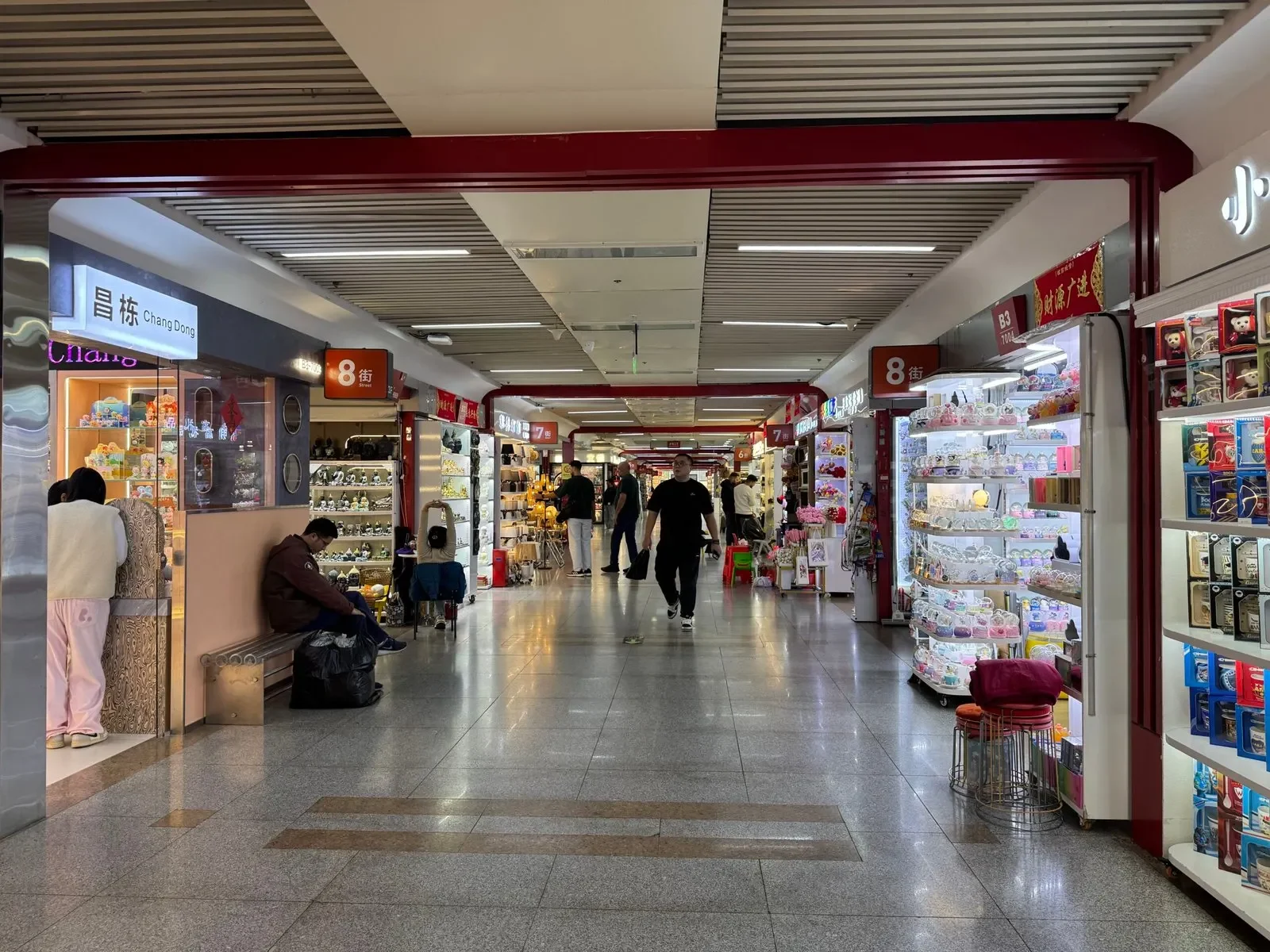
A first Yiwu visit is a booth-by-booth comparison walk: the same product question, the same recorded fields, and a shortlist you can use after the trip.
Ten booth chats, three business cards, and a comparison log with empty columns
Ten booth chats. Three business cards. A comparison log with the packaging, repeat-order and factory-versus-trading-desk columns still blank.
That is how a first Yiwu market trip can end without a shortlist. The market did not fail you. You left before those columns were filled, so every quote looked complete in a photo and incomplete in the only place that mattered: a record you could compare.
A first visit works better with a smaller outcome: one product family, three to five complete quotes, and either one paid sample or a written reason not to order. This guide covers the buyer-side preparation and records that make that outcome possible. It does not cover registration or buyer-badge procedure for the permanent market; those depend on current rules and your passport, so confirm them separately before you travel.
A usable shortlist is smaller than you think
Most booths are business-to-business showrooms. A seller may offer one sample, quote only by carton, require a minimum for each colour, or decline a tiny order. None of that makes the market unfriendly. It tells you which transaction the booth is built to handle.
For a first visit, compare one product family, collect three to five complete quotes, and leave with either one paid sample or a clear reason not to order. That is a shortlist you can act on; a long list of stall names is not.
Protect enough time. A curious visitor with one known category should budget roughly 90 minutes to three hours. A small buyer should reserve a full market day for comparison and note-cleaning. A professional order deserves at least two market days plus independent work on contracts, compliance, inspection and freight.
Booth presence is not proof of factory ownership or compliance. It is a sales presence. The business licence, payment route and production evidence are separate questions.
Choose one primary building and one backup, then verify the directory
The market operator's current directory lists Districts 1 to 6. Use it shortly before the trip. Halls, floor labels and product groupings can change, and an old social-media floor card is not a current directory.
The broad product families are usually described like this:
- District 1: toys, artificial flowers, jewellery and decorative or festival goods.
- District 2: bags, hardware, tools, electrical products and related categories.
- District 3: stationery, sports goods, eyewear, beauty-related products and garment accessories.
- District 4: socks, shoes, textiles and everyday goods.
- District 5: imported products, bedding and fabrics, plus automotive and pet-related categories.
- District 6 / Global Digital Trade Center: a newer destination that opened on 14 October 2025, listed with fashion fabrics, beauty or infant-product categories, travel goods, smart technology and IP-related trendy goods.
Treat District 6 as a separate current destination to verify, not an assumed extension of the older halls. Choose one primary building and one nearby backup category. Save the Chinese category term, a screenshot of the current operator directory and the intended gate. "Kitchen item" is not a plan; a specific product noun and material are.
The market is often described as having about 70,000 booths and millions of product types, and being open daily except during the New Year break. That description comes from a commercial guide, not an official operator notice. Holiday closures and individual booth attendance vary, so reconfirm that the market is operating normally, which gate to use and any booth appointments before entering.
Travel and market access are separate. A published guide, citing official visa-centre guidance, reports that ordinary passport holders from the UK, Canada, Australia, New Zealand and many European countries may enter China visa-free for up to 30 days for business, conferences and exhibitions through 31 December 2026. Verify current official notices for your passport, dates and purpose. Do not assume a Yiwu Fair badge arrangement applies to the permanent market; the fair is a separate annual event, held from 21 to 24 October.
Write a one-page product brief before you go
The brief is not a wish list. In Yiwu it first answers four locator questions: which district, which exact product noun and material, which colour or finish reference, and what first quantity. The usual preparation still belongs on the page, including product categories, target customers and must-have requirements, but those are the frame, not the part that helps a seller find the right shelf.
Put the brief in a phone note and a shareable document. Cover product name and use; dimensions, weight and material; colour and finish with a physical or measured reference; required functions and unacceptable failures; packaging type and label languages; first test quantity and possible repeat quantity; destination country and target date; standards, tests or marks already identified; branding type, whether neutral, private-label or licensed; and the unanswered questions that could cancel the project.
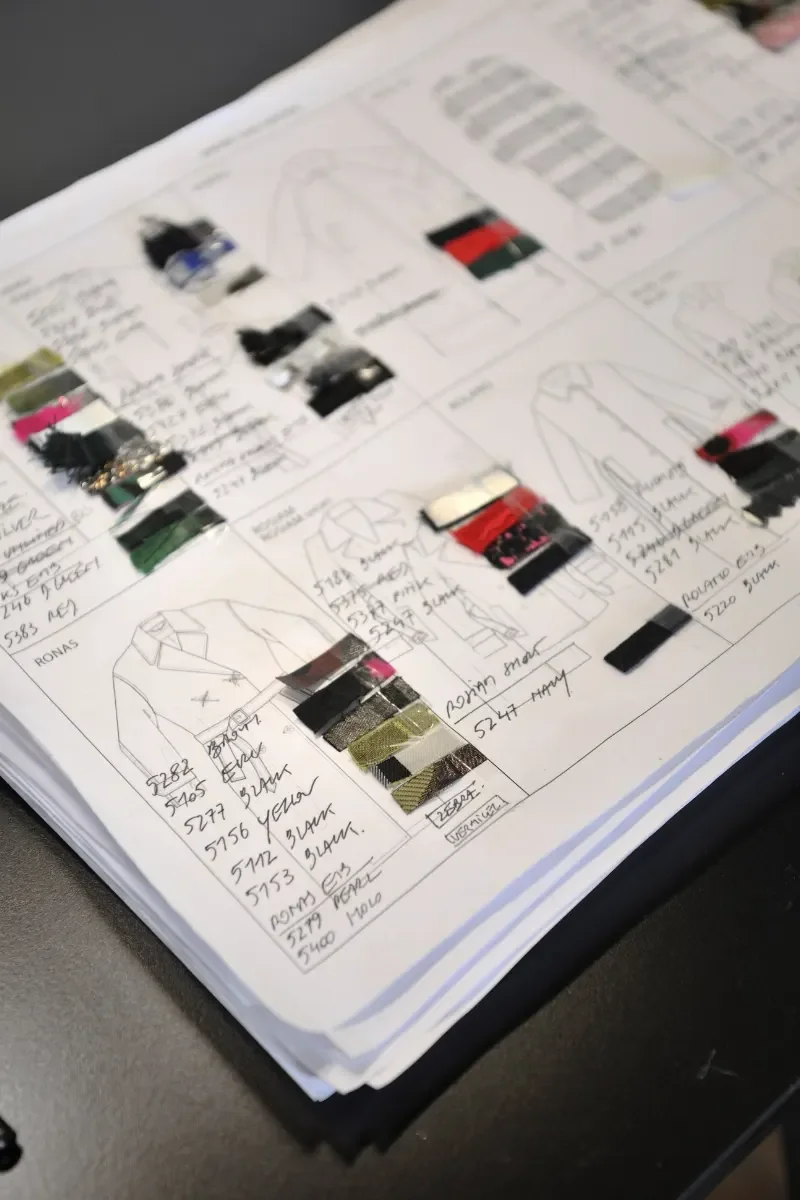
Written specification notes beside small sample swatches keep the product details checkable at the booth.
Translate the short product noun and critical materials into Chinese. Keep the full specification bilingual only if someone who understands the product has checked it. A machine translation can help you navigate a hall; it is weak evidence for a safety requirement or a contract term.
"Kitchen item" is too broad. "350 ml double-wall stainless-steel cup with leak-resistant lid" can lead a seller to the right shelf. Product areas are specialised enough that a buyer interested in golf products should not be routed through the fabrics section and expected to compare offers fairly.
Open each booth with product and quantity
A simple opening is:
我想找这种产品。第一次订单预计 [数量] 件,之后可能补单。请问这是现货还是订做?最小起订量是多少?
I am looking for this type of product. The first order is about [quantity] units, with possible repeat orders. Is this in stock or made to order? What is the minimum order?
Then fill the comparison log. Keep the fields in blocks so the booth conversation does not turn into a different interview at every stall:

Open with the product and quantity, then write the same quote fields into one comparison log at every booth.
- Identity: exact model or item number; supplier legal name; contact; booth number; payment beneficiary as reported.
- Offer: material, dimensions and net weight; stock or made-to-order status; price basis and delivery point; unit price at your actual quantity.
- MOQ: minimum for the item, colour, size, carton and whole order; whether colours or models may be mixed.
- Sample: sample price, sample lead time and whether any amount is credited later.
- Packing and production: packaging included, units per carton, carton dimensions and gross weight; production lead time after deposit and after sample approval; decoration, mould, artwork or packaging charges.
Ask permission before photographing a booth, catalogue, product detail or business card. A refusal is not proof of a problem. Record the information in writing instead, and never include nearby shoppers or another buyer's documents in your photos.
Ask every booth the same core questions so the comparison is fair: material, available colours, MOQ, packing quantity, carton dimensions, lead time, sample policy and whether mixed designs are possible.
Record the stall route and the supplier identity in one note
Save each candidate as District-Gate-Floor-Aisle-Booth. Photograph the public gate sign and, with permission, the booth number. If the booth number is unclear, record the neighbouring stall and ask staff. Do not guess.
Add one product photo, the quoted specification and the salesperson's contact to the same note. Record the payment beneficiary as reported, but leave the licence name and verified beneficiary fields blank at this stage. Fill them after the visit when you check the business licence and bank instruction against the booth route. That link is the point of the code: it helps you find the physical stall again and connects the booth to the legal entity you may pay.
Ask for the legal business name, business scope, address, contact person, and whether the supplier is a manufacturer, trading company or both. Ask which documents they can provide and which they cannot. Do not rely on a chat profile or business card alone.
Use one comparison log for all suppliers. Record claims, documents received, open questions and the next verification step. A strong sourcing note should include booth number, product photo, sample code, MOQ, quoted price, packing method, carton details and questions that need follow-up after the market day.
For a sample bought in person, get an itemized record showing seller identity, model, quantity and amount. Save the electronic payment record with the booth note.
Make MOQ, packaging and sample terms comparable
MOQ is a structure, not one number. It can mean minimum per design, SKU, colour, size, inner box, carton or whole order. Write the unit beside every number.
Send the supplier a list with one line for each model-size-colour-packaging combination. Put your requested quantity beside it and leave space for the supplier to confirm the minimum. The log's minimum column is where that structure becomes visible. Ask for the MOQ per colour, whether models and colours can be mixed, units per carton, minimum cartons per order, the quantity the price is based on, and separate minimums for packaging and printing.
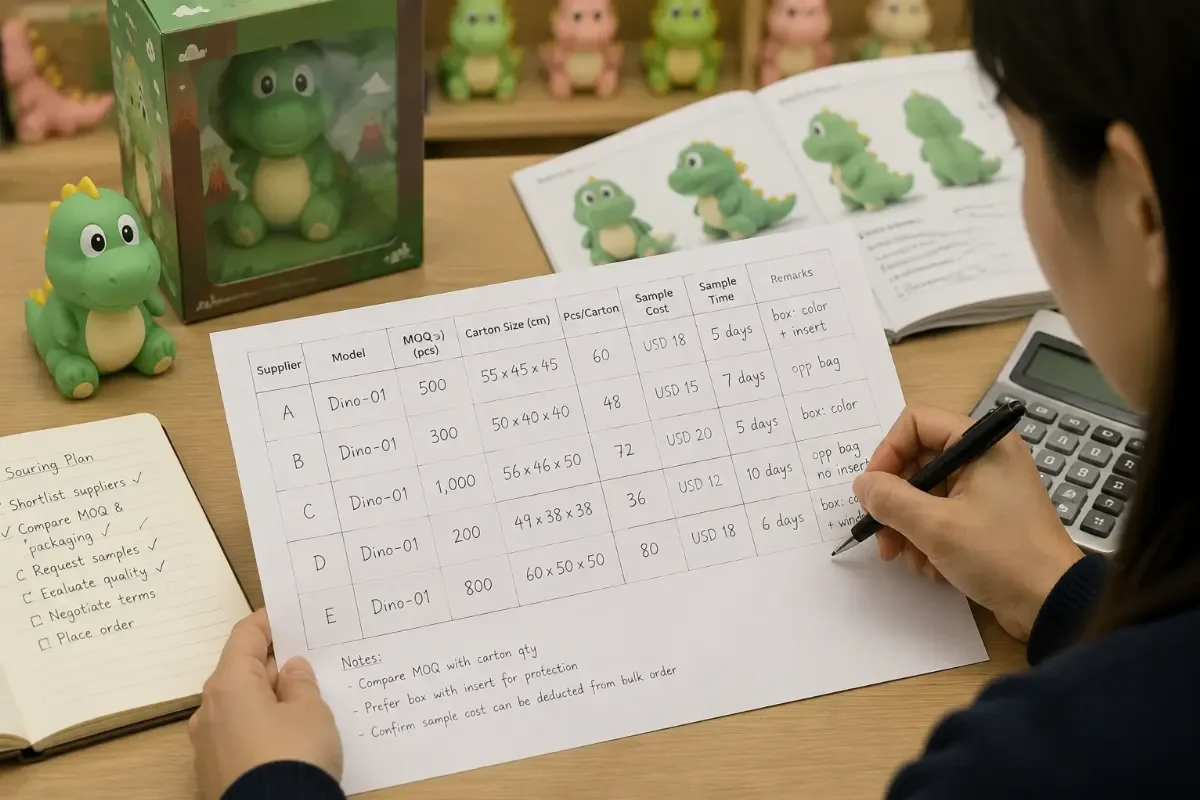
A working comparison sheet keeps MOQ, carton size and sample terms in the same columns for every supplier.
A worked example makes the column useful. Booth A says "500 pieces." Record the quoted figure with its unconfirmed unit, for example "500 pieces, unit unconfirmed," and add a follow-up cell for what the 500 covers. Is it 500 of one colour, 500 stock cartons, or 500 with custom packaging? Booth B may allow five colours of 100. Booth C may quote stock goods by carton and custom packaging by thousands. The numbers look similar until the unit and configuration are written down.
Sample terms go into the same log: sample price, sample lead time and any later credit. Production terms go beside them: unit price at your actual quantity, packaging included, units per carton, carton dimensions, gross weight, production lead time after deposit and after sample approval, and any decoration, mould, artwork or packaging charges.
If a very low price appears, check what is excluded: packaging, labels, accessories or domestic delivery. A lower MOQ may come from stock, simpler packaging, mixed consolidation or a higher unit price; it does not necessarily mean the same production arrangement.
Compare prices only when the material, quantity per variant, packing and delivery point match. A price with an unnamed delivery point is not comparable.
Stop every three or four booths and normalize the quotes
Do not compare offers while walking. After every three or four booths, sit down and put the quotes into the same columns. Drop any candidate that will not identify the product, quantity basis or seller.
If you cannot explain why one quote is lower, you do not yet have comparable offers. Revisit the strongest two or three suppliers. Inspect samples against the brief, ask packaging and carton questions, and buy a sample only when it will answer a decision.
After hours of near-identical products, buyers remember the most recent booth as the best one. A structured note and a night's distance are part of quality control.
Confirm the commercial points in writing before you leave
Before leaving, turn the log into a written commercial summary: sample price, sample lead time and any later credit, plus production lead time after deposit and after sample approval. Write down currency, deposit, balance milestone, fees, refund or remake remedy, sample approval, inspection condition and delivery term. Record the supplier legal name, contact, booth number and payment beneficiary as reported. Request copies of the business licence and payment instructions for later verification; do not treat the summary as verified until those documents match.
A useful payment stop rule for Yiwu starts after the visit: match the legal entity across the business licence, contract, proforma invoice, bank beneficiary, sample label, certificate holder and packing documents. If the beneficiary is a trading company, individual or different entity from the booth note or licence, ask for the relationship and a written payment instruction before transferring funds. A chat message is not a substitute.
Confirm MOQ, tolerances, timelines, change procedures, packaging and inspection terms in writing. Collect written quotations and specifications where possible, note unanswered questions and promises requiring follow-up, and do not let on-the-spot pressure replace comparison.
If you request flexible payment, name the deposit percentage, inspection gate, shipment-document trigger, any delayed balance and the evidence the supplier will receive. Deposit and balance terms vary by product, order size, customisation, relationship history and supplier risk. Treat a quoted deposit as specific to that order, not a market-wide rule. A chat promise and payment screenshot are weak substitutes for signed terms.
After the visit, verify the supplier before a bulk order
Normalize the booth quotes and resolve verbal terms first. If several key answers remain verbal, you are still researching, not ready to place a bulk order.
Ask for the business licence and any relevant export licences. Put the Chinese registered name and 18-character unified social credit code beside the booth note, quotation and payment beneficiary. Check that name or code in the National Enterprise Credit Information Publicity System, the government's public company registry, and confirm the record exists, is in normal operating status and matches the licence. That registry check is the official route. A third-party verification service can add a separate check, but it does not replace the government record. A supplier-provided PDF alone is not enough.
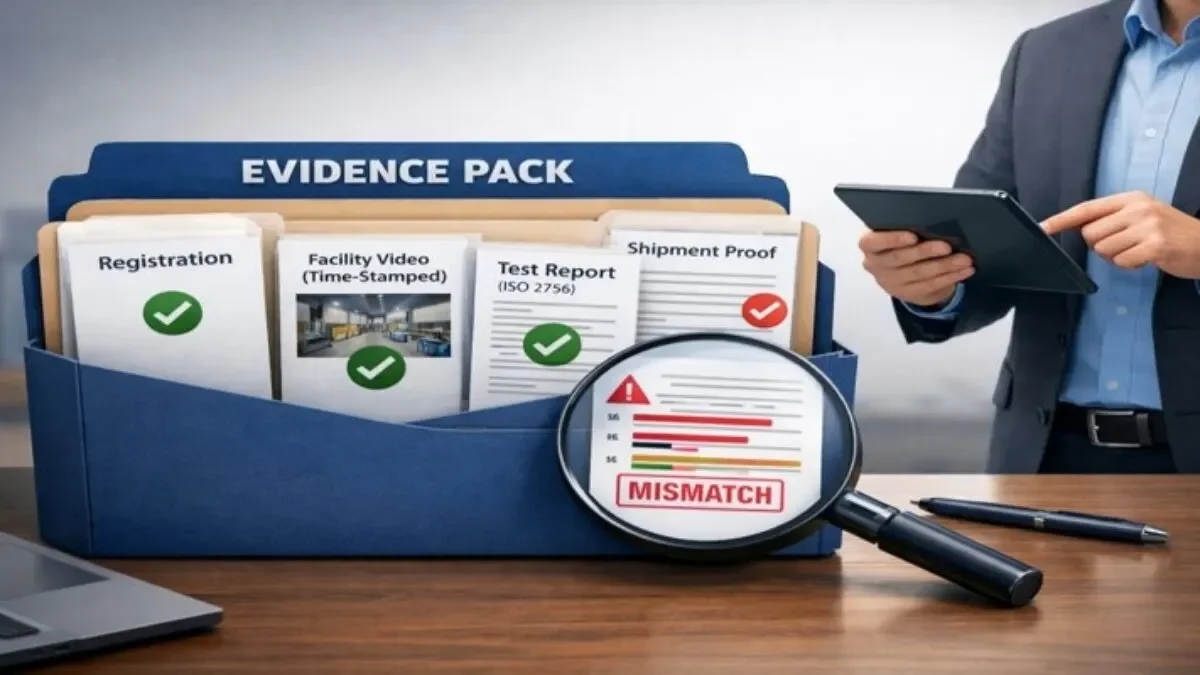
Registration, video, test-report and shipment paperwork laid out together, with one document flagged as a mismatch under a magnifying glass.
The licence shows the registered Chinese name, credit code, legal representative, registered capital, establishment date and business scope. It also lets you ask directly for the production-site address and whether the business scope includes manufacturing of the product. A valid licence is identity evidence. It does not prove manufacturing capability, product certification, quality control or export readiness.
Before releasing a bulk order, the licence name, sample label, certificate holder and packing documents should match the payment file. Ask for relevant certifications and verify them with the issuing body rather than a PDF. Ask for references from customers in your region and for samples made on the production line rather than hand-finished showroom pieces. Before a significant first order, visit the production site or have someone trusted visit on your behalf.
Label the paid booth sample with the booth route, quote version and date, and have the supplier sign or stamp it. That sample becomes the inspection standard. Decide who inspects, when, which sampling plan applies, and whether a failed inspection means hold, rework or reinspection against that sample and the contract terms already written down.
Professional inspection services, including SGS, TUV and local QA firms, are widely available in Yiwu if you need an independent check.
Put product, quality and inspection terms into the written contract: materials, dimensions, tolerances, packaging, labelling, the approved sample, quality standard, inspection method and what happens if goods fail. Include a Chinese-language version and state which language prevails.
A common payment structure is a deposit before production and the balance after a successful pre-shipment inspection, before the goods leave the factory. Pay only the verified company's corporate account. One commercial guide estimates 6 to 8 weeks for thorough supplier verification; treat that as an estimate, not a Yiwu market rule.
Finally, check who owns the design, trademark, artwork, mould and product photography. Request written authorisation for licensed material before ordering.
A good first trip ends with a usable file
Before you go, write the one-page product brief and set the columns you will use at every booth. At the market, collect the same fields, pause to normalize quotes, and ask for the commercial points in writing. After the trip, verify the legal entity, sample and payment route before any bulk order.
That is a usable shortlist: fewer names, more complete answers, and a clear next step. Start with the brief and the comparison log. Those are the two documents you control before you book anything.