Most “private label” products aren’t actually private label.
They’re standard products with a different logo—often produced by the same factory, using the same materials, and sold by multiple brands at the same time.
For businesses sourcing from China suppliers, this is where the real challenge begins. Most factories operate within existing production systems optimized for efficiency, not uniqueness. Without clear direction, your product will naturally fall into those same frameworks.
This is why many products appear branded, but feel interchangeable.
Understanding the difference between private label and white label is not just about terminology, it determines how much control you actually have over your product, and how easily it can be replicated by others.
Difference Between Private Label and White Label
At a conceptual level:
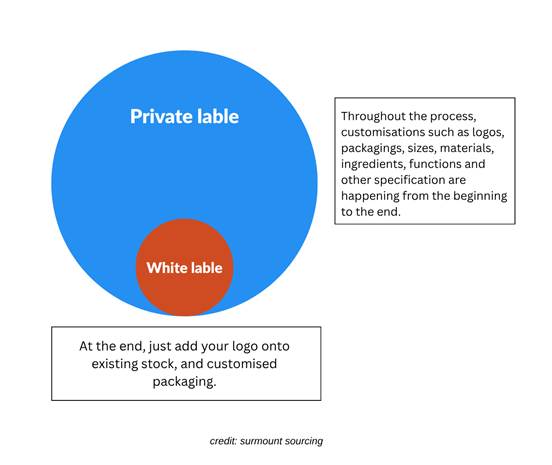
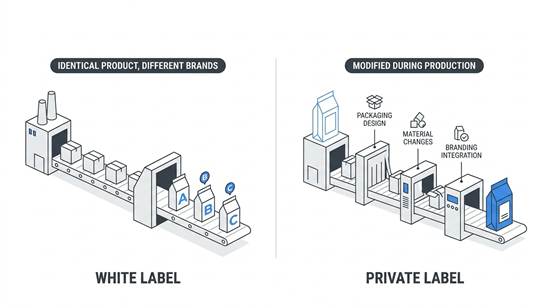
- White label refers to selling an existing product manufactured by a supplier, with only branding elements such as logos or packaging changed.
- Private label involves customizing the product itself, which may include materials, formulation, design, or packaging structure.
However, in practice, the difference lies in when customization takes place. White label customization is applied after production, typically at the final stage. Private label customization, by contrast, is integrated into the production process itself. This distinction determines how much control a business has over the final product.
Why the Confusion Exists in the First Place
In sourcing conversations, the term “private label” is often used broadly. Many suppliers will confirm that they offer private label services, but what they are referring to is typically:
- logo printing
- basic packaging changes
- selection from existing product variations
From a supplier’s perspective, these are valid forms of customization. However, they do not fundamentally change the product itself. This creates a gap between expectation and execution—especially for businesses entering sourcing for the first time.
White Label VS Private Label in Scented Candle Sourcing
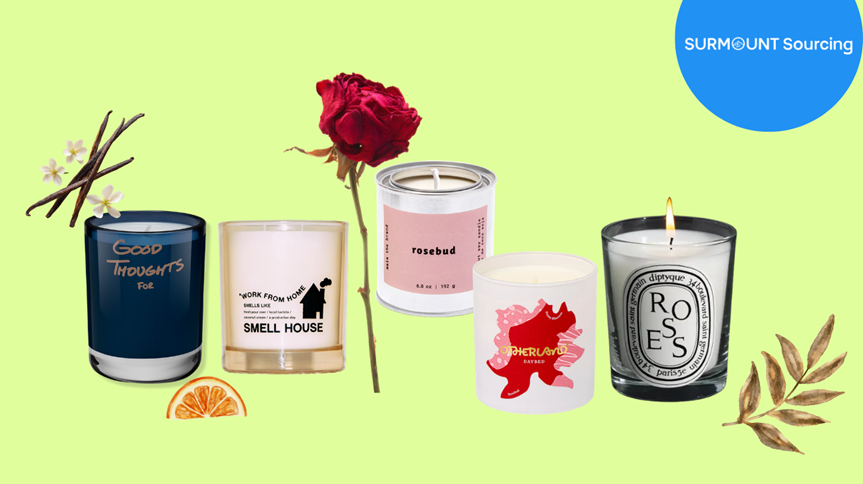
Scented candles provide a clear example of how these two models differ in practice.
A typical white label candle involves selecting from a supplier’s existing catalog:
- standard glass jars or tins
- pre-developed scents such as lavender or vanilla
- existing wax formulations
Branding is then applied through labels or simple printing.
A private label candle, by contrast, may involve:
- adjusting the wax composition (e.g. soy blends, burn performance)
- developing a custom fragrance profile
- selecting or designing a unique container
- creating tailored packaging with specific materials and structure
While both approaches result in a branded product, the level of control—and therefore differentiation—is significantly different.
What “Customization” Actually Means in Manufacturing
Customization is often misunderstood as selecting from available options.
In manufacturing terms, private label begins when production itself is influenced. Real customization means changing something within the production process. This could involve new materials, adjusted specifications, or modified workflows.
If a product is assembled the same way for multiple buyers, with only surface-level differences, it remains within a white label framework.
How MOQ Reflects the Level of Customization
Minimum order quantity (MOQ) is one of the clearest indicators of how much customization is actually being implemented.
Lower MOQs—typically between 100 and 300 units—are generally associated with logo application or basic packaging adjustments. These changes do not affect how the product is manufactured.
As customization moves deeper into production, MOQs increase:
- Custom packaging may require 500–1000 units
- Product-level changes, such as new materials or formulations, often require 1000 units or more
This reflects the additional cost and operational complexity involved.
If customization is offered with very low MOQ, it is likely limited to surface-level changes.
Why Most Small Brands Struggle to Differentiate
A common pattern in private label sourcing is focusing on visible changes rather than meaningful ones.
In categories like scented candles, this often results in:
- similar scent profiles under different names
- identical containers used across multiple brands
- minor visual differences that are not noticeable to customers
From a sourcing perspective, this is expected. Suppliers prioritize efficiency and standardization.
Without deliberate decisions about what to change—and why—products tend to converge toward the same formats. Private label is therefore less about adding elements, and more about choosing which elements are worth controlling.
Where Real Differentiation Actually Happens
For many products, differentiation does not begin with the product itself. Packaging is often the most accessible and effective starting point.
In scented candles, packaging shapes the first impression. Two identical candles can be perceived very differently depending on how they are presented.
Options range from:
- basic packaging with minimal branding
- custom printed boxes
- fully designed packaging structures with premium materials
Compared to product-level changes, packaging typically requires lower MOQ and shorter development time. As a result, many brands use packaging as the first step toward building a distinct identity.
From Sample to Production: Where Things Often Go Wrong
Samples are an important part of the sourcing process, but they can also be misleading.
In some cases, samples are prepared under conditions that differ from mass production. For scented candles, this may affect:
- fragrance strength
- wax consistency
- burn performance
When production scales, small variations can appear if specifications are not clearly defined and controlled.
Ensuring that samples accurately reflect production conditions is essential, particularly for private label products where consistency is critical.
Private Label vs White Label: Which One Should You Start With?
The choice between white label and private label depends on your stage of development.
White label is often more suitable for early-stage businesses. It allows for faster market entry, lower upfront investment, and reduced risk while testing product demand.
Private label becomes more relevant as the business grows and seeks stronger differentiation. At this stage, customization supports brand positioning and long-term competitiveness.
In practice, most businesses transition gradually—starting with standard products and introducing deeper customization over time.
When to Consider Working with a Sourcing Partner
As customization increases, so does complexity.
Managing product specifications, packaging, materials, and production timelines often involves multiple layers of communication with China suppliers. Misalignment at any stage can affect cost, quality, or delivery.
This is typically the point where businesses consider working with a sourcing partner—particularly when:
- customization goes beyond standard options
- multiple suppliers are involved
- consistency between sample and bulk production is critical
The role of a sourcing partner is not only to identify suppliers, but to align requirements and ensure that what is planned can be executed at scale.
Final Words: Control Determines Differentiation
In competitive markets, the difference between products is rarely obvious at first glance.
But over time, the brands that stand out are usually the ones that move beyond surface-level changes—and take control of how their products are actually made.
1. What is the main difference between private label and white label?
White label products are existing items with only branding changes, while private label products involve customization at the production level. The key difference is how much control you have over the product itself.
2. Is private label more expensive than white label?
Yes. Private label typically involves higher costs due to customization, higher MOQs, additional sampling, and longer production timelines. White label is generally more cost-effective for starting out.
3. Can I start with white label and switch to private label later?
Yes. Many businesses begin with white label to test the market, then gradually introduce customization once demand is validated. This reduces risk and allows for more informed investment.
4. What is the typical MOQ for private label products?
MOQ depends on the level of customization. Basic branding may require 100–300 units, while product-level customization often requires 1000 units or more due to production complexity.
5. How do I know if a supplier is offering real private label services?
If customization affects the product itself—such as materials, formulation, or structure—it is likely true private label. If changes are limited to logos or selecting from existing options, it remains within white label.
6. Is private label worth it for small businesses?
Private label can be valuable, but timing is important. For small businesses, starting with simpler customization is often more practical. Full private label becomes more beneficial once there is proven demand.