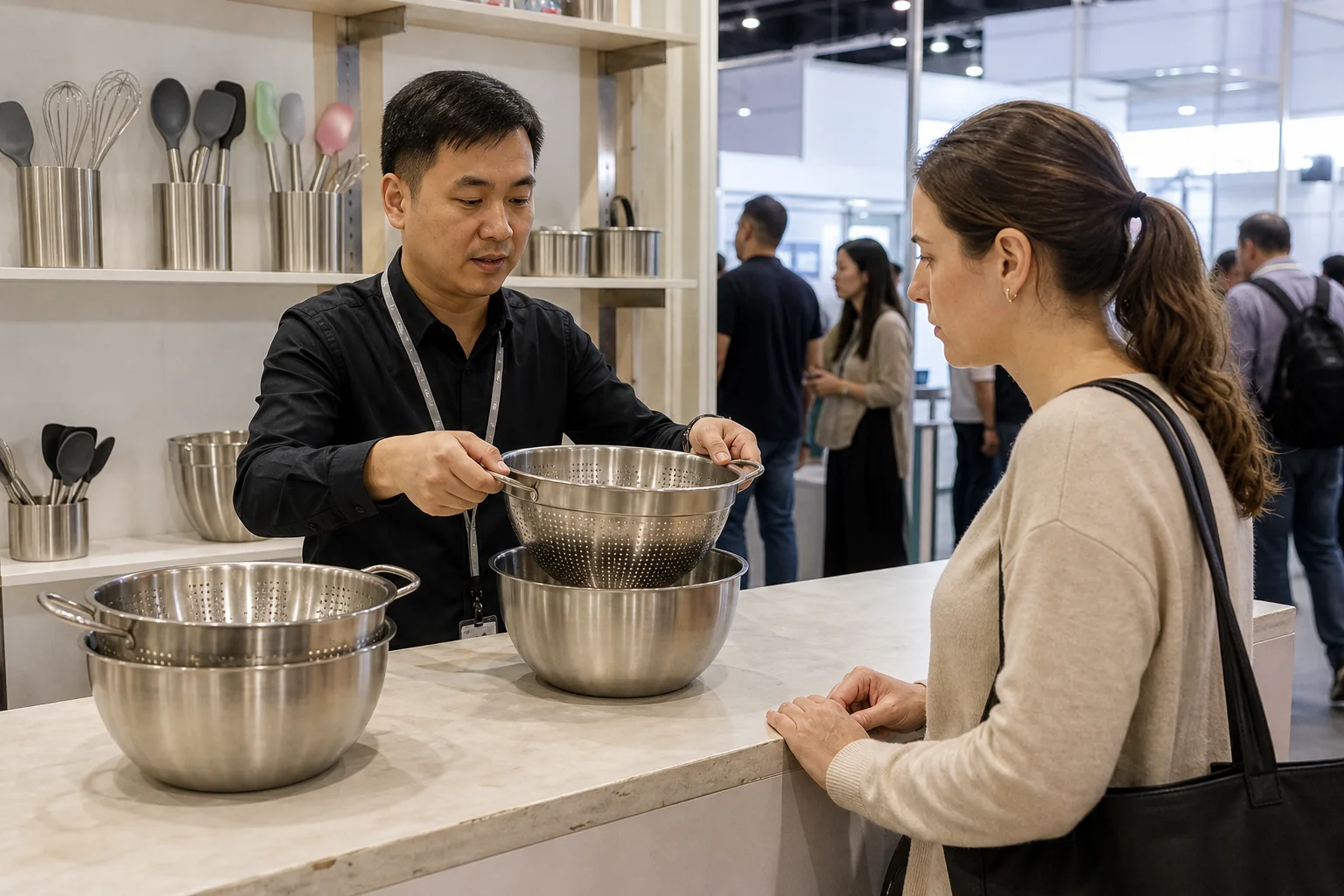
At a busy trade fair, it is easy to leave with a phone full of product photos and still be unable to compare suppliers. Your photos may lack model numbers, while the prices in your notes refer to different sizes. Later, the person answering your messages cannot identify the sample you handled.
Use your Canton Fair sourcing visit to create a small set of traceable product enquiries. Each enquiry needs a supplier identity, a specific product version, a written quotation basis and an agreed next action. You can build that record while you are at the booth, then use it to decide where to spend your sampling and verification budget.
The official schedule for the 140th Canton Fair in Guangzhou lists October 15 to 19, October 23 to 27 and October 31 to November 4, 2026. Check your category and travel arrangements against the organiser's current schedule. The approach below covers booth enquiries and supplier follow-up; it does not replace registration or travel advice.
Arrive with a purchase decision you can explain
Before you walk the halls, write a short buying brief. Include your target market, product use, likely first-order quantity, required delivery date and the features you will not compromise on. If you are looking for an alternative to an existing product, take photographs of the parts that matter and explain which changes are acceptable.
Separate firm requirements from ideas you are still testing. A printed logo may be essential, while the retail sleeve is still open for discussion. Without that distinction, one supplier might quote a standard stock item and another a fully customised version. Both prices can be correct for what each supplier understood.
Set limits on the next stage too. Decide how much you can spend on samples and which unanswered questions deserve a factory visit or an external check. Keep your contact list within the follow-up capacity of your team, so promising enquiries receive attention.
Connect the booth, the contact and the product
Create an enquiry reference for each serious candidate. A simple internal code such as CF26-K01 is enough. Put it on the product photo, your meeting note and the follow-up subject line. Record the booth number and date, the exhibitor's company name, the named contact and the supplier's own model number.
Ask which business will issue the quotation and supply the order. The name on a booth sign, a sales contact's message account and a later invoice may need clarification. If a separate exporter or trading company is involved, record its role and how it relates to the proposed manufacturer. An explanation should be available before you start treating the names as interchangeable.
With permission, photograph the item from enough angles to identify it later, including the distinguishing part or accessory. Keep the business card beside the product record rather than mixed into a general camera album. A screenshot of a contact profile helps identify the person; it is not a substitute for checking the business.
Use the supplier verification checklist for that separate task. A busy booth or an attractive display cannot settle every question about the company behind an order.
Clarify what the display sample actually represents
Imagine that you are sourcing a nesting stainless-steel colander and mixing-bowl set. This is a hypothetical example, not a customer case. Two exhibitors show products that look similar at a distance. One set has different handles, a larger bowl and a different surface finish. Your notes say only “steel bowl set”. A later price comparison would hide those differences.
Ask the representative to identify the exact model and explain whether the displayed set is a current standard product, a development sample or a customer's customised version. Confirm which parts and finish are included in the quoted configuration. If you want changes, mark them on the product record and ask for a revised quotation instead of assuming the booth price still applies.
Also establish what you can actually obtain next. Is this display sample available to send? Will another sample be made? Which version will it represent, and when can it be ready? Photographing an impressive prototype does not establish that the same configuration is ready for your order.
If the supplier provides supporting reports, check that the named product and configuration relate to the item being discussed. Ask a qualified specialist to assess applicable market requirements where needed. Keep unresolved requirements visible in the enquiry instead of marking the product approved because a document was shown at the booth.
Ask for a quotation that survives the trip home
A handwritten unit price can start a conversation. Request a dated written quotation for the identified model before you use it as a purchasing comparison. Give all shortlisted suppliers the same buying brief and ask them to answer the following points:
- The model, included components, material and finish being offered.
- Quantity per version, with any minimums for colours, branding or packaging stated separately.
- The packaging configuration and any sample, development or tooling charges.
- Currency, quotation validity and the delivery basis, including the named place or port.
- Sample availability and the events that start the proposed production lead time.
- The business issuing the quotation, the responsible contact and any outstanding assumptions.
Ask suppliers to state exceptions in writing. If one cannot offer the requested handle, its alternative should be visible in the comparison. If the production schedule depends on approving artwork or receiving a material, record that dependency. An estimate measured from sample approval is not the same as an estimate measured from the day you met.
For a detailed cost comparison, use the existing guide to supplier quotations and hidden costs. At the fair, your immediate task is to obtain comparable inputs and preserve them.
Sort contacts by the question that remains unanswered
After each day, review the candidates against your buying brief. Give every enquiry a next action and a reason. You might keep one supplier as a sample candidate because it has confirmed the configuration and can explain its quotation. Another might remain a comparison candidate until it clarifies the packaging or delivery basis.
Put incomplete enquiries aside with the missing information listed. “Interesting supplier” is too vague to act on. “Need confirmation that the displayed colander belongs to model K01, plus the matching bowl size” tells you what to request and what would justify continuing.
Treat a low price and an incomplete quotation as information that needs context. Send a specific clarification request before judging the offer, then assess whether the supplier provides answers you can verify and use.
Keep the commercial shortlist separate from approval to order. A candidate may deserve a sample while still needing company checks or confirmation of manufacturing capability. The guide to factory audits and product inspections explains how to choose a check for the decision you are making.
Send a follow-up the supplier can recognise
Send the first message while the conversation is still easy to identify. Attach the product photographs and the buying brief together. State the model and configuration you understood, then list only the unresolved points. Asking for “your best price” without the product record invites another broad catalogue reply.
The following is an original template you can adapt:
Subject: CF26-K01: quotation confirmation for the nesting colander set
Thank you for speaking with us at your booth. The attached photographs show the set we discussed. Please confirm your model number, the included colander and bowl sizes, handle construction and finish.
Our proposed first order and packaging requirements are in the attached brief. Please quote this configuration, identify any minimums per version, and list sample and development charges separately. Please also confirm sample availability, quotation validity, the delivery basis and what starts your production lead time.
If any requirement cannot be met, please mark the proposed alternative rather than changing it silently. Please confirm when you can send the quotation and who will handle our follow-up.
For messages across time zones, use a specific date and identify the time zone if a reply deadline matters. Keep the current brief and quotation in the same record. When a supplier changes a component or a price, save the revised version instead of editing away the earlier agreement.
Choose the next expense before requesting samples
For each candidate, write down what receiving a sample would tell you. If the missing answer is whether the handle is comfortable or the pieces nest properly, a correctly identified sample may help. If the question concerns who manufactures the product, another display sample will not answer it.
Confirm the sample version, charges, delivery address and review purpose before arranging dispatch. Follow the product sample guide for evaluation. Record differences between the received item, booth photographs and supplier quotation, then decide which version should move forward.
Schedule further checks around the remaining uncertainty. A manufacturing assessment may be appropriate before awarding a customised order; an inspection of finished goods concerns the later shipment. Ask whoever conducts the check to tie the evidence to your enquiry reference, product and requirements.
Create an enquiry file for the person continuing the work
If a colleague or sourcing team will continue the work, provide the booth reference, supplier details, product photographs, current brief, quotation revisions, unanswered questions and the action already agreed with the supplier. Name the person authorised to approve a sample, change a requirement or advance the purchase. This prevents a useful contact from being restarted as a fresh, vague enquiry.
You can send your supplier shortlist and product requirements to Surmount Sourcing to discuss follow-up support. Include what you have already confirmed and what still needs checking. The first useful outcome is a defined next action for each candidate, with enough information for the responsible person to carry it out.