If you are deciding whether to approve a new factory, book an assessment of its manufacturing capability. If you need to decide whether a particular order is ready to ship, arrange a product inspection against the agreed specifications. A factory audit and a product inspection answer different questions, and paying for one does not automatically answer the other.
With a limited checking budget, start by writing down the decision you need to make and the evidence that would change it. A good sample does not settle questions about the production site. Even a report marked “pass” needs to be read against the work you actually commissioned.
Start with the decision waiting on your desk
A manufacturing audit assesses the facility and its capability; a product inspection checks goods against requirements. Those definitions establish the scope. Your brief must then connect that scope to your own product and order.
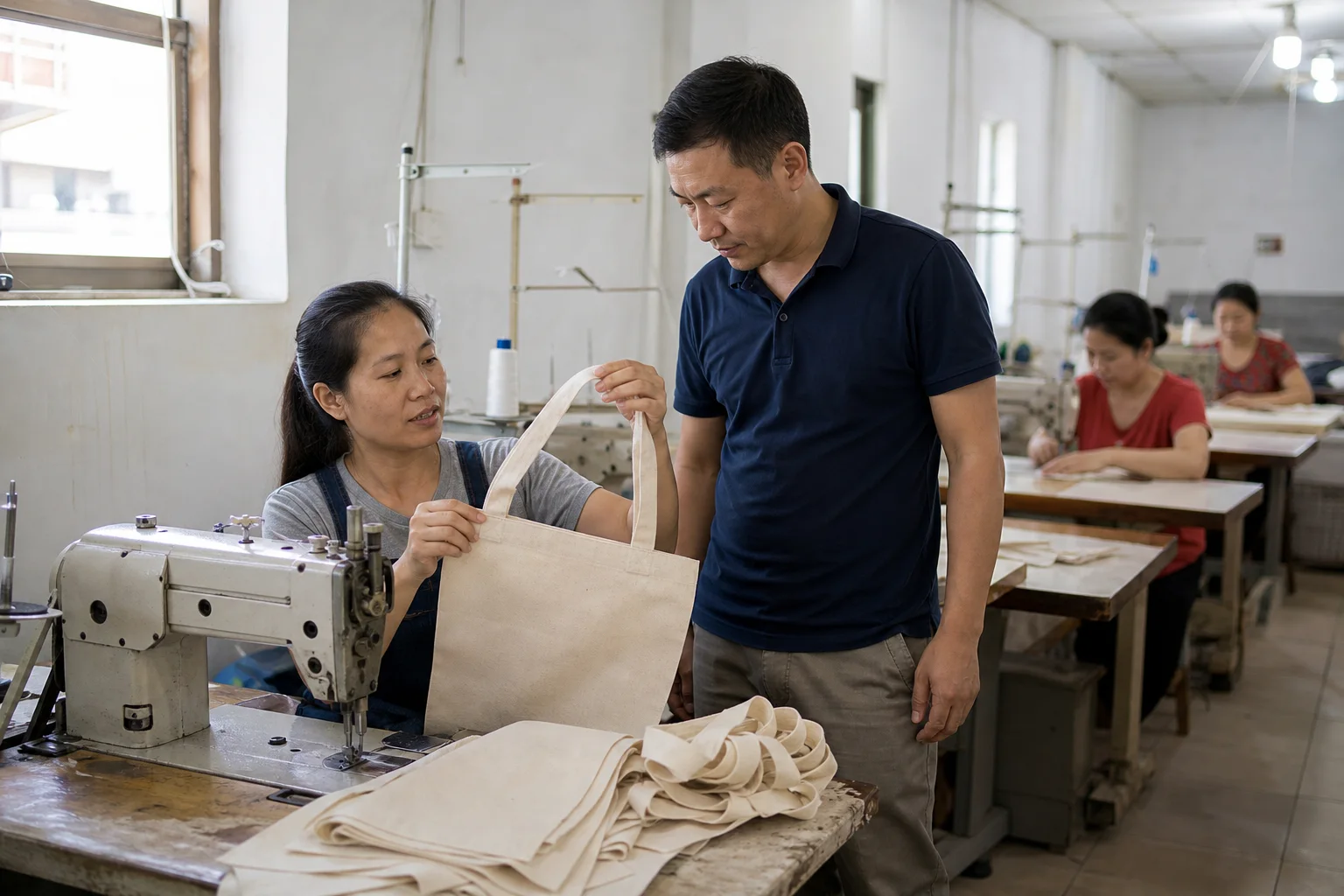
For example, imagine ordering a custom canvas tote bag with reinforced handles. This is a hypothetical purchasing situation, not a customer case. Before awarding the order, you want evidence that the proposed factory can sew the specified construction consistently. When the bags are finished, you want evidence that the order actually contains that construction, the correct dimensions and the approved labels. Photographs of sewing machines cannot answer the second question. Inspecting a few finished bags cannot establish how the factory manages its production process.
If you still need to establish who the supplier is, start with the supplier verification checklist. Company identity, manufacturing capability and the condition of a shipment are related checks, but their results should remain distinguishable in your purchasing file.
Before paying a deposit: specify which capability needs checking
“Please check the factory” is too broad to produce a useful quotation. Send the proposed product, construction details, expected quantity and delivery schedule. Explain the operation that worries you. For the tote bag, that might be the handle attachment, the way operators receive sewing instructions, or how production separates an unapproved fabric from the approved material.
Ask the auditor to follow that operation through the workplace. Which equipment performs it? What instruction does the operator use? Where does someone check the result? What happens to work that needs repair? Request evidence tied to these questions, together with any access or document limitations. A photograph of a quality department sign is not evidence that your specified seam will be checked.
Also identify the proposed manufacturing address and any outsourced operations. If printing happens elsewhere, record that location and ask how printed panels return to the sewing factory without mixing versions. If access to a subcontractor is outside the visit, the report should say so. An undisclosed gap should not disappear inside an overall score.
For capacity, ask which line and production window the supplier proposes for your order, and what evidence supports the estimate. Counting machines tells you little about the existing workload or the operation that limits output. The findings can support your purchasing decision; they cannot guarantee the delivery date.
During production: catch the problem while correction is still practical
Suppose the factory has suitable sewing equipment, but the first bags use the wrong handle reinforcement. An audit completed before production would not establish that this later batch was sewn correctly. Waiting until every bag is finished could make the correction more expensive and disrupt the shipping plan.
In this situation, ask about checking early production or inspecting while production is running. Choose the timing around the operation you need to observe. If a lining will conceal the reinforcement, arrange the check while that construction can still be examined. Confirm how much work must be available for the agreed scope; do not book a date solely because the supplier says production is “almost ready.”
Provide the approved specification revision, physical reference where needed, and photographs or descriptions of unacceptable results. Agree how the inspector will record differences and who can approve a change. Our guide to writing product specifications for suppliers covers preparing that reference. A late instruction in a chat should not silently replace the version held by the inspector.
After checking early units, record what still needs inspection once the order is completed. Accepting an early sample does not approve the goods that have yet to be made.
Before shipment: connect the inspection to the actual lot
Send the purchase order reference and the quantities by style or variant. Ask the inspection provider to explain how goods will be selected from the available lot and how unavailable quantities will appear in the report. A supplier-selected display of its best units gives you a narrower view than an agreed selection method applied to the shipment.
Confirm the checklist, inspection scope and acceptance criteria before the visit. For the tote bag example, the brief might cover construction, dimensions, label placement and the agreed function checks. Any load test needs a defined method and acceptance requirement; inventing a weight on the day can create a dispute instead of a useful result.
The report should show how much stock was present and how much was examined. Your release decision should identify the goods it covers. If part of the order is unavailable, decide whether to delay the visit or assess the available portion separately; a report on that portion cannot support releasing the unexamined remainder.
A sampled inspection cannot promise that every unit is defect free. Laboratory testing and market-specific compliance work also need their own agreed scope when applicable. Ask which requirements cannot be checked during the visit and arrange those checks separately. If the inspection finds problems, use the steps for handling a failed pre-shipment inspection before agreeing to release the goods.
How to choose when the budget will not cover everything
Do not use a single order-value threshold as a universal rule. A small customized order can expose you to tooling costs or a missed launch, while a larger repeat purchase may come from a well-documented production process. Write down what you know, what remains uncertain and the cost of discovering the problem after shipment.
- For a new factory with an unfamiliar process, resolve the capability questions before committing to production. Keep a separate plan for checking the eventual goods.
- For an established supplier with an unchanged product, review what has changed at the site and in the order before deciding whether another audit is useful.
- For a product whose important construction becomes hidden during assembly, consider an earlier check instead of relying entirely on finished-goods inspection.
- For goods already finished and awaiting shipment, prioritize evidence about that lot. Schedule any broader factory review according to the remaining supplier risk.
If the necessary checks make the order uneconomic, reduce the exposure, simplify the product or reconsider the supplier. Skipping a check does not remove the uncertainty it was meant to resolve. Record the uncertainty explicitly so the person approving the order knows what has and has not been verified.
Send a brief that makes quotations comparable
Give each provider the same site details and list of tasks. Request a breakdown of travel charges, time on site, reporting, specialist checks and revisit costs, with exclusions stated. Find out who will do the work, their experience with the product and who receives the report. A low daily rate offers little comparison if the quotation excludes the operation you need examined.
You can adapt this request before placing a new order:
We are evaluating this factory for a custom canvas tote bag. Before committing to production, we need evidence about handle reinforcement, material identification and any outsourced printing. Please quote a visit to the proposed manufacturing site, state the evidence you will collect and list the activities you cannot verify. Quote product inspection separately, using our specification revision and the eventual order quantities.
For goods approaching completion, change the request:
We need a decision on shipment of the referenced purchase order. Please confirm the lot availability required, selection method, inspection checklist and acceptance criteria before scheduling. Record any missing quantities or checks that cannot be completed. Send the report directly to us; any shipment approval will follow our review and the agreed purchasing terms.
These are brief templates, not inspection standards. Replace the example product and operations with your own, and ask the provider to identify gaps before you authorize the visit.
Read the findings before accepting the overall result
On receipt of the report, compare the actual address, visit date, product and scope with your booking. Read exclusions and incomplete checks first. Then connect each unresolved finding to an action, a responsible person and the evidence needed to close it. “Supplier will improve” is not a closure record.
Keep factory approval separate from shipment approval in your records. You might accept a factory subject to a process correction while still requiring inspection of the first order. Equally, an acceptable shipment does not settle an unresolved question about where future production will take place.
If you want help defining the visit, send Surmount the product specification and current order stage. Include the proposed factory location, the decision you need to make and the problem you are most concerned about. That gives a useful starting point for discussing scope before arranging checks.