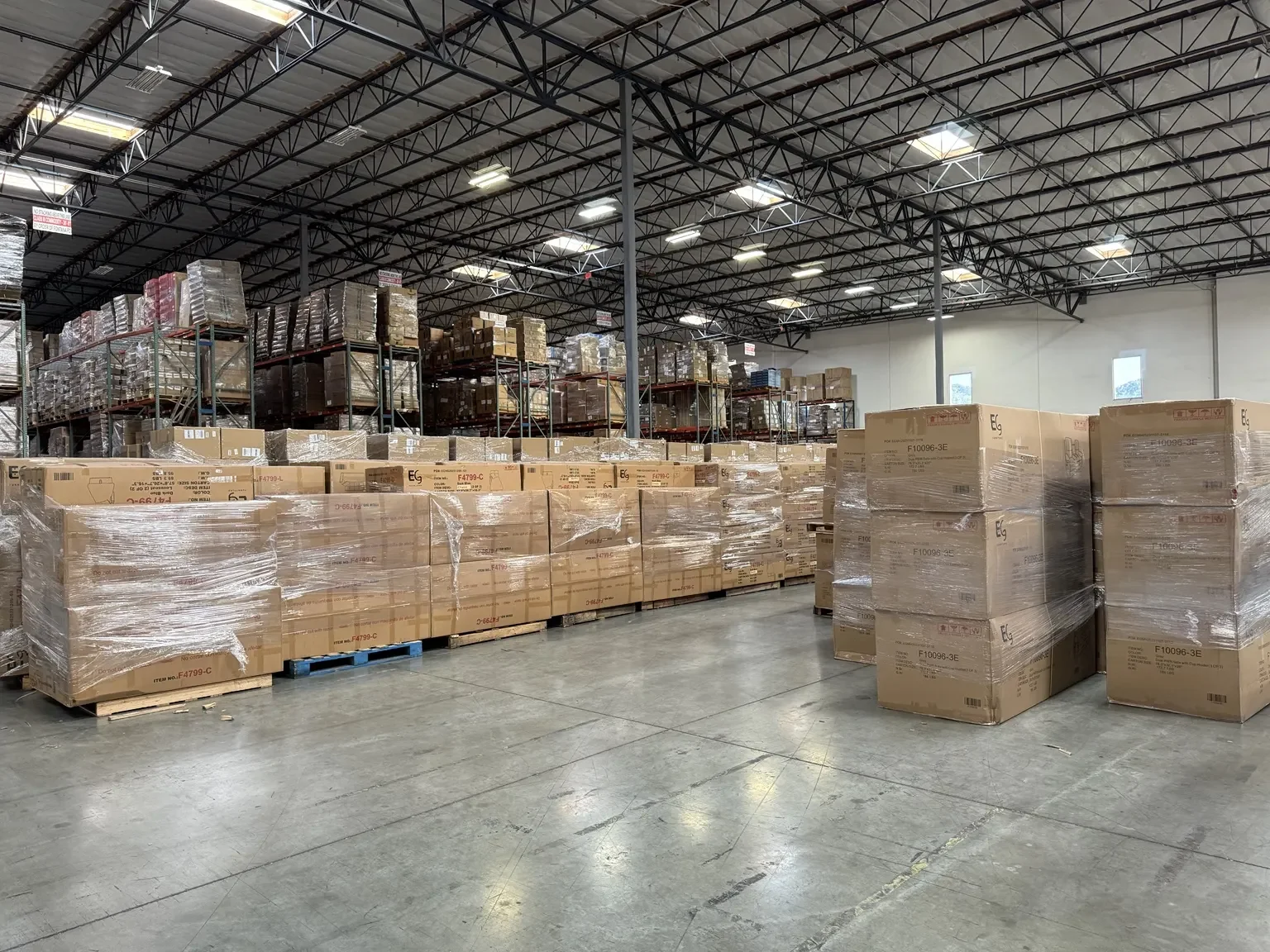
Palletized cartons wrapped in clear stretch film stand in a warehouse receiving area.
If goods from China arrive damaged, check the cargo policy or certificate to see who can file a claim. The party that bears transit risk under the sales contract is not necessarily the named insured. Photograph the load as received, keep the packing materials, and notify the insurer or its claims agent and the carrier in writing. Ask about a survey before returning or disposing of the goods.
A crushed carton at the dock: what are you actually looking at?
A damaged carton tells you something happened between the factory and your door. It does not tell you whether the cause was poor packing, rough terminal handling, a container defect, water ingress or a carrier exception.
Before you decide who to chase, split the recovery into three channels:
- The sales contract. The agreed delivery term decides when risk passes from seller to buyer. That may leave you bearing transit loss even when the seller paid the freight.
- The carrier's liability. The shipping line or airline may owe something, but its liability is usually capped and subject to defences. A bill of lading is not a cargo-value guarantee.
- A separate cargo insurance policy. A different contract, with its own insured party, exclusions, valuation and claim conditions. Cargo insurance is what covers the actual commercial value of the goods in transit.
What follows stays general, not legal advice. Your actual policy wording and the law governing your shipment still control.
Separate three questions: who bears risk, who is insured, who is liable?
Buyers often merge these questions. They have different documents behind them. The sales contract allocates risk and cost. The insurance policy decides whether a loss is covered and who may claim. Carrier liability turns on the carriage contract, the cause of loss and mandatory rules. Incoterms rules replace none of the three.
Incoterms 2020 is a starting point, not a complete answer. Only CIF and CIP require the seller to arrange insurance. The other nine rules impose no seller insurance duty, so the party carrying the risk has to decide how to protect its own interest. An Incoterms rule does not create insurance cover by itself.
Three things buyers routinely miss:
- A DDP price is a delivery term. The rule creates no seller insurance obligation, and risk allocation and insurance cover answer different questions. Do not read 'delivered duty paid' as 'insured to my door'. Turn it into a document request instead: the policy or certificate, the named insured or loss payee, the sum insured, the coverage clause and the claim route. The DDP row below sets out what to ask for.
- Paying freight and insurance to a destination does not mean the seller keeps the risk that far. Under CIF and CIP, risk can pass before the main carriage ends. That is why the policy must enable the buyer, or another party with an insurable interest, to claim.
- Other insurance duties may exist in the contract or under applicable law, but the eleven Incoterms rules alone do not create them. Confirm the contract and the governing law instead of assuming a universal requirement.
CIF, CIP, FOB, DAP or DDP: who arranges the policy, and where does risk pass?
Write the term precisely: CIF Shanghai, Incoterms 2020. Rule, named place or port, edition. A vague place or a missing edition leaves room for argument.
| Rule | Seller's insurance duty under the rule | Where risk generally passes | What the buyer should verify |
|---|---|---|---|
| CIF | Seller arranges minimum Institute Cargo Clauses (C) cover, at least 110% of contract value in the contract currency. | When goods are loaded on board at the origin port, even though the seller pays freight and insurance to the named destination port. | Is the certificate transferable? Does it allow you to claim directly? Is Clause C enough for your cargo? |
| CIP | Seller arranges Institute Cargo Clauses (A) cover, at least 110% of contract value. | When goods are handed to the carrier hired by the seller. The named destination is a cost point, not a risk point. | Does the policy cover the inland leg and the full intended route? |
| FOB, CFR or EXW | No seller insurance duty under the rule. The buyer bears the relevant risk and should arrange cover. | FOB and CFR: generally on board at origin. EXW: at the seller's premises, before loading. | Who buys the policy, on what terms, and before which handover? |
| DAP | No seller insurance obligation under the rule. A commercial guide notes the seller usually insures because it carries transit risk. | At destination, ready for unloading. | Ask what is actually insured and obtain the policy or certificate. The rule does not say whether a DAP buyer must arrange separate cover; confirm it in your sales contract. |
| DDP | No insurance obligation created by the rule itself. | At destination, import cleared and ready for unloading. | Do not assume the seller's cover protects you. Check the named insured and claim route. |
Under CIF, the buyer generally bears transit risk from loading and is the party expected to pursue the marine insurance claim. The seller must provide a transferable certificate or policy that lets the buyer claim directly with the underwriter, without the seller's permission. If the document names only the seller and is not properly transferred, you can hold the risk without holding an easy claim route.

A desk review of documents beside a laptop, with a truck parked outside.
Under FOB, CFR and EXW, the seller has no duty to insure. If nobody buys cover, there is nowhere to recover from when a loss occurs.
For DDP, separate the delivered price from insurance protection. A DDP price can put goods at your door without giving you a policy you can claim under. Ask for the actual policy or certificate, the named insured, the sum insured, the coverage clause and the claims-settling agent.
A one-line test runs through all five rows: the party that bears the risk should hold the claim route. If risk and claim route sit in different companies, that is the gap to close before booking.
What the carrier or forwarder pays, and why it rarely covers your cargo value
A bill of lading is not a substitute for cargo insurance. Carrier liability may depend on the cause of loss, be limited by law or contract, or fall short of the cargo value. Cargo insurance protects a different interest under its own terms.
For US-related ocean shipments, a commercial guide states that COGSA caps the carrier's maximum liability at $500 per package or customary freight unit unless a higher value is declared and a higher freight rate is paid. That figure is not a global rule. Under the reported 2026 Chinese Maritime Code and Hague-Visby framework, a commercial claims guide cites a cap of 666.67 SDR per package or unit, or 2 SDR per kilogram of gross weight, whichever is higher. Treat that as a reported framework example, not a confirmed answer for your shipment; check the actual bill of lading, route and governing law.
The arithmetic is worth doing before you ship. Compare the applicable cap with your invoice value. If the pallet is worth more than the cap, the gap stays with you unless you bought cover.
Bills of lading also commonly include exceptions such as acts of God, inherent vice and improper packing, which reduce the carrier's exposure further. Carrier liability can also exclude common risks such as severe weather or theft. That is why 'the carrier is responsible' is not a full recovery plan.
Freight forwarders are intermediaries, not carriers. Their liability to the buyer is typically limited to the carrier's liability, while separately purchased cargo insurance covers the actual commercial value of the goods.
Which cover and insured value should a China shipment carry?
The Institute Cargo Clauses are widely used standard terms. They define the risks covered, the exclusions, when cargo is in transit for cover purposes and the insured's duties. The three common levels are not interchangeable.
| Clause | What it means in practice | What to watch |
|---|---|---|
| ICC (A) | All-risks cover: pays every fortuitous loss unless a listed exclusion applies. | Still excludes willful misconduct, unsuitable or insufficient packing, inherent vice, certain delays and acts of war. |
| ICC (B) | Named-perils cover. Only listed causes are insured. | A loss from an unlisted cause is not paid. |
| ICC (C) | The narrowest standard cover, focused on major casualties. | Breakage, theft and leakage often fall outside cover. |
For manufactured goods such as electronics, apparel, automotive parts or food products, ICC (C) is rarely sufficient. That matters under CIF, because the seller's mandatory cover is only minimum ICC (C) at 110% of contract value in the contract currency. If you import sensitive or high-value goods on CIF, you can require ICC (A) in the sales contract or buy top-up marine cargo insurance through your own logistics provider.
The usual insured value is 110% of the invoice CIF value: the goods plus 10% for expected profit and incidental costs. That is a commercial benchmark, not a promise that every business loss is covered. For fragile or high-value cargo, one commercial guide says the markup can rise to 15% to 30% with insurer approval. Treat that as an illustration, not a universal rule.
Above all, coverage details vary by insurer and policy. Confirm the actual policy wording, exclusions, insured value basis, deductible, limits, route, transit period and claim conditions before the shipment leaves China.
Who can file the claim: assured, buyer, loss payee or assignee?
Document product defects after payment
Check three lines with the insurer: who may submit the claim, who receives any payment, and whether you need an endorsement or assignment. A buyer may be listed as the party to receive payment without having the same rights as the named insured. If the seller arranged cover, ask for the certificate and the claims contact before the goods leave China.
Start with the policy, not the purchase order. The assured or insured is normally the policy claimant. A cargo damage claim may be submitted by the shipper, the consignee or the insurer, so the overseas buyer is not automatically the claimant.

A person points to a document headed “INSURANCE”; the policy details are not legible.
Under CIF, the claim route depends on the certificate being transferable and acceptable to the insurer. If the policy names the seller as assured and is not assigned to the buyer, the buyer may need the seller's cooperation rather than an independent right against the insurer.
Three policy features change the picture:
- Loss payee. A loss payable clause directs some or all claim proceeds to a named third party. It does not usually make that party an assured or give it an independent contract with the insurer. The claim remains the assured's claim; the direction tells the insurer where to send the payment.
- Assignment. A broker summary of section 50 of the UK Marine Insurance Act 1906 says a marine policy is assignable unless expressly prohibited, may be assigned before or after loss, and an assignee with the beneficial interest may sue in its own name. But the insurer keeps any defence it could have raised against the original assured. This is general commentary, not China-specific law.
- Co-assured status. A party named as a co-assured with its own separate insurable interest may be insured in its own right. Where the policy is composite, one assured's conduct does not necessarily defeat another's cover.
One distinction is easy to blur. Being entitled to claim differs from carrying the economic loss. If you bear the risk but the policy names someone else as assured, the goods can be insured and your balance sheet can still take the hit. That is why 'insurance is included' is not an answer. Ask for the document.
For a specific shipment, the answer depends on the policy's named insured, co-assured, loss-payee or assignment terms, insurable interest and the insurer's claim conditions. None of those can be confirmed without the actual policy or certificate.
Three lines to check on the certificate: who is named as insured, whether you can claim directly, and where the money goes. If any line is blank, get it in writing before the container sails.
Before you sign or open the box: evidence that supports a claim
The receiving dock is where many claims are won or lost. The sequence is simple, but it has to be agreed before the truck arrives.
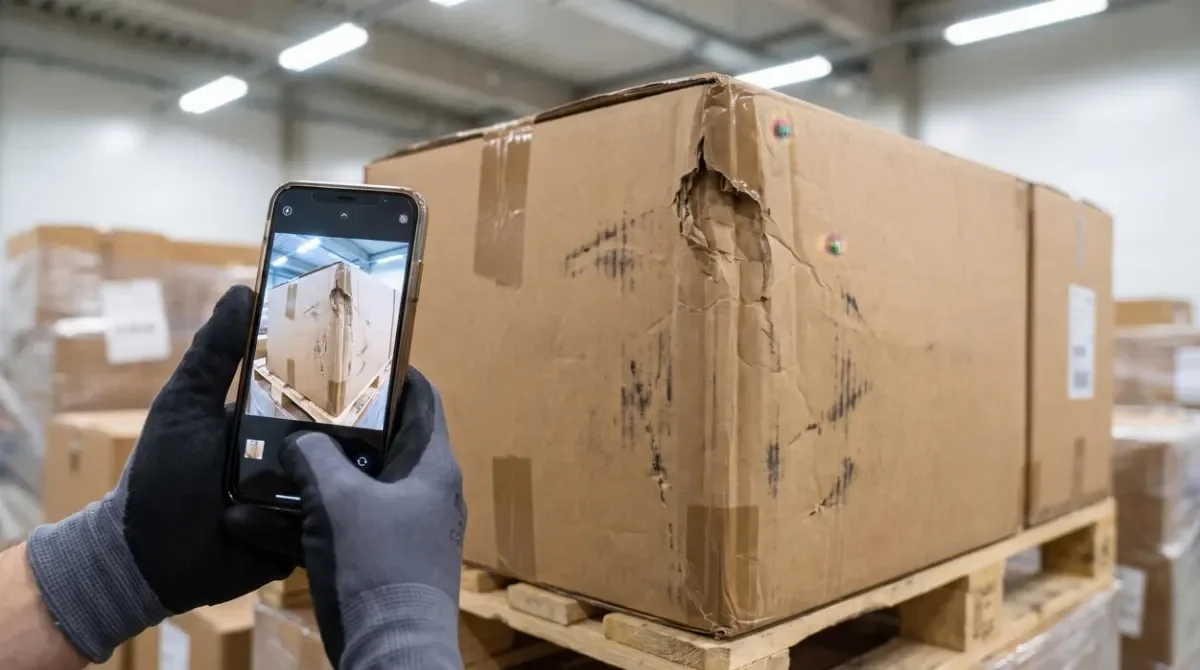
A worker photographs a damaged carton before it is opened, creating a visual record of the packaging condition.
- Inspect before signing. Before signing for the goods, the receiver should inspect the shipment and note any visible damage or loss directly on the carrier's documents.
- Use the arrival record for both claims. Write carton references, package count, visible damage and arrival time on the carrier's receipt before signing, and flag any exception on the delivery record. Then match those details to the packing list and the bill of lading. One receiving record can support both the carrier notice and the insurer's claim file.
- Photograph before unpacking. Ask the warehouse to record damaged carton references and photograph the unopened box before documenting the contents, where practical.
- Preserve the evidence. Photograph damage from several angles. Keep broken packaging and damaged goods until the claim is resolved or the insurer gives instructions.
- Note discrepancies immediately. If the delivery and shipping documents disagree, record the discrepancy on the delivery receipt or bill of lading.
- Give the carrier separate notice. A notice of loss to the carrier is the first formal step in the carrier claim process. It triggers the carrier's assessment or investigation and is separate from the insurance claim.
Notify the carrier and the insurer promptly through the channels listed in the transport documents and policy. Ask each to confirm the deadline and required form. A notice of damage and a formal claim may have different deadlines.
If the carrier caused the loss, preserve the right to claim against the carrier. Failing to do so can block the insurer's subrogation and cause the payout to be refused.
The claim file should include:
- the original policy
- commercial invoice
- bill of lading or air waybill
- packing list
- accident or survey report
- damage photographs
- the carrier claim letter
- freight invoices and proof of payment
- a statement of the claim amount
Insufficient documentation risks rejection or reduced compensation. A survey report, together with the bill of lading, commercial invoices and packing lists, often forms the backbone of the insurance claim. Your insurer may require more originals than this list.
Check the quote, then send a written request before booking
A common estimate looks like this: cargo value x 110% x insurance rate. That is a calculation model, not a guaranteed price. The final premium can change with cargo type, packaging, route, transshipment, coverage terms and whether the goods are standard or higher-risk.
When a freight quote includes an insurance line, do not check only whether the number looks small. Check what it is based on:
- Does the quote state the cargo value used for insurance?
- Is the insured value 100%, 110% or another basis?
- Does it show the rate, or at least explain how the premium is calculated?
- Does it mention a deductible and any minimum premium?
- Does it explain coverage scope, exclusions and claim document requirements?
- Does the final invoice keep the insurance charge separate from freight and handling fees?
Before booking, send a written request. This is a template; replace the bracketed fields with your shipment details.
Subject: Cargo insurance confirmation for [shipment reference]
Please confirm in writing before booking:
- The Incoterm, named place or port, and edition, for example CIF [port], Incoterms 2020.
- Commercial invoice value and currency.
- Route, transport mode and any transshipment or inland leg.
- Cargo description, packing method and any fragile, battery, temperature-sensitive or high-value status.
- Required Institute Cargo Clauses level, and any extensions such as war, strikes, theft or water damage.
- Insured value basis and whether freight or other costs are included.
- Deductible, minimum premium and any sublimits.
- Named insured, beneficiary or loss payee, and whether the buyer can claim directly.
- Claim documents, notice deadlines and the claims-settling agent's contact details.
- A separate insurance line on the final invoice.
Ask whether cover is arranged, what it covers and how damage is reported. Then request the documents that answer those questions: the certificate or policy, the named insured, the coverage level and the claims-settling agent's details. Confirm the insurer's notice channel and deadline in writing too. A sentence saying 'insurance is included' does not give you a claim route.
Next action: send the request before the container leaves China
Before the shipment leaves China, send the written request to the seller or forwarder, attach the commercial invoice and packing list, and obtain the actual policy or certificate. Do not sign a clean delivery receipt when damage is visible. Do not assume the buyer automatically owns the claim. Check the named insured, the claim conditions and the notice procedure. If the policy is silent on any of them, get the answer in writing before booking. Getting those answers before departure is cheaper than arguing about a claim after arrival.