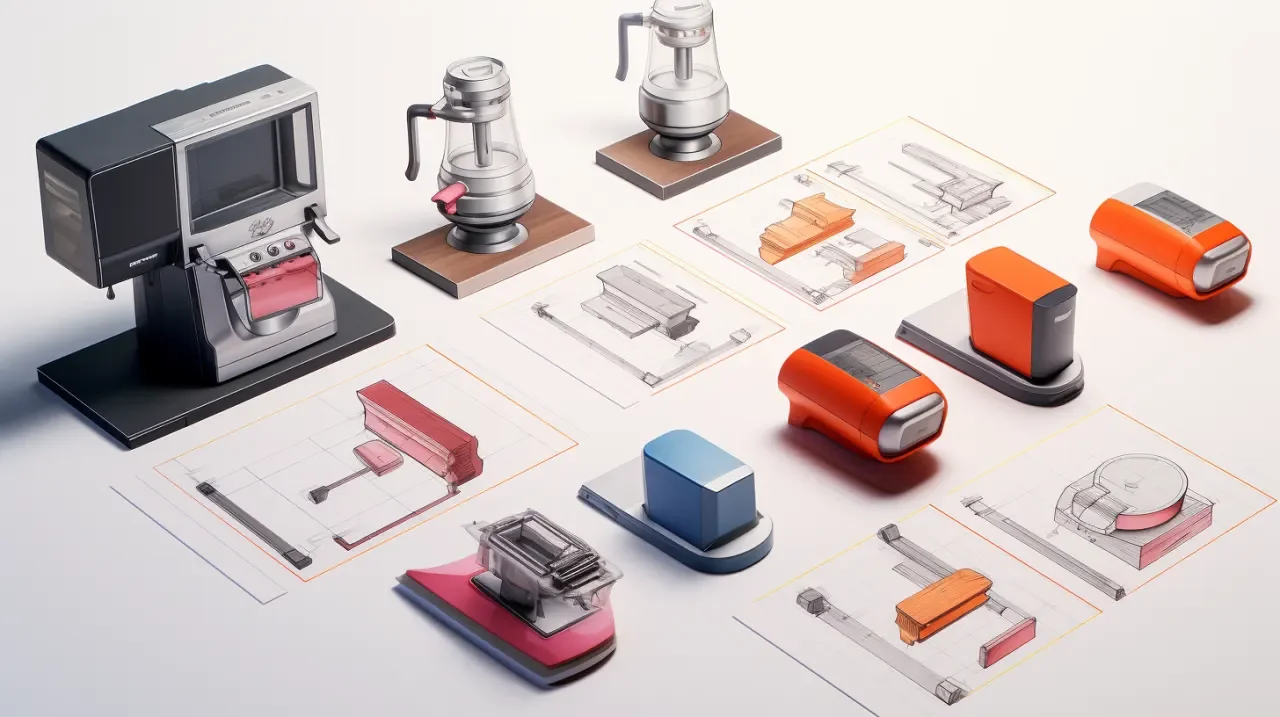
Small-appliance concept models with technical drawing sheets at the product development stage.
Before you pay for tooling at a Chinese factory, agree on what each sample must prove. Start with measurable requirements, ask the factory how it plans to meet them, then approve a specific drawing revision and sample. Keep production approval separate: the test records, final materials and process still need to match what the factory will use for the order.
1. What should you define before contacting a Chinese factory?
Start with a product brief that a factory can quote and develop without guessing. A clear brief should cover the following:
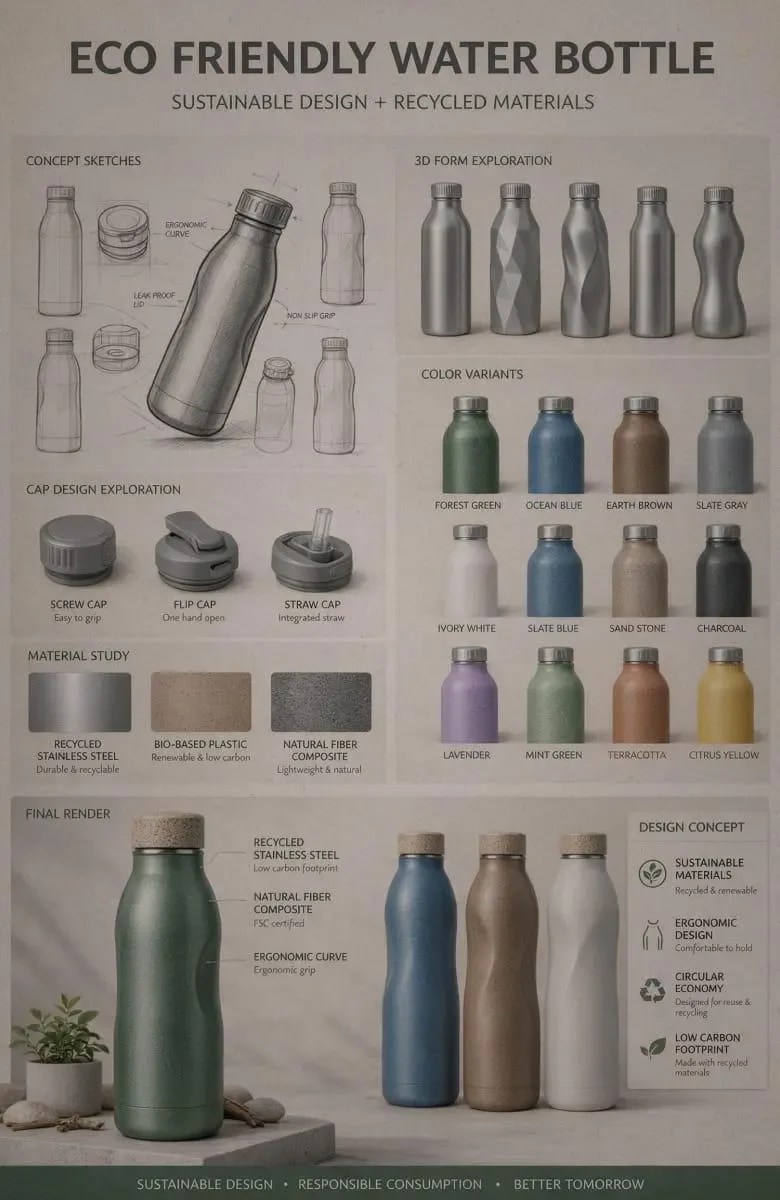
A concept sheet groups bottle sketches, a material study and colour variants so a design direction can be reviewed before sampling.
- Intended use and target customer
- Target sales market and destination
- Core functions
- Materials and major components
- Dimensions and units of measurement
- Appearance, colour and finish
- Expected quantity and target cost
- Packaging and labelling requirements
- Brand and artwork requirements
- Known testing or compliance questions
Separate confirmed requirements from references, assumptions and open decisions. A sketch or reference product can start the conversation, but label it clearly. Otherwise, the supplier may treat an illustrative image as the final specification.
Replace vague descriptions with measurable ones:
- “Good quality” becomes a material grade, composition or named reference.
- “Medium size” becomes dimensions in agreed units.
- “Navy blue” becomes a colour code, physical swatch or approved sample.
- “Premium finish” becomes a marked reference showing the required surface.
- “Strong enough” becomes a defined use, load or performance question to confirm.
These are ways to make a request clearer, not universal technical standards.
Ask the supplier to repeat its understanding in writing before sampling begins. Request confirmation of the proposed materials, components, process, estimated tooling, sample cost, timing, MOQ implications and known technical limitations.
Use a response table like this:
| Requirement | Buyer specification | Supplier confirmation | Open question | Owner |
|---|---|---|---|---|
| Material | [insert exact requirement] | [supplier response] | [what is unconfirmed] | [name] |
| Dimension | [insert measurement] | [supplier response] | [tolerance question] | [name] |
| Function | [describe expected result] | [supplier response] | [test still needed] | [name] |
| Packaging | [insert format and artwork] | [supplier response] | [pending item] | [name] |
A clear brief improves quote comparability. It does not prove that the supplier can manufacture the product consistently.
2. How do you assess feasibility and choose the development supplier?
Do not select a development supplier on unit price alone. Ask whether the factory has built products involving similar materials, processes, tooling, assembly and testing requirements.
A factory that produces an existing catalogue item may not be equipped to develop a new product. Ask the supplier to review:
- Manufacturability and production method
- Difficult features or tight fits
- Component availability
- Tooling and mould requirements
- Expected changes to cost or lead time
- Packaging and assembly constraints
- Testing or compliance questions it cannot yet confirm
Request a written “cannot confirm yet” response where necessary. An explicit unknown is more useful than an optimistic promise.
You should also establish who is actually developing the product. If the factory starts from its own platform or existing design, record which technology belongs to the supplier and which custom work is being developed for you. Paying for a prototype does not automatically resolve ownership of every underlying technology, file or improvement.
Before sharing sensitive files or beginning paid development, identify the contracting entities. Decide which confidentiality, development, manufacturing, tooling and intellectual-property questions require professional legal review. These are contract topics to put in front of qualified counsel, not conclusions about ownership or enforceability in every jurisdiction.
Supplier feasibility request template
This is a template. Replace the brackets with your product details before sending it.
Product: [name and short description]
Target market: [country or region]
Intended volume: [estimated quantity or range]
Required process: [for example, injection moulding, sewing, CNC, assembly]
Please confirm: proposed materials, components, production method, tooling, sample deliverables, estimated cost, lead time, MOQ implications and known limitations.
Please identify any item you cannot confirm without further testing or engineering review.
3. What should each prototype round prove?
Define the purpose of a sample before ordering it. A prototype may be intended to prove:
- Appearance
- Dimensions and fit
- Material or component choice
- Function
- Packaging
- Production method
- A specific technical question
One sample may not prove every requirement. A 3D-printed model can help review shape, but it may not prove the final surface, material behaviour or production consistency. A sample made with a substitute component may demonstrate assembly while leaving the final component unresolved.
Review the first prototype item by item against the brief. Classify every difference as one of four possibilities:
- An unstated requirement: the supplier guessed because the brief did not say.
- A misunderstanding: the requirement was present but interpreted differently.
- An understood but uncompleted requirement: the supplier understood it but did not follow it.
- A capability limitation: the supplier cannot meet the requirement using its proposed process or resources.
The classification determines the next action. Clarify the brief, correct the sample, escalate the process issue or reconsider the supplier. Do not automatically order another round without identifying what failed.
Give feedback through photographs, circles, annotations and direct comparisons. Separate must-fix issues from optional improvements.
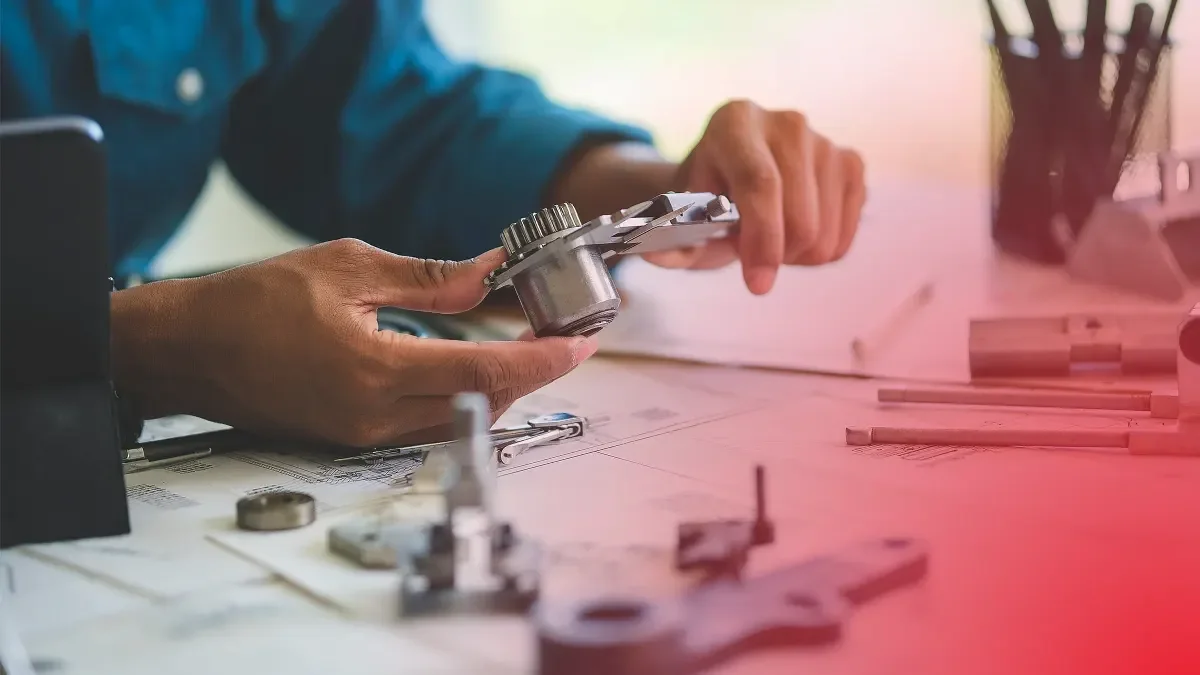
A metal gear assembly is examined above technical drawings during a hands-on review.
Maintain one confirmed change list rather than scattering decisions across email, chat and video calls. For every revision, record:
- Sample or drawing version
- Date received
- Issue photograph or video
- Problem description
- Required correction
- Responsible party
- Target date
- Buyer approval for any drawing or specification change
Do not promise a fixed number of sample rounds. Sampling continues until the agreed functional, visual, packaging and applicable compliance criteria are met and the approved version is clearly recorded.
4. What does a real prototype approval include?
“Looks good. Go ahead.” is usually too vague for a customised product.
Approval should answer two separate questions:
- Is this the product the buyer wants to manufacture?
- Which characteristics must remain consistent during production?
Make the approval scope explicit. You might approve the main product while leaving packaging artwork pending. You might approve appearance and fit while waiting for a product-specific test. That is acceptable if the record says so.
Identify the exact reference:
- Prototype revision and date
- SKU, model or product name
- Drawing revision
- Artwork version
- Material and component specification
- Packaging version
- Approved photographs
- Outstanding items
- Any agreed tolerances or acceptance criteria
Where practical, physically verify characteristics that photographs cannot reliably establish, such as texture, weight, hardness, colour, surface feel, fit and precise dimensions. A photograph can document a sample, but it may not replace physical review.
Prototype approval template
This is a template, not a universal legal or technical form. Adapt it to your product.
We approve prototype [ID/version/date] for the following features: [list approved dimensions, material, colour, function, finish, artwork and packaging items].
The following remain pending: [list items].
Production must not begin until: [condition or approval].
Any change to the approved files, materials, components, tooling, process or packaging requires written review and approval.
The approved sample should remain available for later production checks. Approval establishes the intended production reference. It does not prove that the factory can reproduce every unit consistently.
5. What must be settled before production starts?
How to approve the packaging proof
A hand-finished sample can settle the shape and feel. It cannot show what parts will look like off the production tool. If the prototype used different material or tooling, write down the exemption, the feature it affects and the check that will close it. For a dimension that controls fit, agree how it will be measured on production-intent parts before you release the run. Reference: Fictiv.
Prepare a production handover package. Depending on the product, it may contain:
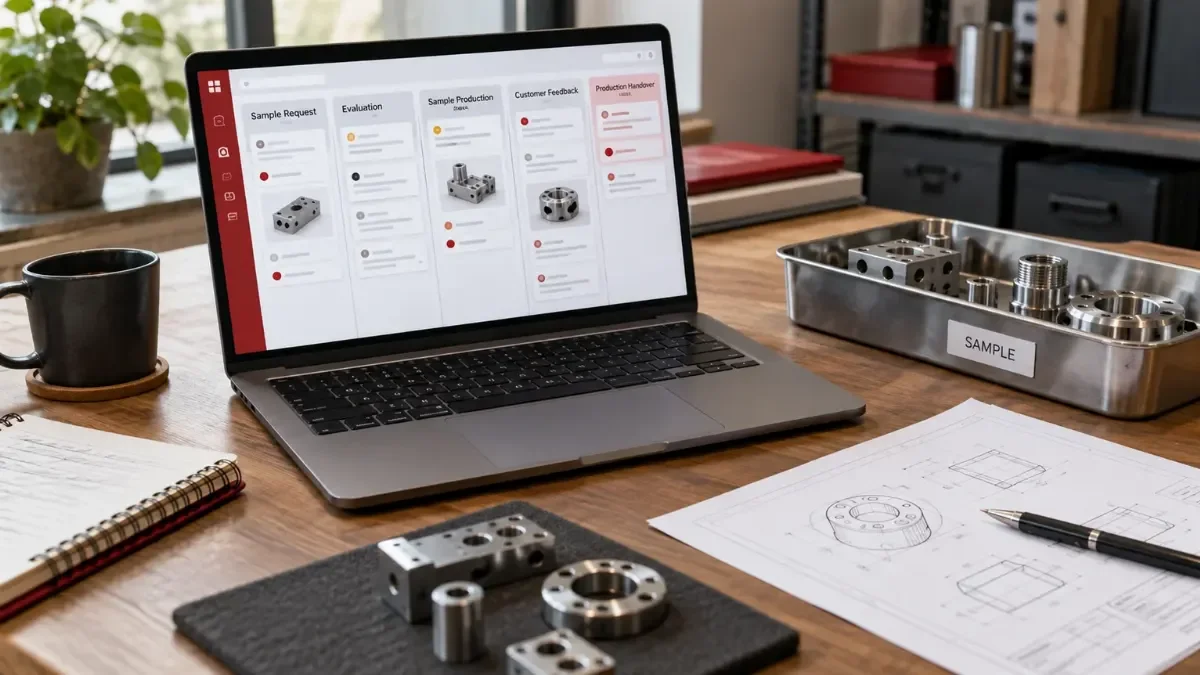
A workflow board tracking samples towards production handover, with machined parts and a technical drawing on the desk.
- Approved sample reference
- Final drawings
- BOM or material and component requirements
- Critical dimensions and functional requirements
- Colour and finish references
- Artwork and labelling files
- Packaging instructions
- Inspection checklist
- Quality control plan
- Revision history
- Applicable test or compliance records
- Open-risk register and responsible owners
A sample alone does not establish a production standard. Write down what counts as conforming to expectations, how each characteristic will be measured, what equipment or method will be used and what action follows if the result does not conform. The exact tolerances, defect limits, sampling plans and test methods must be agreed for your product with the supplier, laboratory or qualified engineer where appropriate.
Four evidence gates before release
| Gate | Decision | Evidence to hold | Do not assume |
|---|---|---|---|
| Product definition | Is the request specific enough to quote? | Brief, drawings, materials, functions and open questions | A reference image is a final specification |
| Prototype approval | Does this version represent the product you want? | Dated sample, revision record, photos and approved scope | Approval covers unresolved packaging or testing |
| Production handover | Can the factory make and inspect against a written standard? | Final files, BOM, control plan and inspection method | The approved sample explains every tolerance |
| Pilot or release | Does actual production follow the approved reference? | Pilot results, corrective actions and signed release | A pilot quantity is universal |
Freeze the files and control changes
Once the production package is released, establish change control. A new material, colour, tolerance, feature, package, tool or process can affect cost, MOQ, testing and timing.
Require written review before implementation. Record the old version, new version, reason for change, impact assessment, approval and effective date.
Record tooling arrangements
If tooling is required, document:
- Design approval
- Relevant trials and sample review
- Final tool sign-off
- Ownership
- Storage location
- Permitted use
- Maintenance responsibility
- Return or transfer arrangements
An invoice line item alone does not settle practical control of a mould or tool.
Review development ownership separately
Before production, distinguish:
- Buyer background technology
- Factory background technology
- Custom improvements
- CAD and drawings
- BOM and source files
- Test records and reports
- Mould drawings
- Subcontractor deliverables
- Milestone handovers
- Termination and exit arrangements
- Whether prototype approval creates a production obligation
These are matters to put before qualified counsel in the relevant jurisdiction. Do not present a commercial guide as proof of Chinese-law default ownership or contract enforceability.
6. Should you run a pilot before full production?
Use a pilot or controlled production launch when the product, tooling, process or order risk justifies it. The purpose is to test whether the approved design survives actual production conditions, not merely to create another sample.
Where possible, use:
- Production tooling
- Production equipment
- Production components
- Intended work instructions
- Intended packaging process
Review the output for applicable process data, product function, reliability, packaging and market-specific compliance work. The exact checks depend on the product and destination.
Record nonconformities, corrective actions, responsible parties and closure evidence. If the pilot changes a drawing, material, process or specification, update the relevant files and decide whether another approval cycle is needed.
Set a release gate signed by authorised representatives. It should confirm that:
- The approved reference is identified.
- The production package is complete.
- Required checks are complete.
- Open risks are closed or explicitly accepted.
- No unapproved change is in use.
Do not present “100–500 units” as a universal pilot rule. One commercial guide gives that range as an example, but pilot quantity must be justified by product risk, process, cost and validation needs.
Final handoff checklist
Before you move from concept to production, confirm the following in writing:
- The product brief separates requirements, references and open decisions.
- The supplier has repeated its understanding and identified limitations.
- Feasibility, process, tooling and cost questions have an owner.
- Each prototype had a defined purpose.
- Feedback was recorded in one confirmed change list.
- The approved prototype version, date and scope are identified.
- Pending packaging, testing, compliance or technical items are visible.
- Final specifications, drawings, BOM and artwork are frozen by revision.
- Inspection and quality-control responsibilities are agreed.
- Tooling ownership, storage and transfer arrangements are documented.
- Development files, subcontractor deliverables and IP questions have been reviewed.
- A pilot or controlled launch decision is recorded.
- The final production-release decision is signed by authorised people.
The exact tests, tolerances, quantities, compliance work and contract language depend on your product, destination market and supplier arrangement. Prepare the product brief, mark what is still unknown and request a written feasibility review before anyone cuts tooling or starts production.