
Put the purchase order beside the audit report and compare the addresses. If the factory will send sewing or packing to a second site, ask which site the auditor visited and whether the retailer accepts the proposed arrangement. Record that answer before authorizing production.
Start with the retailer's exact requirement
Get the customer's requirement in writing before reading any grade. Does it name a due-diligence process, an audit report, a certificate or another standard? The answer determines the evidence the customer accepts for this factory and product scope. A supplier's preferred label is secondary. NewBuyingAgent's buyer evidence guide makes the same point: begin with the customer's actual requirement, then compare the document against it.
Sedex membership, a SMETA report, an amfori BSCI rating and an SA8000 certificate are different document types. A platform membership is not an audit report; an audit report is not necessarily a certificate. A supplier's confident label does not establish acceptance for this factory.
Four records make a qualification decision. Identify the required document. Match it to the factory that will make the goods, not merely a supplier group. Read scope, dates, findings and the corrective-action record. Then decide release, conditional release or hold.
Ask the customer to confirm in writing:
- the named scheme or due-diligence process, and whether an equivalent route is accepted;
- the accepted report or certificate type, version and audit scope;
- the legal entity and full production address that must be covered;
- the product family or production line in scope;
- the maximum audit age, any minimum grade and any finding threshold;
- whether platform access, a PDF or another submission format is required;
- who can clarify the requirement before you commission or accept a document.
Supplier assurance and audit-firm marketing are not acceptance rules. If the customer cannot state what it accepts, you do not know what to request.
What a China social compliance audit covers, and what it does not
A social compliance audit examines how a site employs and treats workers: contracts, wages and deductions, working hours and leave, freedom of association, child and forced labour, discrimination, grievance and discipline, health and safety, and living conditions where the employer houses workers. ASC's ethical audit guide describes that subject matter.
These are practical labels rather than an official taxonomy. A quality audit tests whether a supplier can consistently make conforming products. A social compliance audit tests whether the workplace meets labour, health, safety, ethics and buyer-code requirements, as TradeAider's comparison explains. The Inspection Company's social-audit guide separately defines product inspection as checking goods against order requirements and product-compliance testing as assessing product characteristics. They answer different questions.

Three people sit at a table with a clipboard and papers; no document text is legible.
Timing matters. Social compliance issues can take longer to correct than packaging defects. If the audit happens after the shipment is ready, you may face a commercial block even when quality is acceptable. For a new supplier producing an important consumer product, you may need both a quality audit and a social compliance audit. Keep them separate enough that you know which requirements each document answers.
Checks vary by buyer requirements, supplier, location and framework. A clean product sample says nothing about whether the production site meets the customer's social requirement.
Match the report to the factory that will make your order
Ask for the exact legal entity, full production address, proposed product or line and any subcontracting boundary. A report for a sister plant, a trading company or a former site may be background, but it is not proof for this order.
Start with a field-by-field match. From the order file, take the contracting legal entity, full production address, product family or line, subcontracting boundary and order reference. From the report, take the audited entity, address visited, facility details, visit date, declared scope, issue date, expiry information where applicable and every stated exclusion. A trading-company name that matches is not a production-site match. A sister plant, a former address or a scope short of your line is a gap to resolve before reading the grade. Begin with exclusions and incomplete checks, because they show what the report cannot answer. Keep documented observations separate from your interpretation.

Two unreadable printed documents with charts and text lie side by side on a wooden desk.
If subcontractor access fell outside the visit, the report should say so. An undisclosed gap should not disappear inside an overall score. Read the visit details too: audit company, site visited and stated notice mode. The China Quality Service audit guide describes an announced audit as giving the factory firm advance notice and the maximum opportunity to prepare and stage conditions. That does not prove your site was staged, but it tells you how much weight the file can bear. The customer's required mode, or the current scheme rule, controls, not the supplier's preference.
Template: request for a site-specific social-compliance file. Adapt the bracketed items to your order; this is a request list, not a standard.
For [factory legal entity] at [full production address], proposed to produce [product family] for order [reference], please provide:
- The exact document [customer name] requires, including scheme, report or certificate type and version.
- The legal entity and production address covered, plus any production line or subcontracting boundary.
- Scope, issuing or audit body, site visited, visit date and stated notice mode.
- Issue and expiry information where applicable, plus current status.
- Full findings, including any zero-tolerance or critical finding, and corrective-action status with named owners and evidence.
- Any site, process or subcontractor excluded, and whether that work is in our order.
- Return deadline and the person authorized to clarify the customer's acceptance requirement.
Send it to one named contact. Keep the request, response and revised deadline with the order file.
Worker interviews: what the sample can and cannot show
A social compliance audit draws on three evidence streams: the organisation's documents, audit-team observations and worker statements. Each has a blind spot the others do not cover, as Eurotech's worker-interview guide explains. A policy manual or payslip shows what was written down. It cannot show whether overtime was voluntary, whether a grievance line is trusted or whether a recruitment fee was quietly deducted.
Typical practice is more specific than 'the auditor talked to some workers.' Auditors pull their own sample from payroll, attendance registers and, where relevant, labour-agency or subcontractor lists. The sample spreads across shifts, departments, contract types and worker categories, including agency, migrant, young and overlooked support workers. Selection is designed to sit outside a supervisor's control: auditors walk the floor and approach workers directly, or draw names at random, rather than asking a line manager to send particular people.
Interviews normally happen away from supervisors, with no manager present or interpreting, in the worker's language where possible. Testimony is set against time and attendance data, payroll and bank-transfer records, recruitment and agency contracts, training registers and personnel files. A disagreement is the finding. Reports usually present themes across the sample rather than naming individual workers.
ASC's description of a South African ethical-audit practice illustrates the method: the sample is built before the site knows which files will be pulled, stratified by contract type, shift, gender, home language and each labour broker, then reconciled from clock records to payroll, payroll to payslips, and payslips to what the worker says was received. Use it as an illustration of sampling and reconciliation, not a China legal requirement or evidence of scheme recognition.
When reading an interview summary, ask:
- Who selected the sample, and from which records?
- Were agency, seasonal or subcontractor workers included?
- How was the sample spread across shifts, departments and contract types?
- Which discrepancies were recorded, and what happened to them?
A completed interview section is not a pass mark. Ask the auditor how the sample was sized and which current scheme rule or customer requirement sets the minimum.
Read findings in the scheme's own terms
If a supplier says it “passed SMETA,” request the site report and its Corrective Action Plan Report (CAPR). Sedex does not issue a pass grade. For an open finding, record the agreed action, who will verify it and when the retailer needs the evidence. A supplier’s target date tells you when to follow up. Read Sedex’s explanation of SMETA findings
Use the report's own vocabulary. A finding or non-conformity should identify the requirement breached, severity, evidence observed and whether it is open or closed. Do not convert every scheme into a generic pass or fail.
For an amfori BSCI audit, China Quality Service's social-audit guide describes grades A (Very Good), B (Good), C (Acceptable), D (Insufficient) and E (Unacceptable), with zero-tolerance violations possibly triggering a ZT status. The guide says a zero-tolerance finding is recorded as its own flag rather than averaged into area scores, so respectable scores can coexist with a blocking finding such as one falsified record set or one under-age worker. Treat the grade labels and ZT rule as a reading aid and confirm the current scheme text and the customer's threshold.
| Document label | What it may tell you | What you still confirm |
|---|---|---|
| Sedex membership | Access to a supply-chain data platform | Whether a current SMETA audit report exists, and its audited site, scope, date, findings and corrective-action status |
| amfori BSCI rating | A grade band, plus a separate zero-tolerance flag | Legal entity, production site, report date, full findings, current scheme rule, customer minimum and accepted age |
| SMETA report | Descriptive findings rather than a single pass-fail grade | Audited site, scope and pillars, audit company, report date, open findings and customer acceptance |
| SA8000 certificate | A three-year certificate lifecycle with surveillance audits | Exact certified entity and site, scope, current validity, accredited issuer and any open findings |
The table shows what a document can support. Your customer's written requirement decides whether that is enough.
Read the corrective-action plan like a buyer
A corrective-action plan should show how each finding will be corrected and how recurrence will be prevented. A social audit report records one moment. Eurotech's corrective-action guide notes that under the certification rules governing SA8000, the report itself may not contain the root-cause analysis or the proposed corrective and preventive action, because that work happens after the audit closes. Treat that as a scheme-specific example rather than a universal report format.
A correction fixes the immediate nonconformity. A corrective action follows root-cause analysis and aims to eliminate the cause. For every finding, require a row with:
- the requirement breached and the original finding;
- root cause, correction and corrective action;
- a named owner, not a department;
- a due date and implementation evidence;
- an effectiveness check and named verifier;
- open, overdue or closed status, with the verification method.
Use a trace test instead of accepting a promise: can a reviewer who was not on the audit connect the original finding to a named owner, current implementation evidence and an independent effectiveness check? If the answer depends on the supplier's summary, the row is not closed. OBCO's CAP follow-up guidance asks whether photographic, documentary or record evidence relates directly to the finding and is current. A replaced fire extinguisher can be shown in a photo; a wage or overtime finding needs payroll and time records. Fixes may be verified by desk review or follow-up audit. Closure should involve someone other than the action owner and confirm no recurrence over a set observation period.
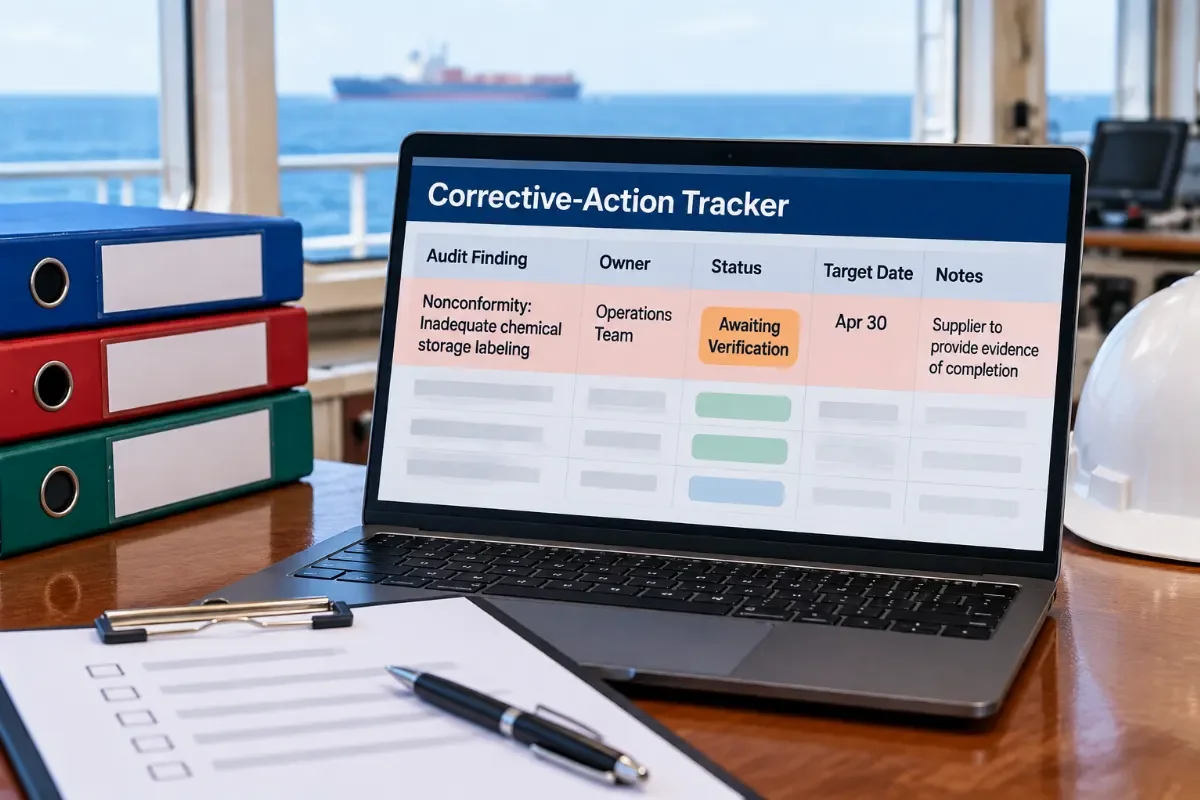
A generic corrective-action tracker keeps an open finding visible, with an owner field and a status awaiting verification.
Keep the original finding visible. If a deadline changes, record the reason and revised date rather than replacing history. Before closing, confirm that agreed actions were implemented with evidence attached and that an effectiveness check was completed against the stated criteria. A reported completion and an accepted result are separate events.
Closure does not automatically prove sustained improvement over time. Ask what observation period and evidence support that claim.
Decide release, conditional release or hold, and keep the file
Make the commercial decision explicit:
- Release: only when the document matches the customer's requirement, legal entity, production site, scope and accepted age, and no disqualifying finding remains open.
- Conditional release: with named open items, owners, evidence deadlines and a next review date.
- Hold: when the site, scope, date or status is unresolved, or the file cannot answer the customer's requirement.
Factory approval and shipment approval are separate records. Treat the social-compliance decision as its own factory-approval call, recorded next to shipment release rather than folded into it. Product inspection and testing stay on their own track. The social report cannot stand in for either, and a clean shipment does not resolve an open social finding. If entity, site, scope, date or a disqualifying finding is unresolved, the file is not a release. Name the missing item and the evidence that would change the decision, then tie the gap to the one-page file below.
Build a one-page evidence file: the customer requirement; report or certificate details; entity, site, scope and date; findings and open or closed status; corrective-action plan with owners and deadlines; verification evidence; revision history; the earlier report; the decision, decision-maker and date. Submission format and retention period are customer-specific. Put the customer's written instruction in the file and ask how long it wants the record kept.
The China Quality Service guide notes that a site which changes ownership, relocates or adds a production building is normally treated as a new site and audited again rather than updated in place. If any of those changes affect your supplier, return to the customer's rule instead of extending the old report's meaning.
Next move: send the supplier the request above for the site-specific report, current status and corrective-action evidence. Ask the customer to confirm in writing what it will accept.