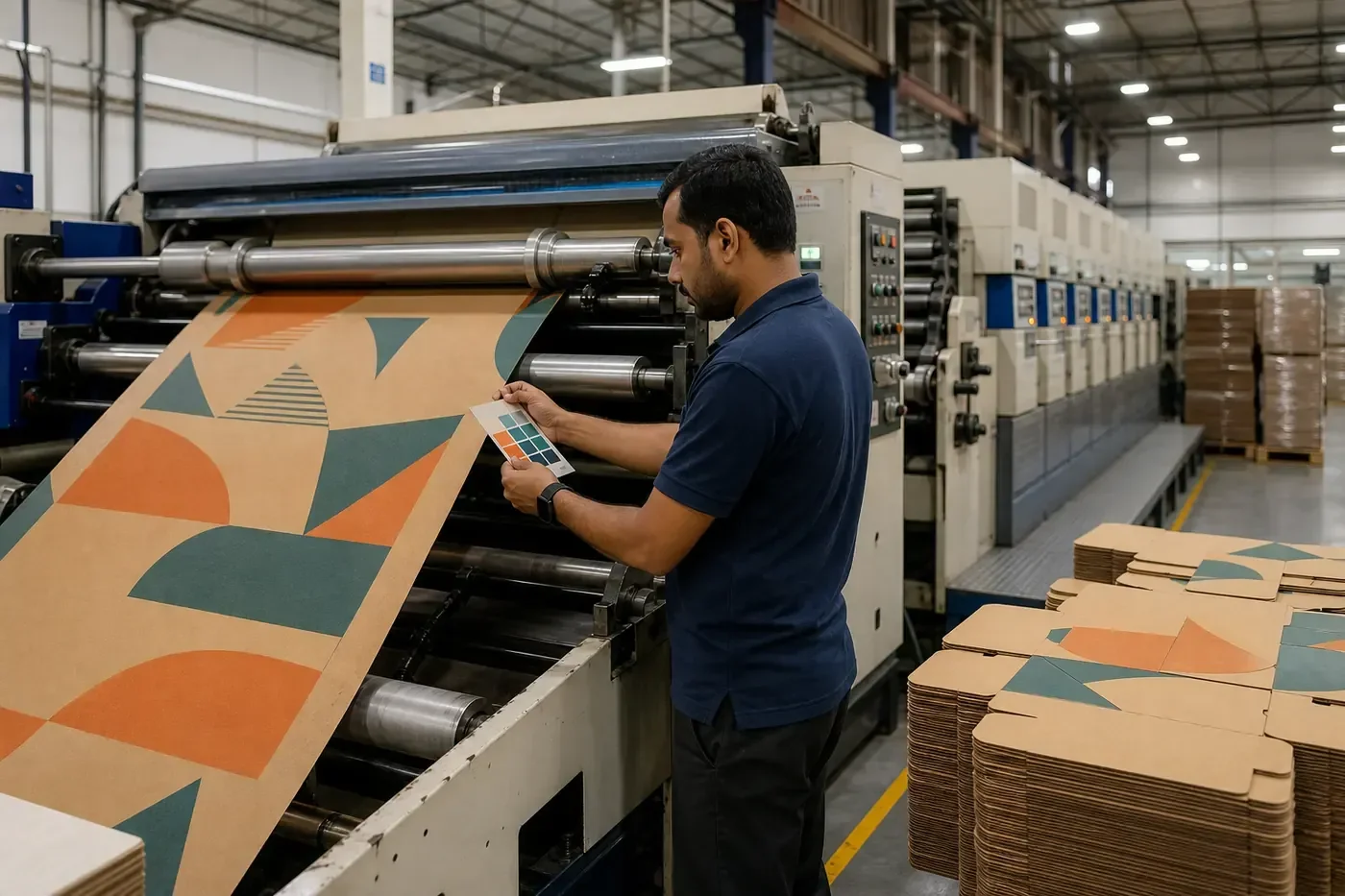
A quality check of printed packaging materials during production, illustrating the inspection process before shipment.
If your China supplier refuses a pre-shipment inspection, ask what it is refusing: the date, the inspector, access to your goods, or random sampling. Get the reason and a proposed alternative in writing. If your purchase order makes inspection a condition for balance payment or shipment release, keep that condition in place while you resolve access.
Start by naming exactly what was refused
"We cannot accept inspection" is too vague to act on. Inspection providers' buyer guidance on refused inspections treats the phrase as a possible cover for five different problems, each needing a different response.
| What was blocked | What to ask next |
|---|---|
| The proposed date | What quantity is finished, packed, and still in production for each SKU today? What is the earliest workable new date? |
| A named inspector | Will you accept another qualified inspector from the same independent company? |
| Photography or one production area | Which areas cannot be photographed? Can the inspector still photograph our goods, cartons, labels, tests, and selected units? |
| Random sample selection | Will the inspector be free to select units from all finished cartons? |
| Any third-party inspection | How can an independent inspector check our order before payment and shipment? |
Ask one direct written question: identify the agreed inspection, summarize the objection, ask whether the obstacle is readiness, access, scope, or timing, and request a workable alternative date. A supplier's reluctance may reflect nothing more than a production delay or poor coordination, but reassurance alone does not resolve the access problem.
Separate a practical access problem from a refusal to let any independent inspector check the order. A factory may genuinely need to move a date because goods are unfinished or because another customer's line is visible. If it rejects every qualified inspector, the issue is no longer scheduling.
Keep the service types separate as well. A factory audit, a general factory visit, a product inspection, and laboratory testing are different services. A factory may limit a general visit and still be able to arrange inspection of your own order. A product inspection also does not replace a required safety or compliance test.
Check the inspection clause in the PO and the payment sequence
Pull the signed purchase order, quality agreement, quotation, emails, inspection booking, and platform messages. Confirm the inspection type, date, location, sampling level, defect limits, and approved sample. Most importantly, check whether balance payment and shipment approval were due before or after inspection.
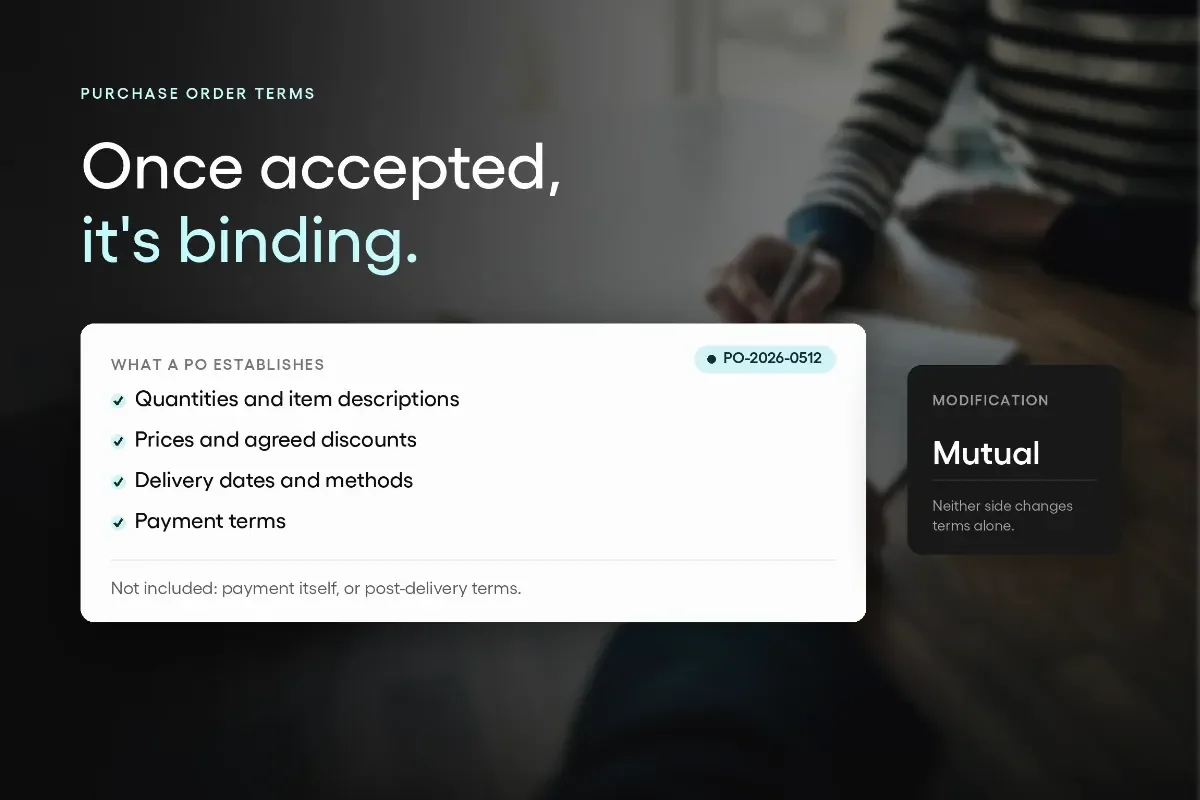
Visual summary of key elements established by a Purchase Order, highlighting payment terms and mutual modification rules.
If the agreed sequence was inspection first, leave the balance unpaid and do not approve shipment merely because the supplier refuses the inspector. Remind the supplier of the payment sequence in writing.
That does not mean every refusal justifies freezing every amount; an invoice date does not automatically override an inspection clause.
If the contract says a 70% balance is payable after a satisfactory report from a named pre-shipment inspector, obstruction may directly prevent that payment condition from being satisfied. If the contract merely requires inspection cooperation while the balance has a separate fixed date, refusal may still be a breach, but postponing payment needs its own analysis. A refusal should correspond to the unmet part. A payment sequence you agreed to cannot simply be reversed.
Treat the legal analysis as a timeline: governing law, any CISG exclusion, the priority of the contract, purchase order and pro forma invoice, and the parties' actual performance history all matter. Put the inspection duty and payment maturity on one page before deciding what to withhold.
For the next contract, make final payment conditional on a defined inspection result, not simply completion of an inspection visit. A clause saying only "inspection before shipment" does not answer whether the supplier can demand payment after a failed inspection or whether you may require rework first. If final payment and shipment are linked, state whether the supplier may ship before inspection approval and payment. An express prohibition on shipment before written release is one drafting option.
One inspection provider describes a common China structure as a 30% deposit with the 70% balance released against a passed pre-shipment report. Treat that as a market example to adapt, not an entitlement. Also check that the business licence name on the contract matches the factory the inspector will visit, and forbid subcontracting without your written approval.
Put the affected goods on hold without calling it a product failure
If inspection was supposed to come before balance payment and shipment approval, stop both steps after a refusal or a cancelled inspection.
Write the hold as a release-control checklist rather than a general request, and anchor each line to the inspection-before-balance condition already in the PO:
- Scope of the hold. PO number, the SKUs and lot or carton range affected, and the finished quantity the inspector has not yet seen.
- Status. State plainly that the agreed inspection has not taken place, so the order is held rather than cancelled, and neither balance nor shipment approval will move.
- Release authority. Name one person, whether you, your sourcing coordinator, or a named agent, whose written release is required before those goods may be collected or loaded.
- Segregation. Ask that the affected cartons be kept physically apart from stock already approved for other orders, with carton identification left intact.
- Acknowledgement. Require written confirmation that the hold has been received and applied.
A short note carries the same points:
PO [number], lots [references], quantity [number]: the agreed inspection is not complete and the order is on hold. No collection or loading until [name/role] issues written release. Please confirm receipt.
Send it to the supplier and to whoever controls movement of the goods, and keep the same instruction in front of your forwarder. This is an operational instruction, not a general email asking the supplier to "improve quality."
If you have already paid in full, first try to arrange inspection before the goods leave the factory. If the goods have moved to your forwarder's warehouse, ask whether they can be held and inspected there. If shipment has already left China, arrange inspection on arrival.
Keep the inspection booking, refusal messages, payment records, and shipping documents in case you need to make a claim. Do not accuse the supplier or treat the goods as approved merely because inspection was blocked.
If the supplier ships after being told in writing that the order has not been approved, treat this as a serious breach. Keep all records, contact the forwarder if you are entitled to give instructions, and obtain legal advice before stopping or redirecting the shipment.
Escalate in writing, stage by stage
Each message should describe what happened and ask for a specific action. Use dates, PO numbers, quantities, and terms already agreed. Avoid emotional phrases such as "you are hiding something."
Stage 1: solve a practical access problem
We understand you cannot receive the inspector on [date]. Please confirm by [time] today the finished and packed quantity for each SKU, where the goods are stored, the earliest new inspection date, and the name of the person who will receive the inspector. If photography is the problem, please list the restricted areas. The inspector can limit photographs to our products, packaging, labels, tests, and selected cartons.
Stage 2: remind the supplier what was agreed
PO [number] requires an independent pre-shipment inspection before balance payment and shipment approval. The inspection booked for [date] could not take place because the factory did not confirm access. Please choose one option by [time]: inspection at the factory, inspection at the warehouse where the goods are stored, or inspection by another independent company accepted by both sides. The inspector must be able to access all finished cartons and select the samples.
Stage 3: keep payment and shipment on hold
The agreed inspection has not taken place. We therefore cannot approve shipment or pay the balance. The order is on hold, but it has not been cancelled. Please confirm an inspection date and location by [time]. If the inspection is refused again, we will review the next steps under the purchase order.
If the inspector reaches the factory but cannot enter, ask the inspector to record the arrival time, location, factory contacts, calls, messages, and the reason given by the factory. The inspector should not negotiate with factory staff. Send the record to the supplier and ask for a new date and a named receiving person.
Keep the roles separate: the supplier provides access, the inspector reports what was observed, and the buyer decides whether the order can be released. The inspector does not approve payment or shipment.
Choose a third-party inspection alternative that checks the same order
What to document if defects are found after payment
A report marked “inspection not performed” tells you why there is no result. It does not tell you whether the goods pass. If you move the inspection to a warehouse, give the inspector the PO, lot list and carton count, and confirm they can select samples themselves from the agreed lot. Reference: QIMA.
Any alternative arrangement may solve a genuine access problem, but it must still check the goods and requirements covered by the original booking.
| Alternative | When it can work | What it does not prove |
|---|---|---|
| Live video verification | The order is small and the checks are simple. You choose which cartons and units are shown. | It is a poor substitute for large-quantity sampling, small surface defects, accurate measurements, long functional tests, or hidden packaging problems. |
| Inspection at an independent warehouse | The full order is moved there. Carton numbers and quantities match the packing list. The inspector selects the samples. | It may not confirm which factory made the goods or how production was managed. |
| 100% sorting after delivery | You decide shipment cannot wait and arrange for every unit to be checked after delivery. | You still pay freight and import costs. Sorting, repairs, and disposal may delay delivery and increase costs. |
Visual records have a narrow job here. A time-stamped photo set or a short clip, tied to the order reference, can establish that specific goods exist, show where production stopped, and document packaging as it currently stands. That is a record of what is there. It says little about how much of the order is ready, and nothing about whether all of it meets the specification. One finished unit held up to the camera says nothing about how many cartons are ready behind it, so treat visual material as one input into the release decision, never as a substitute for sampling.
If the goods can be moved, warehouse inspection is often the most practical fallback. It must explicitly include product checks, not only carton counting and exterior checks. Opening cartons, counting units, inspection, and repacking should be agreed separately on scope and price. At Surmount's Yiwu warehouse, the stated default is Level II at AQL 2.5, with one-by-one checks at the labor rate and on-site factory inspections when needed. That describes one warehouse's service menu; confirm the written scope for your own order.
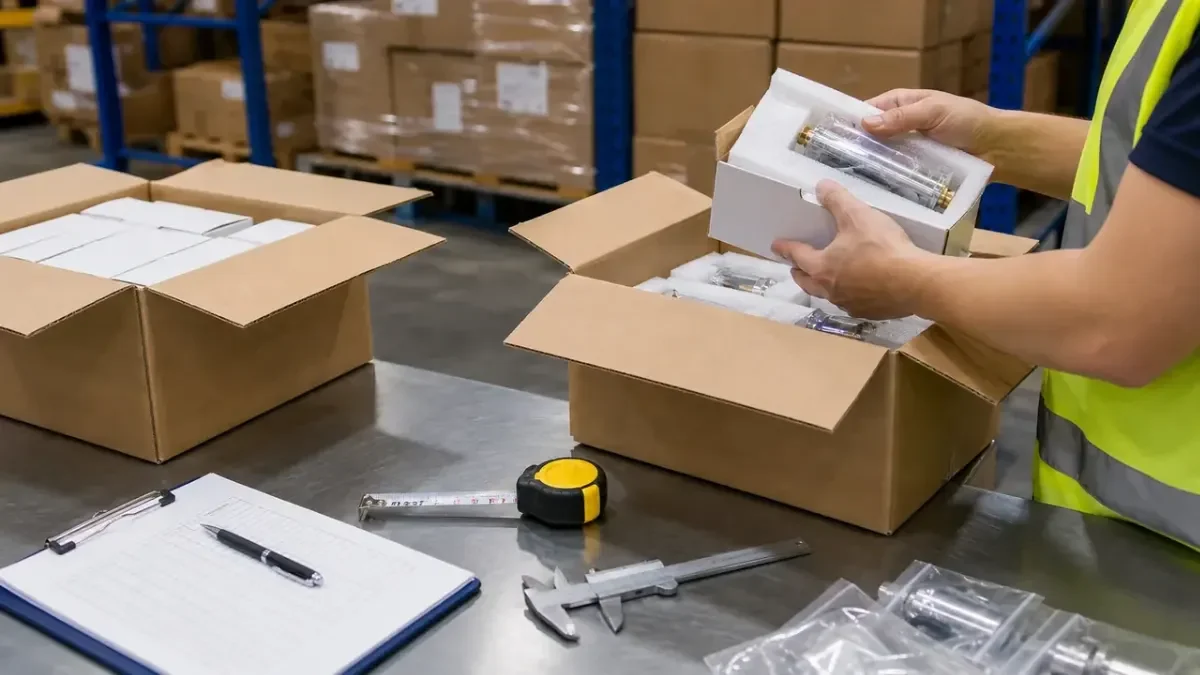
Warehouse inspection can include product checks, not only carton counting and exterior checks.
Partial orders need a release rule. When some SKUs or cartons are not yet available, the report covers only what the inspector could actually see. Match the release to that scope: list the lots and SKUs that were inspected, list the ones that were not, and state in writing that approval covers only the first group. The balance stays held until a later inspection covers the finished quantity. A supplier-curated display of its best units is narrower still: it reflects the supplier's selection method rather than the method you agreed, so it cannot stand in for a check of the shipment as a whole.
After-delivery sorting is a damage-control option, not proof that the order passed before shipment. Use it only when you have accepted the trade-off in freight, delay, and disposal costs.
Decide whether to continue, hold, or assess termination
A refusal does not always mean the order must be cancelled. First confirm what was refused and why, along with finished quantities, location, payment status, shipping status, and the inspection terms in the purchase order.

Before deciding whether to continue, hold, or escalate, confirm what was refused and check the order and inspection terms.
| Evidence | Practical position | Next action |
|---|---|---|
| The supplier gives a clear reason, confirms a new date, and will let the inspector check the complete order. | Continue. | Rebook the inspection. Keep the agreed payment date and shipment approval unchanged. |
| Quantities do not match earlier updates, the date keeps moving, or some goods remain unavailable to the inspector. | Hold. | Do not pay the balance or approve shipment. Confirm location and quantities, then inspect the complete order. |
| The supplier hides the factory, rejects every inspection option, ships without approval, or withholds required compliance documents. | Prepare to assess cancellation or termination. | Review the purchase order's cancellation and dispute terms, and check the payment, platform, insurance, or legal route that applies. |
One refused booking does not automatically meet a termination threshold. A supplier's categorical refusal of every agreed inspection, refusal to deliver as promised, or delay defeating the contract's purpose may support performance, termination, refund, and damages analysis on the full facts. Those are general contract points, not an order-specific legal conclusion.
Obstruction of an agreed inspection may support withholding or another remedy, but the amount, notice, and conditions for resuming performance need a contractual and legal basis. Suspension without definite evidence may itself be a breach. One scheduling dispute, a late inspector, or a legitimate disagreement about sampling is not automatically proof that the supplier will fail to perform a substantial obligation.
If no pre-shipment inspection term was agreed, post-receipt examination rules do not automatically create a right of unrestricted factory access. Get advice on the governing law, CISG status, and forum.
General China law context: the Civil Code, as translated by China Law Translate, places processing, custom manufacturing, repair, copying, testing, and inspection within the works-contract category. For a works contract, the contractor must accept the client's necessary supervision and inspection during the work, and the client must not hinder the contractor's normal work. Sales contracts generally include inspection standards and methods. Failure to perform, or performance inconsistent with the agreement, can trigger breach liability such as continued performance, remedial measures, or damages; where performance does not conform, liability is borne according to the parties' agreement.
That does not establish that a buyer-hired independent inspector has the same right as the client's own staff, or that a particular refusal is a breach. Those questions depend on the contract, governing law, CISG status, forum, and facts.
Seek prompt local advice if the balance or shipping deadline is imminent, the supplier may resell the goods, lots are being mixed, the actual factory or payee differs from the contract, a platform dispute is about to close, or evidence and asset preservation in China may be needed.
Document the refusal and write the access clause into the next PO
Preserve evidence by purpose within the first 24 hours:
- Terms and sequence: signed contract, purchase order, pro forma invoice, payment plan, amendments, platform terms, and the governing-language clause.
- Readiness: completion notice, production status, packing list, lot and quantity, packing images, shipping date, and native messages about the ready date.
- Inspection arrangement: appointed provider, AQL or full-inspection plan, test standard, sampling place, cost allocation, booking confirmation, postponements, and access requirements.
- Refusal and impact: complete responses from the seller or actual factory, any extra-payment demand, alternatives offered, missed sailing, reinspection costs, storage, and cover-purchase consequences.
- Payment status: deposits and milestones, amount of the balance, maturity condition, payee, any letter of credit or escrow, and any undisputed sum.
Ask the inspection company for a neutral written record covering booking time, contact, place, order and batch, attempted attendance or remote connection, the person refusing access, the stated reason, and any alternative date. The record should distinguish no inspection from a failed product inspection.
Send a written notice to the contracting seller. Cover the precise clause placing inspection before payment; the goods, batch, place, and earliest workable date; whether the supplier rejects the provider, date, method, or every inspection; alternatives that might solve the obstacle; the amount withheld, what is undisputed, and what verifiable event will release payment; and any shipping, notice, termination, platform, insurance, arbitration, or court deadline that must be preserved.
If access to disputed goods is refused, record the refusal, the access requested, and the affected lot references. Ask for a written preservation commitment. Without access or adequate traceability, describe the finding as unresolved rather than treating the supplier's reassurance as verification.
Avoid the common documentation failures: keeping only one screenshot, describing denied access as a product failure, announcing permanent non-payment before analysing the contract sequence, cancelling unconditionally while demanding continued production, or paying in full for a sailing without reserving rights and defining an alternative verification.
For the next purchase order, cover these points in writing:
- Right of access for the buyer and a named inspector at the factory or warehouse during normal hours and on reasonable notice.
- Disclosure and written approval for any subcontracting or move of production.
- Readiness at 100% finished and at least 80% packed on the agreed inspection date.
- Inspector selection of samples from all finished cartons, with unavailable cartons or SKUs listed in the report.
- The checklist, drawings, approved sample references, tolerances, tests, packaging specification, and defect classifications.
- Buyer decision authority: the inspector reports findings, while the buyer issues shipment or payment approval.
- Responsibility for failed or cancelled inspection costs, waiting time, travel, sorting, rework, and reinspection.
- Payment and shipment release linked to a defined report or written approval.
- No waiver: accepting one late or alternative inspection does not remove rights on later orders.
A construction and equipment clause sample requires reasonable access on reasonable notice and makes those rights flow into equipment purchase orders and subcontracts. Use it as a drafting idea, not a China consumer-goods template.
Add specific contract damages tied to specific breaches, plus a cure period, a notice procedure, and a defined quality failure. Agree who pays sorting, rework, and inspector-return costs before booking the inspection rather than on shipping day. Keep a record of the refusal, the supplier's reason, and how the problem was resolved, and review it before placing another order or increasing the order value.
The immediate move is to freeze the release decision rather than argue about product quality. Name what was refused, check the purchase order and payment sequence, issue a specific hold, and ask for a dated inspection plan in writing. Release goods only when the record shows that the agreed check covered the order, or when a properly documented alternative does the same job. If the contract terms or the lawful effect of withholding payment are unclear, get advice for the specific order rather than relying on a general rule.