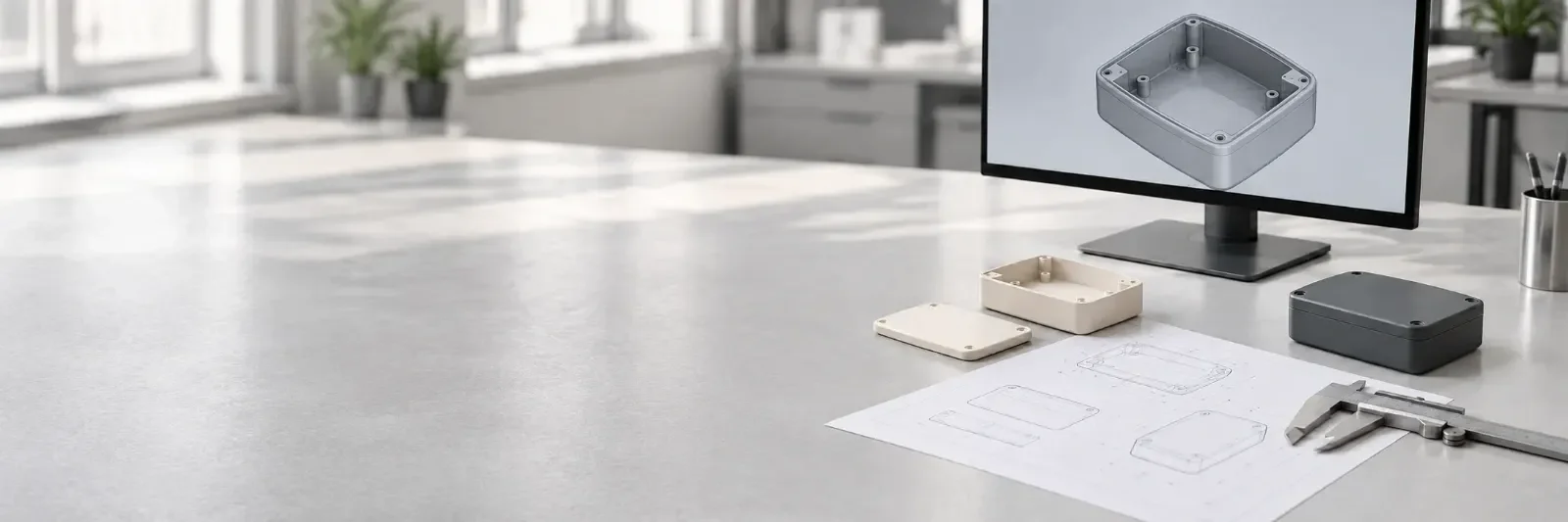
A CAD model on screen beside prototype enclosures, drawings and a caliper on a workbench.
The supplier's email is short: Please send the full CAD package so we can quote. They may need the drawings to price tooling. You still have a decision before you reply: classify what you are disclosing, check the filing position, and identify the contract terms that must exist before disclosure.
That order is the practical core of design protection in China. Inventory the material. File what can be filed. Put a China NNN and a manufacturing agreement in place with the legal entity receiving the files. Restrict access. Keep a dated handoff record. This reduces risk. It does not create blanket protection.
This article covers visible product appearance, artwork, design files and molds. It does not cover formulations or recipes. It is practical risk-control guidance, not legal advice. Legal descriptions here come from published law-firm and academic commentary rather than primary Chinese statutory text. Confirm current law and the filing sequence with China counsel before the first supplier package goes out.
Start with an inventory, not an NDA
Before drafting anything, list each item separately: visible shape, pattern or colour; artwork and packaging graphics; CAD, STP, drawings and renders; prototypes and samples; BOM and specifications; the mold brief; and hidden technical information such as tolerances or internal geometry.
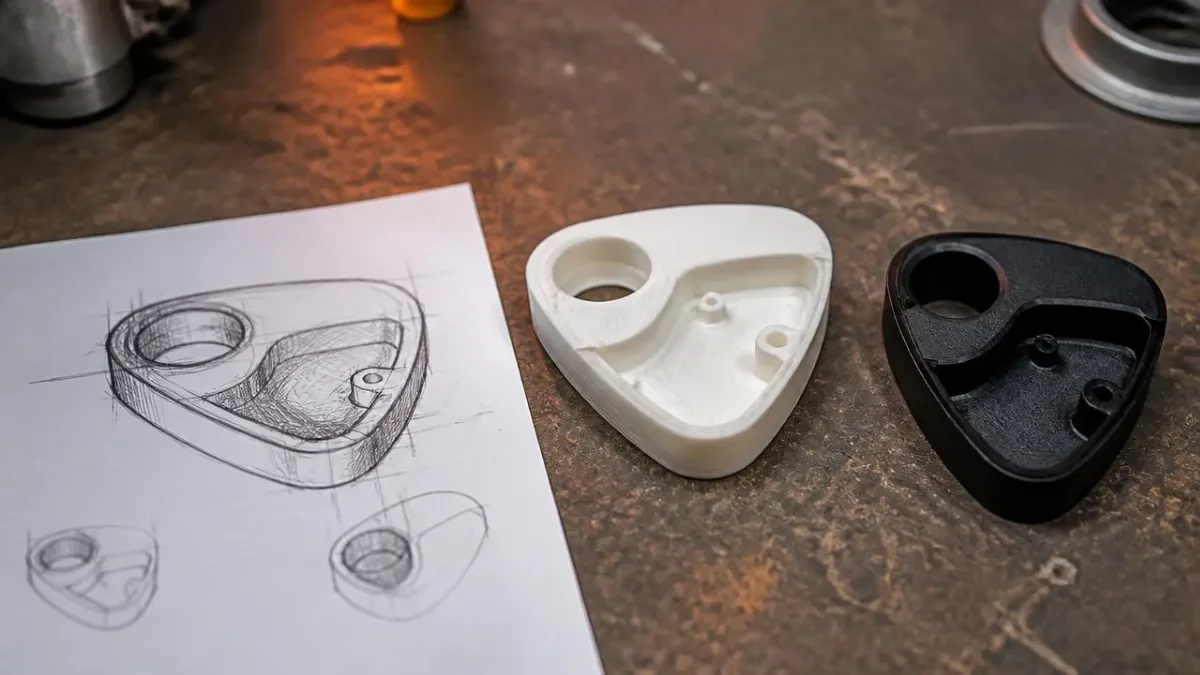
A printed drawing sheet and prototype samples are two distinct items to list before sharing a design package.
A scholarly comparison of design patents and copyright describes several routes in China: trademark, trade dress, design patent, copyright and the Anti-Unfair Competition Law. Match the route to what is actually at risk. The file label does not decide that.
| Route | What it can cover | Main limits |
|---|---|---|
| Chinese design patent | Shape, pattern, colour or a combination; ornamental surface features such as textile patterns, bottle labels or wrapping paper; whole or part of a product; up to 15 years | Must be novel, aesthetically appealing and fit for industrial application. Function and technical effect are not the test. Drawings define the legal scope, so a feature not clearly shown is not protected. Formal examination before grant means validity can be challenged later; a UK law firm's design guide notes that a CNIPA patent right evaluation report may be used in enforcement. |
| Copyright | Original artistic elements such as illustrations, labels and graphic designs. It arises without registration, though registration helps in disputes. | Coverage of works of applied art is contested. The scholarly article says the Copyright Law does not list works of applied art and courts have treated them as works of fine art. A YCIP design guide asserts protection, so treat coverage as unsettled, not a guaranteed fallback. Courts may ask for originality, reproducibility and a minimum artistic or aesthetic level, and rights holders have been refused protection where the design was held not artistic enough. Copyright infringement reaches copying and distribution but not offering for sale and importation, while design-patent infringement reaches manufacturing, offering for sale, selling and importing. |
| Technical trade secret | Tolerances, internal cavity layouts, process ratios and parameter sets. | Requires proof that the information is not publicly known, has commercial value because it is not known, and was subject to reasonable confidentiality measures. Partly visible designs and ideas that combine public and non-public elements are hard to prove as trade secrets. |
A Rouse analysis of a Suzhou judgment reports that a complete combination of dimensions, tolerances and internal layouts remained a protected technical secret after the product had been sold, because simple observation or measurement did not reveal the full set. The same analysis describes the practical split: patent protection for features exposed on launch and easy to reverse engineer; trade-secret protection for know-how that stays inside the factory and the buyer's engineering file. The Suzhou court accepted dated technical drawings marked with ownership information, signed employee confidentiality agreements, declarations and third-party confidentiality clauses as reasonable confidentiality measures. Internal email records showing that an employee received complete 3D model files were used to prove access to the full set.
3D trademarks and the Anti-Unfair Competition Law are residual routes. A 3D trademark protects a packaging shape that customers recognise as coming from the brand, but registration requires acquired distinctiveness built through extensive use. The Anti-Unfair Competition Law can provide residual protection where a product design has achieved well-known status. Neither is a default protection for a new design.
File before the first supplier package goes out
Novelty and prior design are judged at the China filing date against anything public in China or abroad. A sale, advertisement, listing or other public disclosure before filing can invalidate the design. China is first-to-file: a supplier, a supplier employee or an unrelated party who files first can hold the right. A filing sequence guide puts the practical rule plainly: freeze the industrial design and file the Chinese design application before the first supplier package goes out.
A foreign first filing can support a six-month Paris priority claim. The WIPO summary of Chinese design practice describes a separate six-month domestic priority available after an earlier Chinese design filing. In either route, the drawings in the later application must not differ materially from the original filing, or the priority claim may fail and the effective date may move to the later filing date.
The Article 24 grace period is not a filing plan. One Chinese patent firm reads Article 24 as making the grace period unavailable for design applications, while a design-focused guide describes an expanded six-month grace period under Article 24. The patent firm's explainer and the design guide do not agree. Practitioners advise filing before disclosure rather than relying on the exception. Do not send the package on the assumption that a later filing will be rescued.
Copyright has no equivalent pre-disclosure deadline because protection subsists on creation. A Copyright Registration Certificate from the Copyright Protection Centre of China is voluntary, but a CPCC registration guide describes it as the evidence courts, China Customs and platforms such as Alibaba, Tmall and JD.com expect. General works take about 25 working days after acceptance; a foreign applicant should budget six to ten weeks end to end, with most delay in notarisation or apostille rather than originality examination. The certificate is issued without an originality examination, so keep dated design drawings, source files and commissioning or assignment records. The certificate cannot replace that record. Customs recordation, which allows officials to detain infringing goods at the port, is unavailable without a Chinese registration.
Published estimates of design-patent processing time vary. The point of the sequence is to file early, not to promise a grant date.
Use a China NNN, not a US-style NDA
A US-style NDA in English and governed by US law is poorly placed to bind a Chinese counterparty whose assets are in China. It usually focuses on confidentiality and does not stop the factory using the files, modifying the design, producing the product or listing it. A Legal 500 analysis makes the enforcement point blunt: a US judgment against a Chinese factory is usually worth little if everything the factory owns is in China. A contract that cannot be enforced quickly in China may give comfort but not protection.
A China NNN adds non-use, network-wide non-disclosure and non-circumvention. The non-use clause should bar use of designs, concepts, prototypes, specifications and business information to compete with the buyer. Non-disclosure should cover affiliates, subcontractors, related entities and group companies, with the contracting party responsible for misuse inside that network. Non-circumvention should stop the Chinese side from using the relationship, information, market access, opportunity or customer contacts the buyer created to cut the buyer out. In commercial practice, non-circumvention often matters most.

A China NNN puts non-use, network-wide non-disclosure and non-circumvention in writing before design files are shared.
A proper China NNN should define the protected information and prohibited conduct clearly, and should usually be written in Chinese, governed by Chinese law and enforceable in a Chinese court or an agreed China or Hong Kong arbitration forum. A supplier-copying guide by Kelly Zhang names CIETAC, SCIA and HKIAC as practical arbitration options. Where a contract has Chinese and English versions, a mold contract guide states that the Chinese text controls.
Trade-secret law requires proof that the information is not publicly known, has commercial value because it is not known, and was subject to reasonable confidentiality measures. That helps with genuine secrets but does not cover every commercially valuable design disclosure. China's new trade-secret regulation does not replace an NNN agreement. It addresses trade secrets and administrative enforcement, not contractual non-use, network disclosure and circumvention.
A liquidated-damages clause can create leverage, but do not copy a damages figure from a template. Calibrate it with China counsel. Cheap NNN templates can be worse than useless because they create an illusion of protection, may disclose too much, or use the wrong legal structure.
Put file ownership in the manufacturing agreement
The NNN protects early disclosure. The manufacturing agreement governs the production-stage relationship. A China IP Gateway manufacturing guide says the agreement should expressly state who owns technical drawings, CAD and STP files, design files, renders, prototypes, samples and engineering records. If the buyer owns them, say so; do not rely on payment or possession to imply it.
Specify when files must be delivered and in which native formats and software versions. Delivery should not be conditional on the buyer placing future production. Bar use of the files for other customers, products or purposes, and bar transfer to affiliates, subcontractors or related parties. Bar the factory and its affiliates from filing patents, designs, trademarks or other IP based on the buyer's files or products. Require return or certified destruction on termination, supplier change or request.
If the buyer owns DFM improvements, say that explicitly and give the factory only a manufacturing licence to use the designs for the buyer's product. A contract-manufacturing guide by Komaspec puts the usual position this way: in most contract-manufacturing arrangements, the customer owns the designs including DFM improvements, drawings, BOM and tooling, and the manufacturer has only a licence to make the product. That position should be written, not assumed.
Access controls should match the clauses. Ask who can open the full drawing set and which sub-suppliers receive which files. A manufacturing agreement checklist by Kelly Zhang notes that the Civil Code's contractor confidentiality and no-copy duty is described as lacking financial teeth unless backed by contractual damages and clear remedies. Collaborative joint development should sit in a separate development agreement with distinct IP allocation terms.
Treat molds and tooling as a separate asset record
A paid tooling invoice is not a design-ownership document. Tooling payment and design-patent ownership are separate questions in China. Before files leave, separate CAD and mold design files from the physical tool, and make the manufacturing agreement state who owns the files. Then list every physical item and file separately: mold base, cavity and core inserts, jigs, fixtures, CAD data, drawings, spare parts and last-shot samples. A mold ownership guide notes that a quote often covers only the base, so the schedule should state the buy-out price and record a unique mold number on the tool.
A tooling schedule can carry mold number, part name and number, cavity count, steel grade, mold base size, weight, runner type, completion date, price paid and photos. Use those fields as identifiers in the handoff record. The design-protection fields are the mold design files, the approved revision and the last-shot samples. State that the customer owns each listed tool from the final tooling payment and that the factory holds it only as custodian.
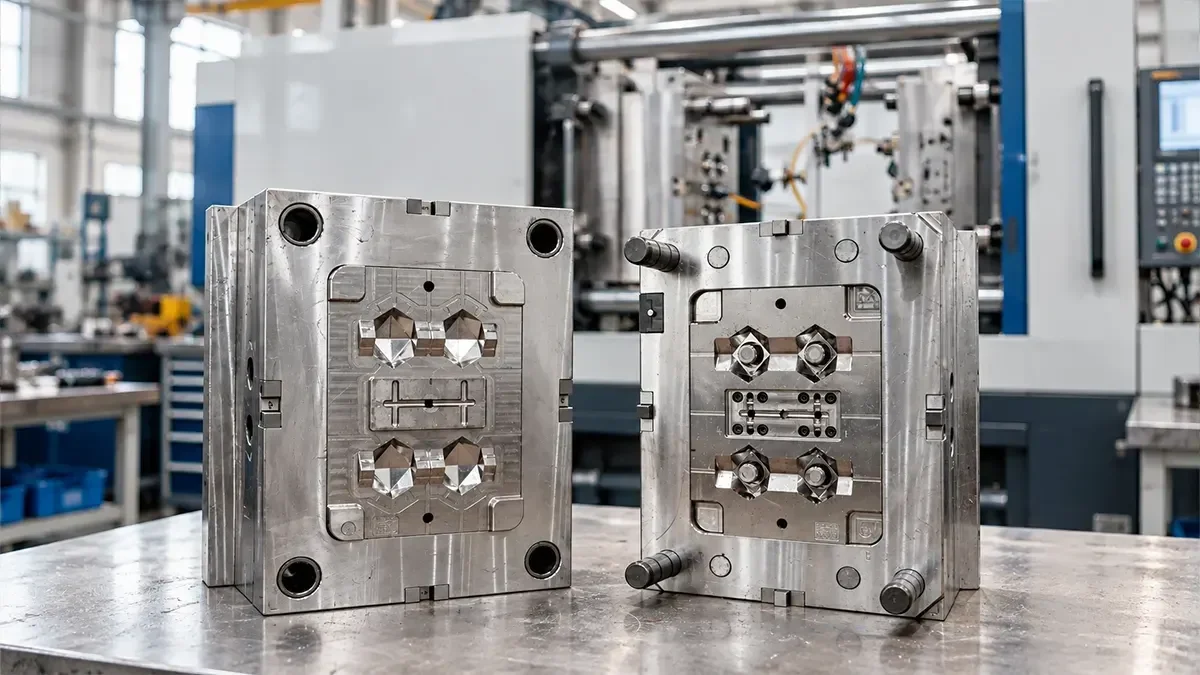
Steel injection mold halves on a factory bench — the physical tool that a tooling schedule would record separately from the design files.
The permitted-use clause should tie the mold and files to the buyer's orders and expressly bar use for other customers, affiliates, subcontractors or related products. Treat that as access control: name who may open the design files for those orders, and require written approval before an affiliate or subcontractor receives them. Give the buyer a contractual right to request return or transfer at any time, including when switching suppliers or ending the relationship.
An unpaid production invoice should not become leverage over the files or the mold. Add a no-lien and no set-off clause covering any claim, including an unpaid production invoice, with money disputes settled separately; confirm how the clause will be enforced with China counsel. One mold agreement guide describes the Civil Code Article 228 possession-on-behalf arrangement and the Article 449 no-lien agreement. A separate law-firm analysis of mold disputes warns that no single statute resolves every mold dispute, so the contract, payment record, transaction structure, mold identity, transfer point and basis of possession all matter.
Release should work as part of the handoff record. On written notice, the factory should hand over molds within a fixed number of days, packed for export, with drawings, spare parts and last-shot samples. The notice should name the approved revision and native file formats, so the physical handoff and the design-file record match. Bar copies or retention of design data, and keep a signed tooling register. Engraving the buyer's name and a unique ID supports matching and receipt; marking and a signed register do not decide title by themselves. The ownership and return clauses must stand on their own.
Write the consequence of non-return as liquidated damages tied to replacement cost, production delay, transfer expense and other provable loss. These clauses are not self-executing: their effect depends on the contract language, the facts and the forum. Do not assume a clause will override a disputed invoice or lien without advice.
Keep a dated handoff record
Before disclosing the material, agree confidentiality and permitted use. Then record what was shared, with which legal entity, on what date and at which revision. A factory handoff guide recommends tying the handoff to an identified approved product revision and reconciling that revision with the BOM, specifications and reference samples. Record any approved deviation and whether it carries forward.
Name the required native file formats and software versions. Keep timestamped originals such as CAD, STP, sketches and renders. A drawing PDF and an editable design file serve different purposes and should not be treated as interchangeable.
Use separate records for release, receipt and production acceptance. Agree what a receiver's signature establishes, so that acknowledging delivery is not mistaken for production approval. Keep an exception log open until missing files, repairs and failed checks have a documented outcome. The record should show what design files were shared, with whom and when, and confirm the NNN is with the entity that did the copying, not merely a trading intermediary.
This is practical risk control, not a legal safe harbour. Treat timestamps, acknowledgements and retention as operational evidence; confirm any legal retention, notarisation or evidentiary requirement with China counsel.
Handle commissions and modifications on a chain-of-title basis
For commissioned artwork, the contract determines ownership. Article 19 of the Copyright Law leaves ownership to the parties' agreement, and a commissioned artwork checklist explains that without a clear provision copyright belongs to the commissioned party. A written assignment is required to transfer specified economic rights, and rights not expressly transferred are reserved. Keep assignment, licence and authority to enforce distinct.
The grant should identify the work and version, the permitted uses, territory, duration, users, group companies, manufacturers, distributors and any sublicensing authority. A promise to deliver editable files does not itself transfer every right needed for reproduction, adaptation, online distribution or enforcement. A packaging mock-up can combine artwork, product information, a logo and a functional dieline, and each element may require a different rights or evidence analysis.
Employee and agency creations need a documented chain of title. The China IP Pro ownership guide notes that under Article 18 an employee's task-related creation does not automatically make the employer the copyright owner. For an agency commission, obtain documents showing the agency's authority to make the promised grant; a warranty gives contractual recourse but does not itself prove that an upstream creator transferred the right.
Copyright protects original expression, not a theme, style or general commercial idea. If the buyer is to own factory-suggested DFM improvements, that must be agreed; otherwise ownership of modifications may remain unclear. This article does not include specimen assignment wording, so a China lawyer should draft the operative Chinese clause. Copyright registration is preliminary evidence; it does not repair a missing transfer of rights.
A pre-disclosure checklist before you send anything
- Classify the package. Visible appearance, artwork, CAD and drawings, prototypes and molds, or hidden technical information. Formulations and recipes are not covered here.
- Register first. File the Chinese design application and assemble the CPCC and dated source record where copyright elements matter. Do not rely on an NDA or an uncertain grace period to fix a late filing.
- Contract with the right legal entity. Confirm whether the counterparty is the factory, a trading company or an agent, and make the NNN bind the entity that will actually receive the files.
- Add manufacturing terms. File ownership, no reuse, no IP filing, return or destruction, a mold asset schedule, custody, no lien, release and damages.
- Restrict access and record the handoff. Record recipient, date, revision and format. If possession, ownership or third-party rights are unclear, pause and obtain project-specific China advice rather than treating a paid invoice as the whole answer.
Back to the supplier email
Before you reply, have China counsel review the contract and filing sequence. Then send the package only if the inventory, filing position, counterparty and handoff record line up. If any one of them is unclear, pause before you send the package.