A steering wheel armature, a lawn mower housing and a wheelchair frame have quite different jobs. During our team's visit to the Lanxi Magnesium Materials Research Institute, these were among the exhibits that made magnesium alloys easier to understand. The material appeared in products people lift, carry, push or move, as well as components used in larger machines.
For a buyer exploring magnesium alloy components in China, the appeal starts with weight. Before ordering, you also need to establish what the component does, how it will be made, which surfaces and joints need protection, and how the manufacturer will check production parts against the agreed requirements. Our visit provided a starting point for those questions.
What we saw at the Lanxi institute
The institute was jointly established by the local government and Chongqing University. In its exhibition hall, we saw aerospace castings, smart lawn mower housings, fan blades, hardware components, automotive bumper components and steering wheel armatures. Other displays covered luggage, outdoor products, motorcycles, e-bikes and medical wheelchair frames.
A buyer developing a portable product might be interested in handling comfort, while a mobility product team is reviewing a frame. A manufacturer working on a housing may need a metal structure with several mounting features. Each starts with a different requirement, even when the same material family enters the discussion.
The exhibits showed application possibilities. They did not establish the alloy grade, manufacturing route, certification or production status of a component for a new buyer's project. Those details need checking against the actual drawing and intended use. We also distinguish an external wheelchair frame from an implant: they are different products with different requirements.
Why magnesium alloys attract lightweight product designers
Magnesium is one of the lightest metallic structural materials. The International Magnesium Association's material overview explains its low density and describes both cast and wrought magnesium products. In practice, buyers normally specify an alloy and a manufacturing condition, rather than ordering an unspecified piece of pure magnesium.
Low density gives engineers room to reduce component mass. Strength relative to weight can also make an appropriate magnesium alloy worth evaluating. However, the finished result depends on the grade, processing and geometry. A supplier needs enough information to assess the proposed part, including the load it carries and how it connects to the rest of the product.
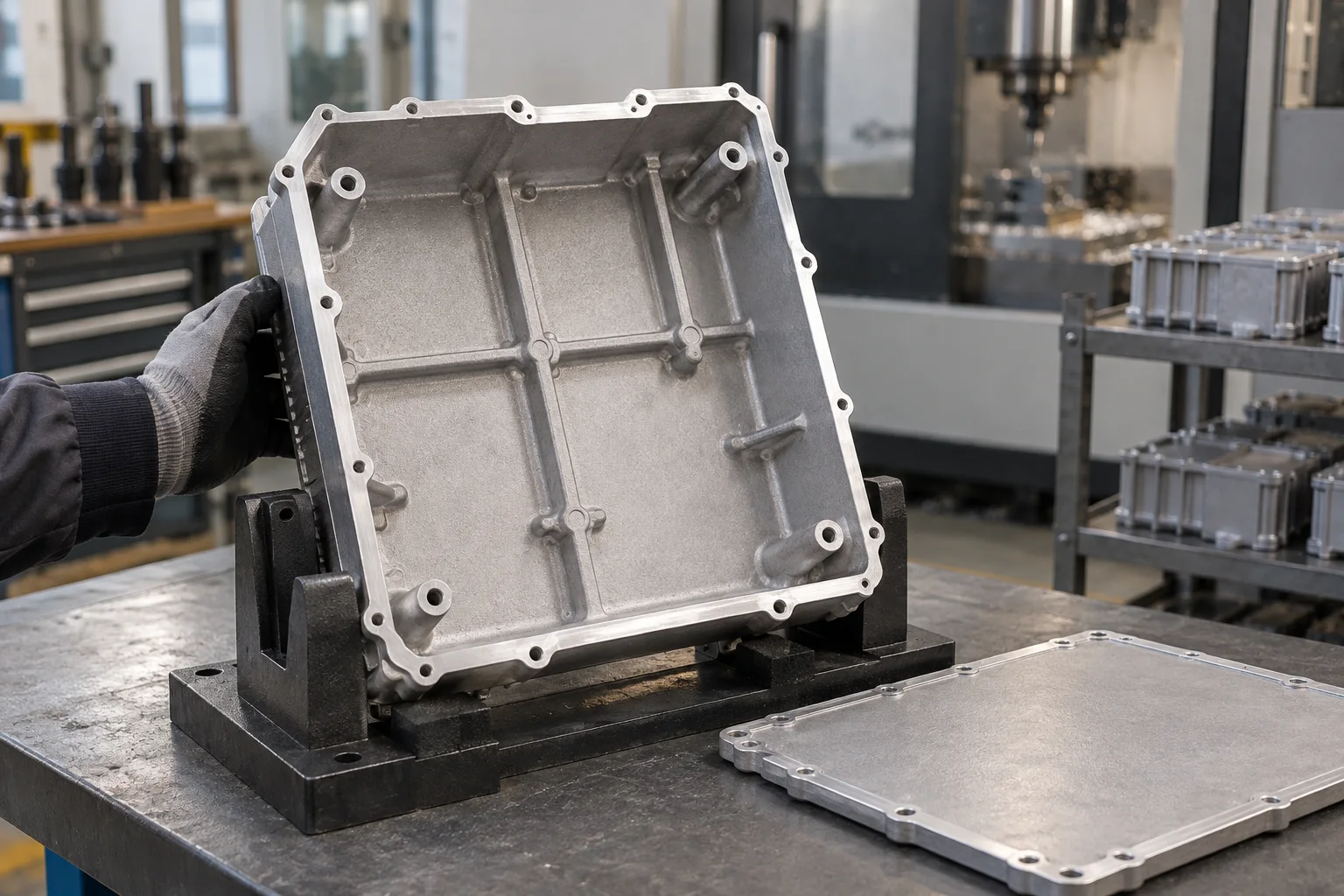
Consider a housing that supports a motor or electronic assembly. Its design has to accommodate fixing points and the space inside. Changing the metal may require changes to ribs, wall sections or local support around a fastener. The useful comparison is the finished assembly that meets the same requirements, including its inserts, coating and fittings.
Ask the engineering team to state what a weight reduction would achieve. Is there a maximum component mass? Does the user carry the complete product? Is the part on equipment that moves repeatedly? A written objective makes a proposed material change easier to judge, without promising that every magnesium design will improve efficiency or battery range.
Different applications need different engineering questions
For luggage and outdoor products, discuss how the part will be handled, stored and exposed to the environment. A frame or bracket may have to tolerate repeated use, while a visible surface also needs an agreed appearance. The application name alone does not tell a supplier what a successful part looks like.
For lawn mower housings, fan blades and other equipment components, the buyer should identify the relevant operating conditions. Depending on the function, the engineering review may need to address vibration, impact, temperature, balance or contact with other materials. Specify which requirements apply instead of requesting every possible test without a purpose.
Automotive components, aerospace castings and mobility frames require particular care over the route to approval. A similar exhibit is a conversation starter; the buyer still needs the relevant engineering validation and any required market or customer approvals. A general material report cannot establish the suitability of a steering wheel armature or a wheelchair frame for its intended duty.
Include a usable drawing, an explanation of the part's function and the target market in the first sourcing conversation. Where the design is incomplete, list the decisions still open. Our guide to writing clear product specifications for suppliers explains how to separate fixed requirements from questions a manufacturer needs to answer.
Match the alloy to a manufacturing route
Magnesium alloy components can take different forms. The IMA's design resources treat alloy selection, processing and finishing as connected decisions. A cast housing and a component developed from wrought material should not be compared solely by the description "magnesium alloy."
When reviewing a supplier proposal, ask which grade and process it includes, what machining follows forming, and which operations another company will perform. Request an explanation of any suggested drawing changes before approving them. A simpler shape may be easier to produce, but its interfaces and function still need the buyer's engineering approval.
Tooling is another commercial decision. Separate tooling and development charges from the part price, then identify what is included in each trial. Clarify who owns the tool, where it will be stored and how changes will be authorized. A low unit quotation can be difficult to evaluate if finishing, inserts or final machining are left outside its scope.
Our visit also drew attention to the step between research and regular production. The institute's official introduction describes testing, technical development and technology transfer, including pilot-scale industrial development through its associated company. On October 10, 2026, its semi-solid die-casting pilot-platform notice reported inclusion in a municipal proposed-recognition list. The notice discusses process verification, trial samples and small-batch work. For buyers, those are stages to plan for; the notice is not proof that a particular part is ready for volume supply.
Discuss corrosion protection together with the assembly
Surface appearance is only one part of a finishing specification. ASM International's overview of magnesium corrosion resistance identifies the environment, surface condition and assembly practice among the factors to consider. Its scope includes galvanic corrosion and protective treatments.
Tell the supplier which other materials touch the component and where moisture or cleaning products may reach it. Ask the responsible engineer to review the fastening and protection approach. A coating description needs to fit the completed assembly, including machined areas, edges and joints.
Agree on the required finish and the checks that will establish acceptance. If a corrosion test is specified, record the method, exposure conditions and acceptance criteria. A statement such as "passed salt spray" gives too little information to compare two proposals or predict performance in a particular use environment.
The same discipline applies to cosmetic samples. Keep an approved reference for the agreed surface appearance, while retaining the technical specification for performance. A visually attractive sample cannot show the alloy composition or confirm every internal feature of a casting.
From a promising sample to a repeatable order
Build a review sequence around the risks of the actual component. An early sample may help check fit or assembly access. A production-intent trial needs to establish more: the proposed material, process, tooling and finishing route should be identified, and departures from the intended production method should be disclosed.
Agree which records the manufacturer must provide. Depending on the part, these may include material traceability, reports for critical dimensions, finish checks and agreed functional testing. Define who approves the results, how nonconforming parts will be handled, and what changes require another review.
Supplier capability checks and product checks answer different questions. A facility review can examine the proposed process and subcontracting arrangements; inspecting a batch establishes whether the selected characteristics meet the agreed criteria. Our factory audit and product inspection comparison explains that distinction. Confirm the supplier's scope before treating a sample approval as permission to start every subsequent stage.
For repeat orders, keep the drawing revision, approved sample identity and production specification linked to the purchase order. Ask for advance notice of a material, process or finishing subcontractor change. That record gives both sides a reference when a later batch differs from the first approved parts.
What to send in a magnesium component inquiry
A useful first inquiry can be concise. For example, a buyer considering a lightweight equipment housing could send the following information. This is an inquiry example, not a specification for a component we tested.
- A drawing or model with a revision number, overall envelope and the interfaces that must remain fixed.
- The component's function, target mass if defined, operating conditions and the market where the finished product will be sold.
- The proposed alloy and process, or a clear request for the supplier to propose options for engineering review.
- Critical dimensions, assembly requirements, surface expectations and the mating materials that need consideration.
- Trial quantity and expected production demand, with tooling, machining, finishing and testing quoted separately where appropriate.
- The required sample records, approval responsibilities and the conditions for progressing to a production order.
Ask suppliers to identify assumptions and exclusions in their reply. This helps distinguish a quotation based on the same requirements from a cheaper proposal that leaves development decisions unresolved.
How Surmount can help develop the sourcing brief
In Lanxi, we saw how widely magnesium alloy applications can differ. Following up on a product idea means identifying its manufacturing requirements and deciding how the proposed part will be verified.
Surmount Sourcing is based in China and supports supplier matching, product development coordination, quality control and worldwide logistics. For a magnesium alloy project, the starting point is to understand the component and identify appropriate manufacturing or technical resources. The visit does not imply an exclusive partnership with the institute or an endorsement of an individual supplier.
If you are exploring custom magnesium alloy components in China, send your drawing and project requirements. Include the application and the questions still open, so the discussion can move toward a defined scope for supplier evaluation and sampling.