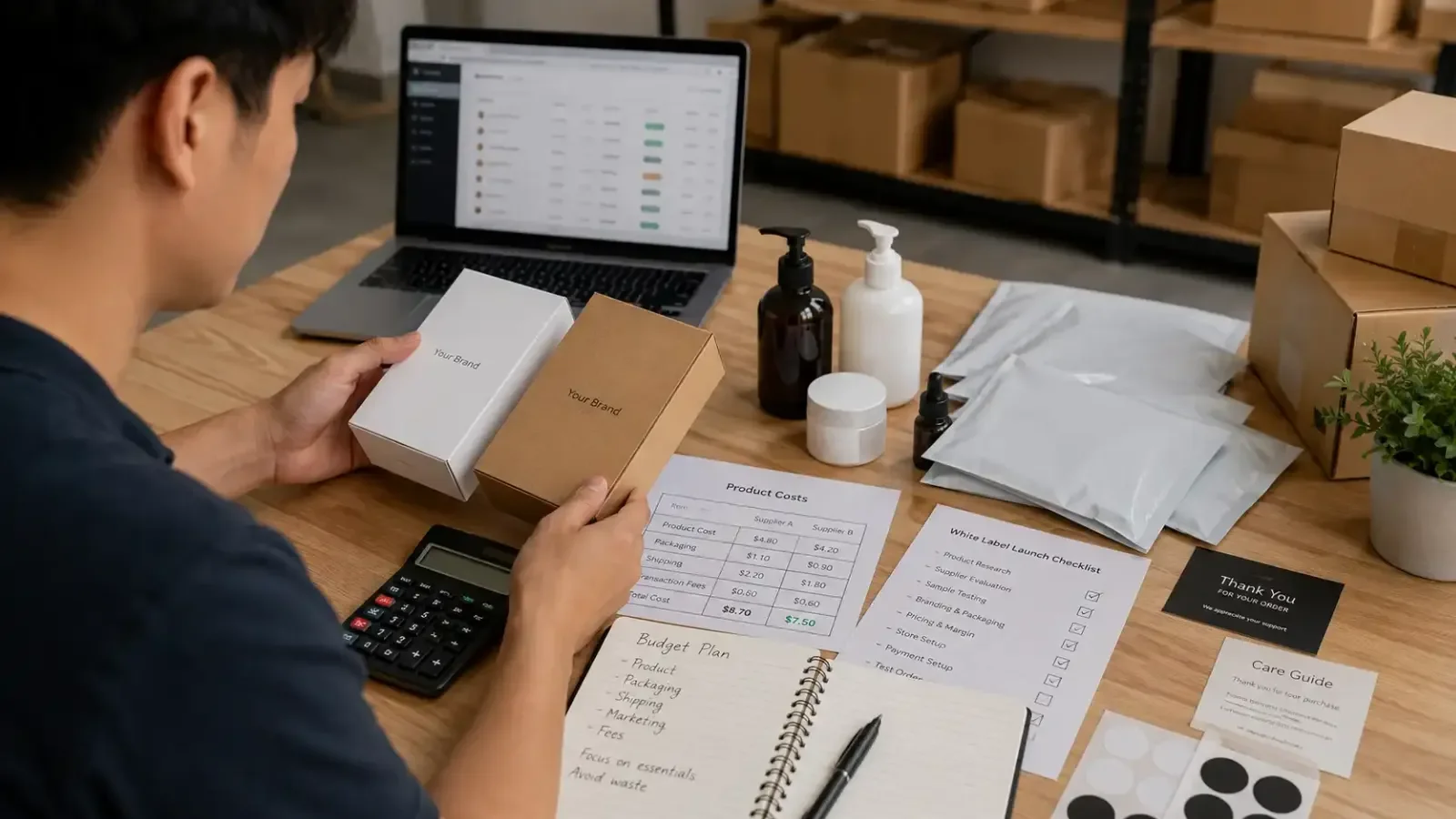
Generic packaging samples and cost paperwork on a sourcing desk. Before any files are shared, confirm who owns the China trademark and what is filed in your own name.
A supplier emails: "We can register your trademark in China to protect our cooperation." It sounds helpful. It may also be the moment someone else decides who owns your brand in China. Before you send another packaging file, approve a sample or pay a deposit, settle one question: who will own the China right, and what are you filing in your own name?
China generally runs a first-to-file, registration-based system. An overseas registration does not secure mainland China, and a pending Chinese application is not yet an enforceable right. The sequence below is for private-label and custom-packaging projects: define the assets and their owner, choose classes, put supplier obligations in writing, keep dated evidence, and watch the register. Treat it as preparation; it does not replace China IP advice.
When China exposure begins, and why an overseas registration does not cover it
A supplier's offer to register the mark is a reason to check whether your own application is already in, before you discuss who will file.

Review your own filing paperwork before a supplier offers to register the mark.
China applies first-to-file, with first-to-use only as the same-day tie-break. The exclusive right generally comes through registration, not prior use. CNIPA also says evidence of use or a statement of intent to use is generally not required at filing, so waiting builds no stronger filing position.
An overseas trademark does not travel. A US, EU, UK, Canadian or Australian registration gives no mainland China rights, and overseas reputation does not automatically become a Chinese right. If an earlier third-party filing blocks you, investigate the mark, classes, goods and status before assuming the other applicant controls every use of the name.
Exposure can start before a purchase order. A trade-show appearance, Alibaba or 1688 listing, product announcement, crowdfunding page, packaging mockup or email to a prospective supplier can reveal the brand. File before China-facing activity where you can. Filing early does not promise that every risk disappears.
Export-only production is not a clean exemption. In HONDAKIT, China's Supreme People's Court held that affixing a mark similar to a China-registered mark on OEM goods can infringe even when the goods are intended solely for export. A brand without its own China registration can therefore face a claim from a prior registrant, lose infringement claims of its own, and be sued by squatters.
The prior-use and bad-faith safety net is narrow. It generally requires use in China before the conflicting filing and recognised reputation among relevant Chinese consumers, not merely international fame. Do not budget around it as a substitute for filing.
Decide what you are registering and who in your company owns it
Private-label production can create separable brand assets: the word mark, logo, Chinese name, product and packaging artwork, design files. Each needs a place in the asset register and a legal owner. The product itself may also be customised through materials, formulation, design or packaging structure, which is why the register can grow beyond a logo printed on finished goods.
Start with the principal word mark. Separate word and design registrations give more flexibility than one combined name-and-logo filing, because a word registration does not protect the artwork around the name. If a Chinese name, transliteration or nickname will appear in customer-facing use, treat it as a separate asset to clear and file in the relevant classes. For an export-only manufacturer with no Chinese-language customer use, a Chinese-character filing may be unnecessary, but confirm that against the actual go-to-market plan rather than accepting a generic rule.
Decide which legal entity in the group owns the mark, whether that is the operating company, the parent or an IP holding company, before filing. The factory, sourcing agent or distributor should not own your principal mark merely because that makes the paperwork convenient.
A foreign owner does not need a Chinese subsidiary to own a Chinese trademark. A foreign applicant without residence or a place of business in China must file through a licensed Chinese agency. The agency files on your behalf; it should own nothing.
Trademark and copyright protect different things. A logo can be original artwork, and a Chinese copyright registration can provide dated evidence of ownership and creation. It does not replace the need to file the logo as a trademark in the classes where it appears.
Before sending a product brief, write a one-page asset register: the exact word mark, logo files, Chinese name to use or exclude, product and packaging items, legal owner, filing agent, and the date each asset will be disclosed. That page lets your China agent and your contract counsel work from the same facts.
Map your actual products to CNIPA classes and subclasses
The class list describes what your registration covers.
Start with the 45-class Nice framework, then check CNIPA's similar-group, or subclass, system and its Similar Goods and Services Distinction Table. Class headings are not a substitute for specific goods and services wording. List every current product and service, then map each item to specific Chinese subclasses across the supply chain, distribution model and customer touchpoints. Cover the groups that correspond to actual or planned business, not every subclass in a class.
Filing in a class does not reserve the whole class. Coverage in one subclass generally does not reach other subclasses, and protection extends only to the exact products or services named in the application.
Class 25 is a practical warning. Underwear, outerwear, footwear, socks, scarves and belts can sit in different subclasses. Registering only "clothing" may not cover shoes or undergarments.
Class depends on function, purpose, composition, material and intended use, not the product name alone. Gloves illustrate the point: clothing gloves in Class 25, surgical gloves in Class 10 and household gloves in Class 21. A protective-work-glove company that registered gloves in Class 25 instead of Class 9 had its shipment challenged by a competitor with the correct-goods registration. The filing succeeded; it just missed the products the company needed to protect.
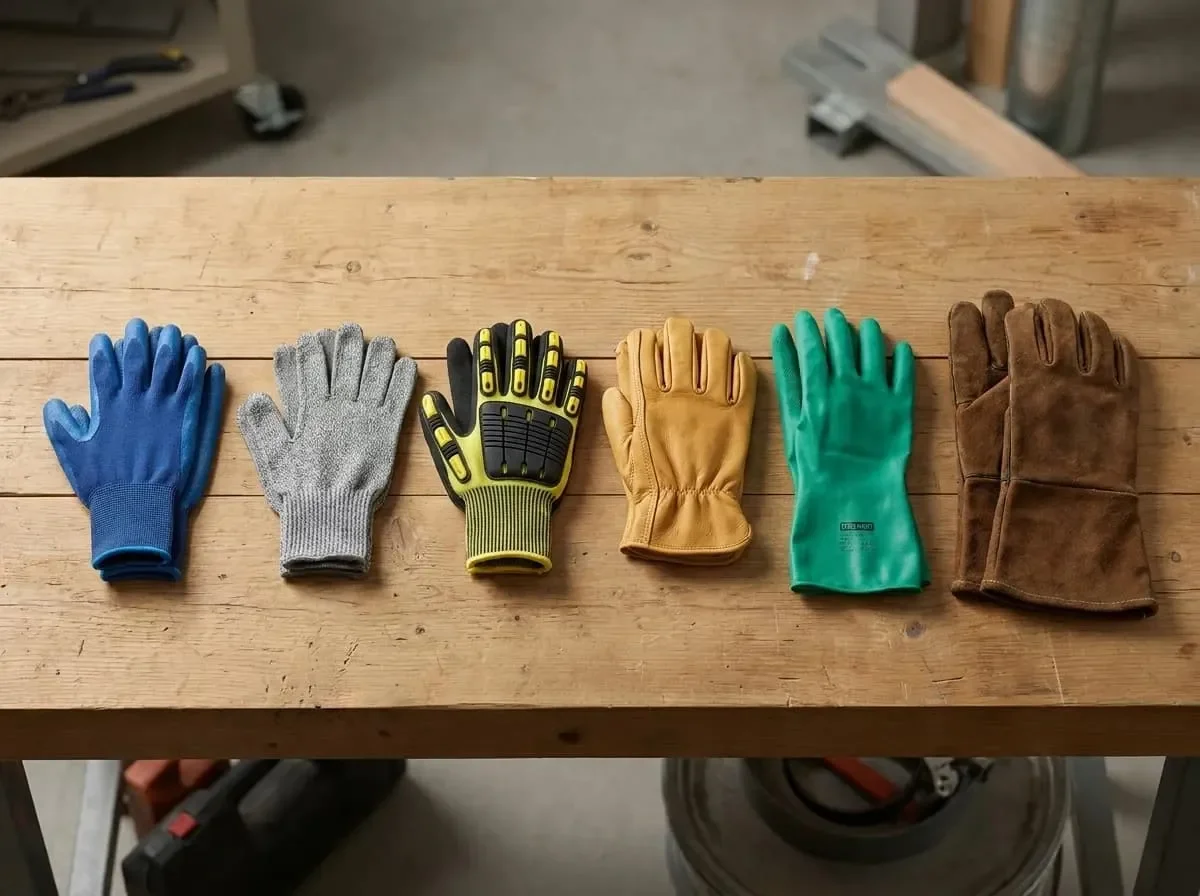
Different glove types built for different uses show why a product's actual function, not just its name, shapes the class and subclass discussion.
Packaging needs a fact-specific decision. Class 16 covers paper, cardboard, printed matter and plastic packaging materials as goods. Class 39 covers packaging and storage as a service. Whether you need Class 16, Class 39, both or neither depends on whether branded packaging is sold as a product or used only for your own goods.
Class 35 covers advertising, business management, business administration and office functions. CNIPA guidance states that selling goods under your own brand is not covered by Class 35. One agency source says e-commerce businesses typically need Class 35 for online retail services. Treat that as commercial guidance rather than a universal rule; your sales and service model decides.
If a Chinese-character mark will be used, file it in the same classes as the English mark. The base application fee covers up to ten goods or services in a class, with an extra fee for additional items. Goods and services generally cannot be expanded or substantively changed after filing. New products or classes require new applications, which lose the earlier priority date.
Check the classification version against the filing date: the current CNIPA table is based on NCL 13-2026, in force from 1 January 2026, while NCL 13-2027 enters into force on 1 January 2027. A Madrid designation is examined under Chinese practice, and CNIPA examiners assign subclasses without consulting the applicant, which can leave key products or services inadequately covered. A direct national filing gives more control over wording.
Similar-group tables are planning tools, not conclusive boundaries. Goods in different subclasses, and sometimes different classes, can still be found similar.
Do not compare filing costs until the filing structure is confirmed. Published agency guidance conflicts on whether a direct national application follows a one-application, one-class rule or can cover multiple classes; ask the filing agent to confirm the route and fee basis.
Any class list is only as good as the product details behind it. Your product category, materials, function, packaging format and sales or service channel decide the specific subclasses and whether Class 35 is relevant, so ask your China agent to verify the current standard items for your own goods.
Put ownership, confidentiality and use limits in writing before production
A trademark registration does not replace a manufacturing, distribution, licensing or NNN agreement. The contract governs what the supplier may do with your mark inside the relationship.
The manufacturer needs limited permission to apply your mark to your goods. That permission should not become a right to sell overruns, supply branded goods to other buyers, register confusingly similar marks, or keep using branded packaging and tooling after the relationship ends. Address subcontractors, control of branded materials and what happens at the end.

Put the terms in writing: who owns the mark, what the supplier may do with it and who may see brand files.
Record any trademark licence with CNIPA. An unrecorded licence remains valid between the parties but cannot be asserted against a good-faith third party.
For direct business with a Chinese manufacturer, use a China-focused NNN agreement with non-disclosure, non-circumvention and non-use clauses. The non-use clause should restrict use to the agreed purpose and bar competing with you or selling your product to competitors. The non-disclosure clause should define who inside the factory group may view or use confidential information, and make the factory liable for disclosure by any group member.
Label shared files and messages "Confidential" so the duty is unmistakable. A refusal to sign an NDA or NNN is a warning sign.
NNN agreements are described as stronger for direct Chinese companies, while NDAs suit sourcing companies or wholesalers based outside China. Choose by counterparty.
An NNN can bar the parties who sign it from misusing or registering your marks, but it reserves nothing at CNIPA and binds no one else. It does not replace your own filing.
Ask China IP counsel to add a specific trademark ownership or assignment clause, an express covenant against filing your mark, and a licence-recordal plan. A useful request to the supplier is:
Before we release final artwork, please confirm in writing: the legal entity that will manufacture, any subcontractors, who may access brand files, the permitted use of our mark, and what happens to branded packaging and tooling at the end of the relationship.
That request asks for disclosure; it is not a contract. A standard NNN template covers confidentiality and non-use. It does not give you trademark-ownership wording or contract remedies, so do not treat a signed NNN as a complete brand-ownership contract.
Build the dated evidence file before you send the brief
Build the evidence file as the design is created, not afterwards. Dated records are more useful than a later explanation of what you think you sent.
Retain dated drafts, design files, briefs and supplier communications so you can prove authorship and the date of creation. Keep dated sketches, mood boards, iterations and CAD or source files. Preserve a version history that shows independent creation and the sequence of development. Use reliable timestamping or deposit to fix the date of creation.
Record the first date the design, logo, packaging artwork or product file was sent to the supplier. Keep a disclosure log covering every file, photo, sample and message disclosed. If a copy later appears, the date you first sent the design matters.
Preserve product links, screenshots, chat records, emails, invoices, samples, shipping records, payment records and design files. Packaging artwork, drawings, product files, photos, manuals and graphic elements may raise copyright issues separate from the word mark.
Identify the supplier's official Chinese legal name, not only its English name, Alibaba shop name or salesperson's WhatsApp name, for contracts, notices or enforcement.
Treat the file as a live project record. It supports an NNN, a copyright or design claim, or a response to a conflicting filing. One file type does not cover every legal theory.
Watch the register and respond before the window closes
A clearance search is a one-off snapshot before filing of marks already on the register. A watch runs after filing and looks for new applications over time. You normally want both.
Watch for identical and similar wording, phonetic equivalents, Chinese transliterations and related classes. A commercial provider may promise daily Gazette review, coverage across all 45 classes and 48-hour alerts. Those are service claims from the provider, so check what you are buying.
Every alert should state the exact calendar date the opposition window closes. A late alert records a missed chance.
During the publication period, any individual or entity may file an opposition with CNIPA. Prior rights holders and interested parties can oppose on relative grounds such as similar marks; any person may oppose on absolute grounds including bad-faith filing. Grounds commonly include similarity to an earlier mark, bad-faith squatting, lack of distinctiveness and misleading or public-interest issues.
An opposition suspends registration. The applicant must answer with counterarguments and evidence by a set deadline; CNIPA then decides. The procedure often takes a year or longer, so an opposition delays the conflict rather than instantly resolving it.
The opposition deadline depends on the publication date, and the law is changing. Under the law in force before the 2026 revision, the opposition period is three months from publication; law-firm commentary on the revision says it drops to two months from 1 January 2027. Transition treatment for applications already published around the change is not settled, so confirm the rule that applies to the publication date you are actually watching rather than working from a generic three- or two-month figure.
After a conflicting mark registers, possible routes include invalidation for bad-faith marks, non-use cancellation, a negotiated transfer or coexistence. Invalidation on relative grounds is generally subject to a five-year window.
A filer with only three to five pirate filings may escape the volume-based bad-faith test. Evidence can still matter: an overview of the filer's business and size, the number of marks filed, a list of copied marks, and reputation evidence such as contracts, invoices, pictures, press releases, orders, packing lists and customs declarations. A reported opposition succeeded on Article 7 good-faith grounds even though the brand owner held no prior registration and had not used the mark in that specific class. That shows a route, not a prediction for every small-brand case.
Turn it into a one-page action list
Before the next sample round, name the exact word mark, logo and Chinese name. Confirm which legal entity owns them. Ask a China agent to clear and file before disclosure. Send the supplier contract to China IP counsel for ownership, licence and no-registration wording. Start the disclosure log on day one. Assign one person to review watch alerts against the closing date.
Filing first is usually cheaper than trying to reclaim a mark later. If the mark is already blocked, get the current register status and deadline before sending a demand. The next step is a written record and a filing decision.