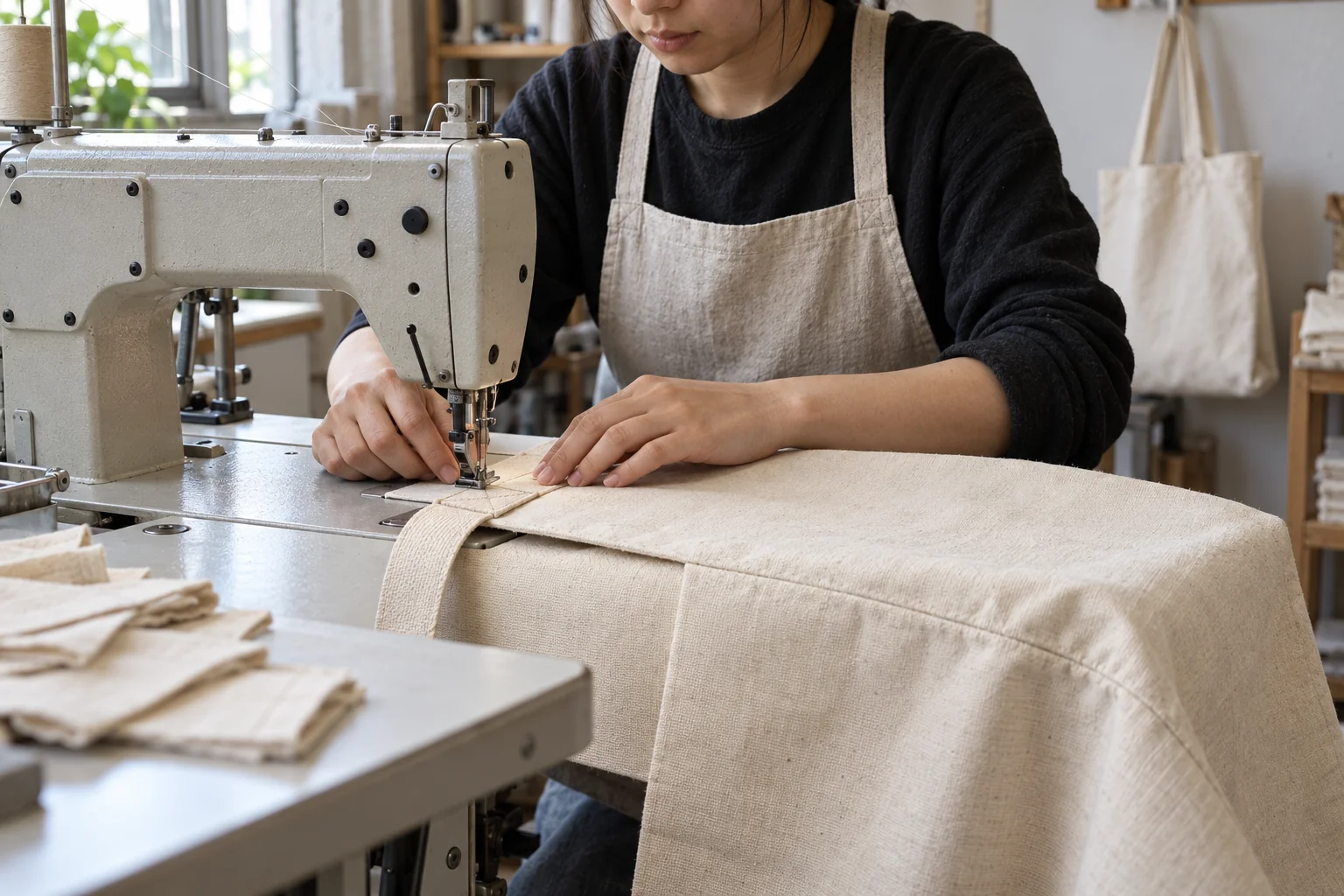
Before ordering custom tote bags from China, agree on what the bag must carry, how the handles are attached, and what should happen after washing. Then ask suppliers to quote the same construction. A heavier fabric or a clean logo photograph cannot answer those questions.
Start with one finished sample and put the intended contents inside. Check whether it carries comfortably, whether the opening is usable, and whether the seams stay sound. Write down what the sample needs to do before discussing bulk production.
For buyers planning an autumn sourcing trip, the 140th Canton Fair International Pavilion schedule lists Phase 3 for October 31 to November 4, 2026, including cases and bags. An exhibition sample can start the conversation, but you still need an agreed production version.
Start with what goes inside the bag
Imagine a bookshop planning a first order of 500 printed totes. This is a hypothetical buying example, not a Surmount customer order. The bag needs to hold several books, be comfortable on a shoulder, and remain usable after the care routine stated on its label.
A flat promotional bag may look similar in a catalogue yet become awkward when filled. A bottom gusset, the extra panel or fold that gives the base depth, can change how the books sit. Longer handles may help a customer wearing a coat, while narrow handles can become uncomfortable under load.
Send the supplier photographs and dimensions of the intended contents. Specify the intended carrying load and discuss how it will be checked. Any carrying-weight claim should be supported by checks on your finished bag, including its stitching and handle attachments.
What does the fabric weight actually tell you?
GSM means grams per square metre. It describes the mass of an area of fabric. It does not describe the weight of a finished bag, and it does not tell you the fibre composition. If a supplier quotes fabric in ounces, ask which area unit is used before comparing it with GSM.
For the bookshop example, ask for swatches with the fibre composition and fabric weight identified. Fold them, look through them against light, and compare their feel. A stiff finish can make a fabric feel substantial without answering how the finished bag will perform after care.
Ask whether the quoted weight applies to the fabric before or after finishing, and agree on the acceptable variation and measurement method. Comparing a finished dyed swatch with an unfinished natural swatch can produce a misleading conclusion.
Words such as canvas, cotton and heavyweight leave room for different constructions. Record composition separately from weave, weight and finish. If the fibre content matters to your label or customer promise, arrange suitable verification; a photograph and a hand-feel comparison cannot establish it.
Look inside the handle attachments
Turn the sample inside out and follow the load from the handles into the body. Look at where each handle ends, how the end is secured, and whether the surrounding fabric puckers or opens when the bag is loaded. A neat outside photograph can hide a different attachment inside.
A rectangle with diagonal stitching is one possible reinforcement. Its presence alone does not establish a carrying capacity. Thread, stitch formation, attachment length and the strength of the fabric around it all affect the result. Ask the factory to propose a construction for the intended use and keep the approved sample as the reference.
Inspect the bottom corners and the ends of seams as well. Loose threads are easy to notice; a skipped stitch or an unfinished fabric edge may need a closer look. Photograph agreed details from both sides so an inspector can compare production bags with something more precise than "strong stitching".
When a measurable performance claim is involved, discuss a suitable test with a laboratory. Intertek's accessory testing service includes handle and fastening strength for bags. That identifies a relevant test category, not a universal load limit or a pass result for your product.
Measure the opening and handle drop separately
A listing that says 38 × 42 cm still leaves questions. Is that the body laid flat? Does it include the handles? Was it measured before washing? Write down the measurement points and the condition of the sample, then agree on tolerances with the supplier.
Handle drop is the distance from the top edge of the bag to the highest inside point of the handle when held upright. It is different from the total length of the strip used to make the handle. Ask for a simple marked photograph to prevent those two measurements being confused.
Put the books into the sample and try the actual carrying position. Check access to a pocket or zip if one is included. A wider body does not automatically solve a narrow opening, especially when a closure reduces the usable space.
Approve the print on the chosen fabric
Ask for a decorated sample made with the selected fabric and print process. A digital mock-up shows placement, but the fabric surface affects how small lettering and solid areas appear. The supplier should explain any changes needed to reproduce your artwork.
Agree on the artwork file, print size and position measured from fixed points. If both sides are printed, specify each side separately. Keep the approved physical sample and identify its revision; screenshots taken under different lighting are poor colour references.
Check the print after the care routine you intend to recommend. Look for cracking, transfer to another surface, and changes in appearance. A quick informal rub can reveal a problem, but it cannot replace a defined colourfastness test where one is needed. Have the test method and acceptance criteria agreed before treating a result as a production requirement.
Decide what the care label is promising
A supplier may describe a tote as washable without saying how. Ask whether that means machine washing, hand washing or spot cleaning, and under which conditions. The same care instructions must make sense for the fabric, thread, decoration and any lining.
For the bookshop sample, record the body dimensions and handle drop before care, follow the proposed routine, and measure again under the same agreed conditions. Also check whether the handles twist, the print changes, or the bag becomes awkward to use. Use the result to decide whether to change the construction or the intended care claim.
Testing one prototype does not establish the behaviour of every future batch. Keep enough samples for development and comparison, and agree on what production checks are needed. Claims about recycled content or environmental benefits need their own evidence; the natural colour of a fabric proves neither.
Separate the quote into choices you can compare
Send the same specification to each shortlisted supplier and ask them to identify departures. If one quote uses stock fabric and another requires a custom dye lot, their minimum quantities and preparation work may differ. Ask which materials are already available and which must be ordered for your job.
Have the supplier distinguish sample development, artwork setup and bulk unit cost. Confirm whether the minimum order quantity applies to the whole order, each colour or each design. Our guide to MOQ by style and colour explains that question in more detail.
Keep optional changes separate: adding a lining, a pocket or a closure changes both the product and the work needed to make it. Ask for the effect on price and timing before approving each change. If you remove a lining to reduce cost, for example, check whether the exposed seams and fabric still suit the intended use.
A supplier message you can adapt
Attach a sketch, artwork and photographs of the contents. Replace the example quantity and fill in the missing dimensions and carrying requirements before sending this request:
We are developing a printed canvas tote for a bookshop. Please quote 500 units using the attached drawing. Confirm fibre composition, fabric weight and finish, body dimensions, gusset depth and handle drop, with your proposed tolerances.
Please show the handle attachment and internal seam construction. Quote the selected print process and identify any artwork limitations. We need a finished sample for carrying and care checks before approving bulk production.
List sample and setup charges separately from unit cost. State the MOQ for each colour or design, what materials are in stock, and when the production schedule starts. Please identify any difference between your quote and our drawing.
The reply should explain the proposed construction and identify anything the supplier has assumed. If the supplier sends only a lower unit price, return to the missing details before comparing offers. You can use our sample evaluation guide to organise the next round.
What should be checked before the bulk order leaves?
Give the inspection team the approved sample, current drawing and the agreed checks. Include the dimensions, handle attachment photographs, print reference and any specified test method. Decide which defects affect use and which are appearance issues, so decisions do not depend on an inspector guessing your priorities.
Ask how production samples will be selected across the order, including different colours or material lots where relevant. A photograph of one good bag cannot show consistency across 500 units. Record quantities and packing arrangements as well, especially when bags for different designs must remain separate.
Keep a reference from the first production batch for a later reorder. When a supplier proposes a substitute fabric or a changed handle construction, compare it with that reference before accepting it. A familiar product name does not establish that the next batch is the same.
Surmount Sourcing can help coordinate supplier matching, sample development and production checks in China. To discuss a tote bag project, send the intended contents, a sketch, quantity, sales market and target delivery date. Those details give the supplier a practical starting point for a comparable quote.