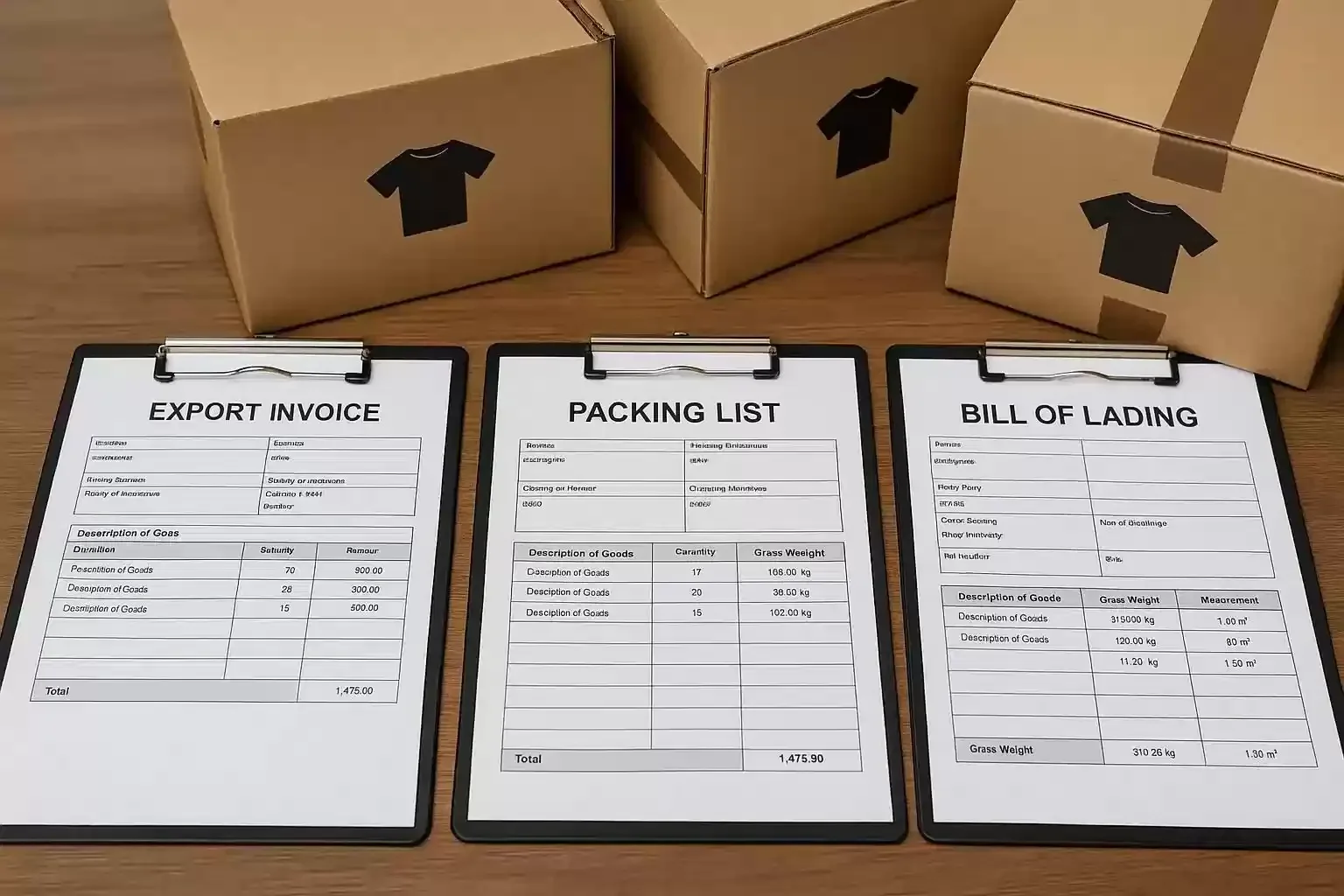
Check the draft against the actual packing list while the carrier can still amend it. After loading, compare the issued transport document with the approved draft. Track any change to carton count or consignee through to the broker’s copy.
Start with the core set and the conditional add-ons
For a typical container shipment entering the US by sea, eight Importer Security Filing data elements are generally due at least 24 hours before loading at the foreign port. Ask the filer which data are missing and when they need them. Air freight follows a different process. US Customs guidance on ISF timing
Put the core set in a table you can send, and keep the conditional column visible.

Paperwork grouped on a desk before shipment, with stacked documents and a checklist form ready for review.
| Usually core | Conditional, depends on the shipment |
|---|---|
| Commercial invoice | Importer Security Filing (ocean cargo) |
| Packing list | Customs bond |
| Bill of lading or air waybill | Certificate of origin |
| Importer of record information | Import permits and licences |
| Customs entry documentation | FDA, USDA, FCC, CPSC or other agency files |
| Purchase order and product specifications | Insurance certificate, test reports, safety data sheets |
Read the right column as questions, not extras. Commercial merchandise valued above $2,500 generally requires a formal customs entry and a bond; goods regulated by another federal agency can need a bond at a lower value (A1 Worldwide Logistics).
The certificate of origin is genuinely contested. A separate certificate is not required for every US import, but the country of origin still has to be correct. Most commercial guidance treats a separate certificate as conditional for a US entry from China: origin is stated on the invoice and checked against the product, and a certificate becomes necessary when a trade agreement or a specific trade measure requires proof (Portolan). One China-to-USA forwarder lists it among five essential documents, next to the invoice, packing list, transport document and customs bond (King-Hor). Both statements can be true of different products. Confirm with your broker and record the answer.
No single document package works for every shipment. Requirements change with what you import, where it was made, how it moves, and whether another US agency regulates it (WWLP). Do not forward last shipment’s list without rechecking it.
Map the supplier, carrier, importer and broker
“The supplier handles the paperwork” is the sentence that creates most gaps. Split the work before drafts circulate.

Two colleagues at a desk with a laptop and a plain dark folder
| Record | Usually prepared by | What the buyer should confirm |
|---|---|---|
| Commercial invoice | Seller or the agreed invoicing party | Which legal entity issues it, and how it relates to the factory |
| Packing list | Supplier, packer or consolidation warehouse | Final packed quantities, not production estimates |
| Bill of lading or air waybill | Carrier or forwarder, from shipping instructions | Document type, release method, and whether house and master bills both exist |
| Importer number | Importer | Whether it is an EIN or a CBP-assigned number |
| Customs bond | Importer, arranged through broker or surety | Bond type, and whether it is active before the first entry |
| Power of attorney | Importer, signed to the broker | The broker cannot file until it is in place |
| Customs entry | Licensed customs broker, on the importer’s authority | Who files the entry, and who files the ISF |
| Product certificates and permits | Manufacturer, laboratory or importer, depending on the product | Whether the file covers this model, factory and market |
Start with the invoice issuer. If a trading company or a separate exporter is involved, record its role and how it relates to the proposed manufacturer. The name on a booth sign, a sales contact’s message account and the later invoice may not describe the same business (Surmount’s supplier follow-up guide).
Then separate transport from customs. A forwarder arranges transport; a customs broker files with CBP. Many companies do both, and some subcontract one half. Ask once, in writing: “Will you file my ISF and my entry yourselves, or does a partner do it?” (Everocean).
Importer-side setup is not a supplier document. The importer supplies its importer number, arranges the bond through a broker or surety, and signs the power of attorney that lets a licensed broker act (Everocean). Before the power of attorney is signed, the broker cannot file anything (Portolan). A licensed broker prepares the entry, may arrange the bond, and may file the ISF if authorised.
Product-specific files belong to the product, not the shipment. Certificates, permits and lab reports are prepared by the manufacturer, a laboratory or the importer depending on the requirement, and they sit with the entry only for regulated goods (Portolan). A factory’s ability to manufacture and export is not evidence that it has cleared FDA, FCC or CPSC requirements.
Finally, check the Incoterms boundary. Who prepares the China export declaration depends on the delivery term: under EXW the buyer carries that job, while under FOB and CIF the seller does (Portolan). At the destination end, the standard DDP rule puts import clearance and applicable import duties on the seller, while DAP leaves clearance and those charges with the buyer (Surmount’s DDP/DAP guide). “Door to door” describes a transport service, and the description alone does not settle the terms of your purchase. If a supplier quotes DDP, ask which company handles destination clearance and which import documents you will actually receive.
Commercial invoice: the record Customs uses to value and classify
The invoice is the first document to read and the one most likely to be vague.
US invoice rules are specific. Each invoice must carry a detailed description of the merchandise, including the marks and numbers of the packages it is packed in; quantities in the weights and measures of the shipping country or the United States; the purchase price of each item in the currency of purchase; itemised charges; and the country of origin (19 CFR § 141.86). The same rule requires the invoice and its attachments to be in English or accompanied by an accurate English translation, and each invoice to state in adequate detail what merchandise is contained in each individual package.
A practical review list for the buyer:
- Full legal names and addresses of seller and buyer, plus the invoice number and date
- The purchase order or contract reference
- A description specific enough to classify: not “machine parts”, but “stainless steel replacement cutting blades for industrial food-processing equipment”
- Quantities and units, with the marks and numbers of each package
- Unit price and line total in the purchase currency
- Country of origin, per line where lines differ
- Charges itemised separately, including freight and insurance, and any assists such as moulds or tooling you supplied to the factory
- The Incoterm and named place
- The name of a responsible employee at the exporter
Keep marketing language out of the customs description. A selling name does not classify the goods, and a description written to fit a preferred duty rate is a problem rather than a solution. If the line reads “home accessory”, the broker has nothing to work with; material, function and model give it something to check.
Names deserve a second look. A CBP ruling in a warehouse-entry context states that the invoice accompanying the entry must include the name and address of the foreign manufacturer or shipper, and that the manufacturer ID on the entry summary must be generated from that information (HQ H109795). That ruling arose in a specific foreign-trade-zone alcohol matter, so treat it as a prompt to verify names rather than a universal rule.
Also keep two invoice types apart. A proforma invoice is the pre-production quote you pay against; the commercial invoice is the final document the entry is built from (Everocean). A supplier or the agreed invoicing party prepares the invoice, with a draft before booking and the final before the entry. If price, quantity or shipment scope changes, ask the issuer for a controlled revision instead of editing an old file.
And do not treat undervaluation as a duty-saving tip. The declaration is the importer’s, and a value the broker cannot support creates a compliance problem that outlives the saving.
Packing list: carton-level detail
Ask for a packing list built from the packed cargo, not from the order.
One row per carton and SKU, including partly filled and mixed cartons. Each row should carry the carton reference, SKU, variant, actual unit quantity, carton dimensions, net weight and gross weight with units. The receiver should be able to look at a carton, find its reference, and see exactly which products and quantities belong inside (Surmount’s carton guide).
A shipment-level total is not enough. It can hide a missing SKU or a partial carton, and it gives the warehouse no way to find a specific box’s contents. A hypothetical pack plan, not a customer case: 60 blue and 20 grey organisers, packed as C01 with 24 blue, C02 with 24 blue, and C03 with 12 blue plus 20 grey. The shipment has three cartons and 80 units. C03 holds 32 units across two SKUs, so a spreadsheet with one row per carton and SKU has four rows for three cartons. Counting rows as cartons would overstate the load (Surmount’s carton guide).
For a consolidated order, ask for a final consolidated packing list and keep each supplier’s own list separately identifiable. The consolidated version should show what will actually move under the booking, and it should record who produced it and which warehouse report it uses (Kelsy Sourcing).
Control revisions before labels are printed. Send the supplier one named, dated label file and its matching packing-list revision, and agree who can authorise changes (Surmount’s label guidance). Ask for a photograph of a printed label on a representative packed carton.
When repacking adds or splits cartons, treat the change as a new document state rather than an edit in place. Mark the original carton reference as closed on your reconciliation sheet, create a successor reference for each replacement carton, record the old-to-new link, and send the revised reference set to the warehouse and forwarder before collection. Retire the old label so that only one active carton can carry it. The named label file and packing-list revision should move together, and the person who approves label changes should approve the reference change too. If two live cartons share one reference, receiving staff have no reliable way to tell them apart.
Use two separate checks after the pack plan. First, treat carton IDs as handling units and verify that every reference has an owner, a status, and a row sum matching its declared contents. Second, reconcile each SKU row against the quantity approved for the shipment. The first check can pass while the second fails: the right number of boxes may arrive, yet a variant may be short inside them. Route unresolved unit or variant questions to the inspection record while the cartons are still accessible, rather than waiting for receiving to discover them.
Transport document: bill of lading, sea waybill or air waybill
The transport document follows the mode, and the mode changes what release means.
For ocean freight, a bill of lading can be straight or order. A straight bill is non-negotiable and names a specific consignee; an order bill is negotiable and can be transferred to another party by endorsement (China Best Freight). A sea waybill is also non-negotiable, but it is not a document of title: the carrier releases to the named consignee under its own procedures without presenting an original negotiable bill. With a traditional negotiable bill, the carrier normally requires the original before releasing cargo, and originals that arrive late can delay collection (Prestige Sourcing).
Keep two terms apart. A telex release or surrendered bill is a release method associated with a bill of lading, not another name for a sea waybill (Prestige Sourcing). If someone says “it will be released electronically”, ask which arrangement that means.
Air cargo works differently. An air waybill is non-negotiable, names a specific consignee, and is released to that party against proof of identity with no original document required. A bill of lading is usually issued as a set of three originals travelling separately; an air waybill is issued as a non-negotiable set (Drip Capital). Do not copy ocean release assumptions onto an air shipment.
Before the vessel sails or the flight departs, settle five questions with the supplier or forwarder: which document will be issued, whether it is negotiable or non-negotiable, who appears as shipper and consignee, who controls the release instruction, and whether a house bill and a master bill will both exist. When a forwarder is used, the forwarder may issue a house bill while the carrier issues a master bill for the same cargo (Prestige Sourcing).
Then check the draft before final issue. Consignee, notify party, carton count and weight should fit the final packing list, and names, addresses, cargo descriptions and destination details should match the shipment information you agreed. Agree the release method before arrival: originals couriered to you, a telex release after the seller surrenders the originals at origin, or a sea waybill that needs no original (Portolan).
One boundary: this article does not cover courier or express-consignment documentation. This article does not establish what an express carrier issues to the importer, or what record replaces a bill of lading. Ask the carrier or your broker which record applies before assuming a parcel needs none.
Cross-check the shared fields without forcing false matches
Assign one primary record to every shared field before comparing values.
| Field | Primary record | What to compare |
|---|---|---|
| Seller, buyer, consignee, notify party, importer of record | Invoice for transaction parties; transport document for shipper, consignee and notify party | Map each role to the right entity instead of forcing one company into every field |
| Invoice and PO references | Invoice | The reference appears on the packing list and in the shipping instructions |
| Goods description | Invoice | Same goods at each level; transport wording may be shorter but must still identify the cargo |
| SKU and unit quantity | Invoice for billed units; packing list for packed units | Reconcile line by line, not just the totals |
| Packages, cartons and pallets | Packing list for cartons; transport document for handling units tendered | Explain the packaging hierarchy |
| Gross weight and volume | Packing list for measured cargo; transport document for the carrier’s figure | Same unit and same basis |
| Country of origin and HS code | Invoice and customs entry | Consistent wherever the field is repeated |
Three records describe the same movement: value belongs to the invoice, packed contents to the packing list, carrier receipt to the transport document. Each shared field should have one authoritative document: value and terms from the invoice, pieces and weights from the packing list, container and seal numbers from the transport document (Parser).
The arithmetic rules are short. Invoice quantity equals packing-list quantity for every SKU. Packing-list line packages add up to the stated total. Packing-list packages and gross weight match the bill of lading or air waybill within a tolerance you choose. Every invoice line carries a country of origin, and invoice line values multiply out and add up to the invoice total (Parser).
Some differences are legitimate. Ten cartons on one pallet can appear as ten packages on the packing list and one handling unit on the transport document. Gross weight includes packaging, a carrier figure may cover a consolidated handling unit, and rounding or a later measurement can differ. A non-match becomes an exception when the document packet cannot explain why the values differ (InvoiceDataExtraction). The useful test is whether the packet explains the difference, not whether every field is identical.
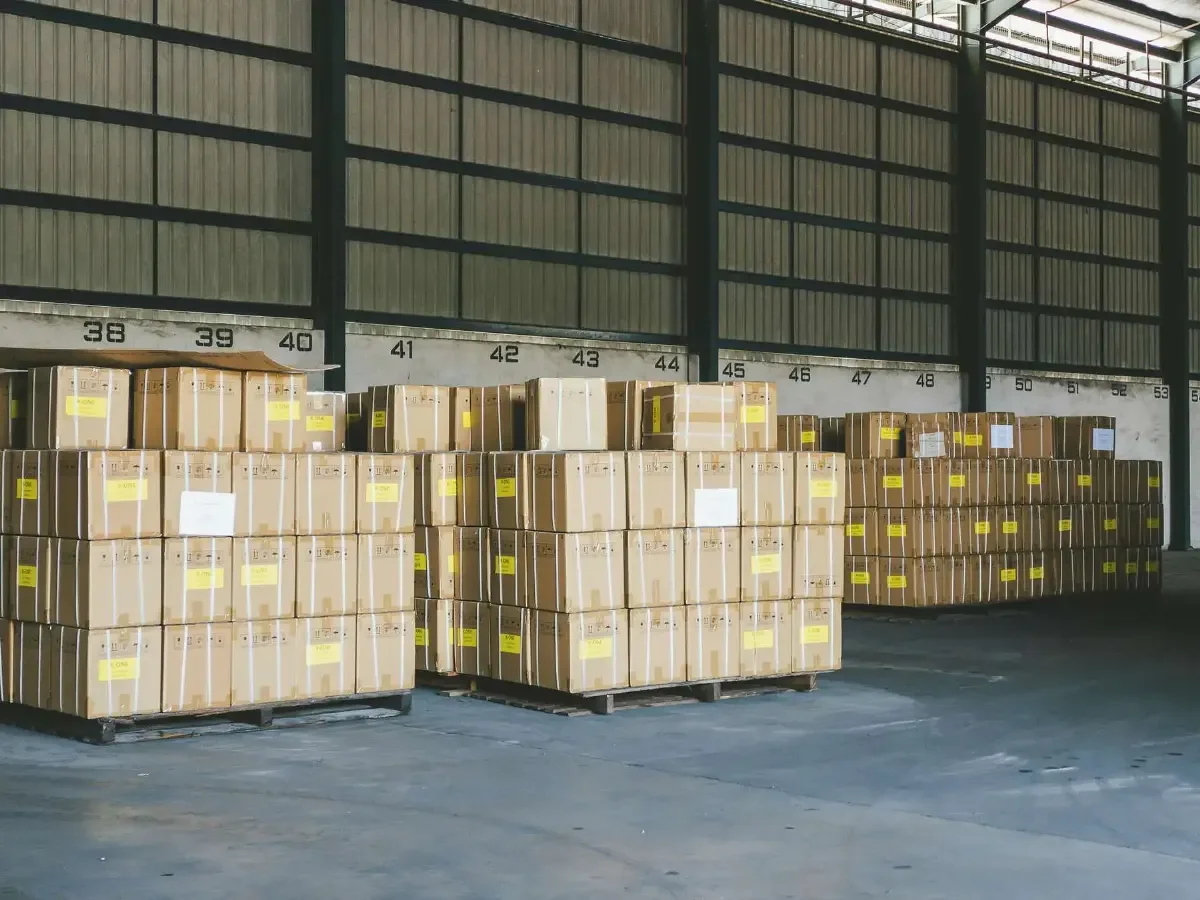
Each pallet load can contain many cartons, which is why package counts and handling-unit counts are recorded separately.
Descriptions are where an innocent difference turns into a question. Wording can differ because each document has a different purpose, but the descriptions should not contradict one another. “Electric oven” on the invoice, “kitchen machine” on the packing list and “spare parts” on the bill of lading is not three levels of detail; it is three different products (Kelsy Sourcing).
Consignee handling is genuinely contradictory in the guides. One says the invoice consignee, the bill-of-lading consignee and the customs importer of record must match exactly, including punctuation (ANJU). Others treat buyer, transport consignee and importer of record as distinct roles to be mapped rather than copied (Yunxi). Confirm your broker’s exact-name requirement, and document any legitimate role difference rather than quietly editing one document to match another.
The hold triggers are familiar: a quantity that differs between invoice and packing list, a package count that does not match the transport document, a description too vague to classify, and a gross weight that contradicts the carrier’s manifest (ovrseas). Matching records addresses consistency only. Admissibility, classification, valuation, origin, agency requirements and CBP review remain separate questions, so no checklist promises release (Yunxi).
Put one reconciliation sheet and a named version behind the file
Name one coordinator for the invoice-versus-packing-list review. That person tracks corrections and approvals without taking over the supplier’s, importer’s or broker’s responsibilities (Yunxi). On a consolidated order, suppliers, the warehouse, a sourcing agent and the forwarder handle different steps, so one coordinator and a recorded dispatch approval prevent the “I thought you had it” handoff (Surmount’s consolidation guide).
Build one reconciliation sheet with a column for every figure that appears in more than one place: invoice quantity, packing-list quantity, warehouse received quantity, inspection quantity, carton and pallet totals, net and gross weight, volume, transport-document packages, and certificate quantity where applicable. Put the source file and version beside every figure (Kelsy Sourcing).
A hypothetical worked example, not a valuation ruling. A draft invoice shows 100 units at $20, or $2,000. The packing list shows 98, and an authorised physical count confirms 98. The revised merchandise line is 98 × $20 = $1,960. The two missing units still need an explanation: backordered, missing, or recorded incorrectly. The arithmetic corrects the line; it does not settle customs value, and the check should end with a supported correction rather than an undocumented reduction in declared value (Yunxi).
If the warehouse count differs from the supplier’s list, record whether cartons were combined, held back or rejected. Then change the booking and the affected documents rather than altering the warehouse record to fit the booking (Kelsy Sourcing).
Before treating a weight difference as an error, check whether both figures are kilograms, whether either is net weight, and whether pallets or protective packaging were added. Reweigh an unexplained difference instead of assuming a universal tolerance; there is no universal tolerance to rely on (Yunxi).
Use filenames that show the shipment reference, document type, version, date and status, and approve named versions rather than a conversation or a file called “final final” (Kelsy Sourcing).
A request you can adapt and send to your supplier. Replace the brackets.
Please send the following for shipment [reference]:
- Commercial invoice draft, stating the legal entity that will issue it and how it relates to the manufacturer.
- Final packing list with one line per carton and SKU, including mixed and partly filled cartons, net and gross weights with units, and carton dimensions.
- Carton-level label file and its matching packing-list revision, with the name of the person authorised to approve changes.
- The PO reference and the agreed Incoterm with named place.
- The transport document type you expect, and who controls release.
- ISF data if the shipment moves by ocean, by [date].
Send corrections to [coordinator] and copy [broker contact]. Please confirm the draft invoice, packing list and transport document are ready for review by [date].
Return to the supplier’s email with one list
Reply to that first message with a single request list, the party responsible for each record, and a date by which the draft invoice, packing list and transport document must be ready for review. Then confirm separately with your broker what entry data it needs, whether your importer number and bond are active, and whether any certificate actually applies to this product.