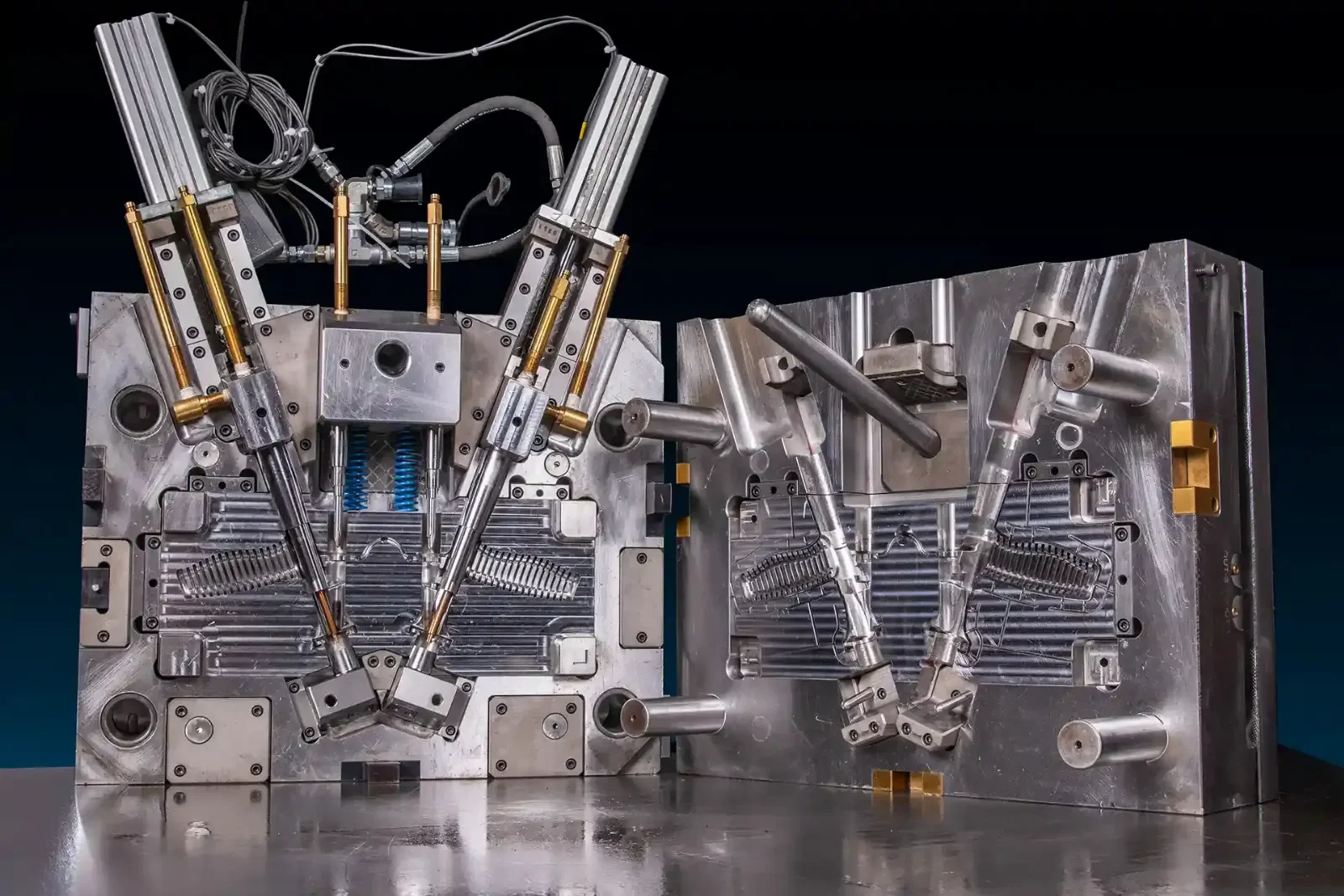
A steel injection mold set: the physical asset behind every tooling charge.
Mold fee: USD 6,000; 50% deposit. That is an illustrative quotation line, not a client case. It is also where questions can stop. The number looks like a capital cost, so it feels settled. But an invoice line does not tell you what asset exists, who holds it, which files come with it, or how you get it out of the factory.
Attach a one-page tooling ownership schedule to the purchase order. It covers the ownership model, the asset record, access and maintenance, and release. Use it at three moments: before you accept the tooling charge, before the final tooling payment, and before you ask for release or transfer. This is commercial checklist material, not a legal opinion. Enforceability and China-specific contract formalities need China-qualified counsel.
What the tooling charge actually buys
A quotation line that says 'mold fee' proves you paid. It does not say what you bought, who holds the mold, or when you can take it.
Ask two questions instead of one: how much is the mold, and what exactly will exist after you pay? Before accepting the charge, get specific answers to five points:
- What physical asset will exist: a complete mold, a die, a jig, a fixture, a printing plate?
- What digital asset will exist: CAD, drawings, parameters, inspection records?
- Who makes it, and where?
- Where will it be stored, and what is its expected service life?
- Can it be transferred, and what would that require?
If the answer is that everything is included, ask for itemized lines. Molds, dies, jigs and fixtures should be separated from engineering, sampling and setup. On the tooling schedule, give each listed mold its own asset-charge line keyed to the mold number and the title-transfer event. Put the agent's coordination work on a separate service line with its scope stated. Then the quotation and invoice show what the asset charge is for and what the service charge covers, even before you compare totals.
Owning the steel does not give you the ability to reproduce or repair the tool. A physical mold, CAD files, product IP and manufacturing know-how are separate control areas. The agreement should define who owns the CAD, mold steel, inserts, spare parts, maintenance records and approved design changes.
Which ownership model are you signing?
Quotes often blend payment models without naming them. Before you pay, identify which one is in front of you. If you cannot state the model in one sentence, the quotation is not ready for a deposit.
| Payment model | Typical ownership position | What the clause should settle |
|---|---|---|
| Paid up front | Buyer owns after final tooling payment | Transfer date, possession, permitted use, release |
| Fully amortized into unit price | Factory usually owns until the agreed quantity ships | Quantity at which title passes; buyout figure if you leave early; per-unit tooling line |
| Partial payment plus amortization | Often disputed | Ownership share and buyout price for the remainder |
| Molder-funded | Molder owns | Whether the buyer can buy it out, and at what price |
| Factory catalog or ODM mold | Factory owns | Exclusivity for buyer-specific changes such as a logo insert or new color |
| Buyer insert in the factory's mold base | Split and easy to dispute | Each insert listed by number as buyer property; removal and handover method |
Put the ownership terms in a two-page standalone document or as a schedule to the supply agreement. Sign and stamp it with the factory's company chop, and use a Chinese version that governs.
A simple paid-up-front clause can read:
Buyer owns each listed tool from the date of the final tooling payment, and the factory holds it on the buyer's behalf at no charge.
That is a sample drafting position, not a self-enforcing legal right. It still needs party names, an asset list, permitted use, release terms and counsel review.
For amortized tooling, the factory usually carries the cost and recovers it through a charge built into each unit. It may own the mold until the agreed quantity ships. Write down the exact quantity, the buyout figure if you leave early, and require the per-unit tooling charge to appear as its own line.
The partial-payment-plus-amortization model is often disputed. State the ownership share and the buyout price for the remainder. For molder-funded tooling, record that the molder owns it and whether you have a right to buy it out.
If the mold is the factory's catalog or ODM tool, you are buying its product. Your leverage is exclusivity for any change made to your design, such as a logo insert or a new color. If you have an insert in the factory's mold base, list each insert by number as your property and state how it will be removed and handed over. Do not assume the whole base comes with it.
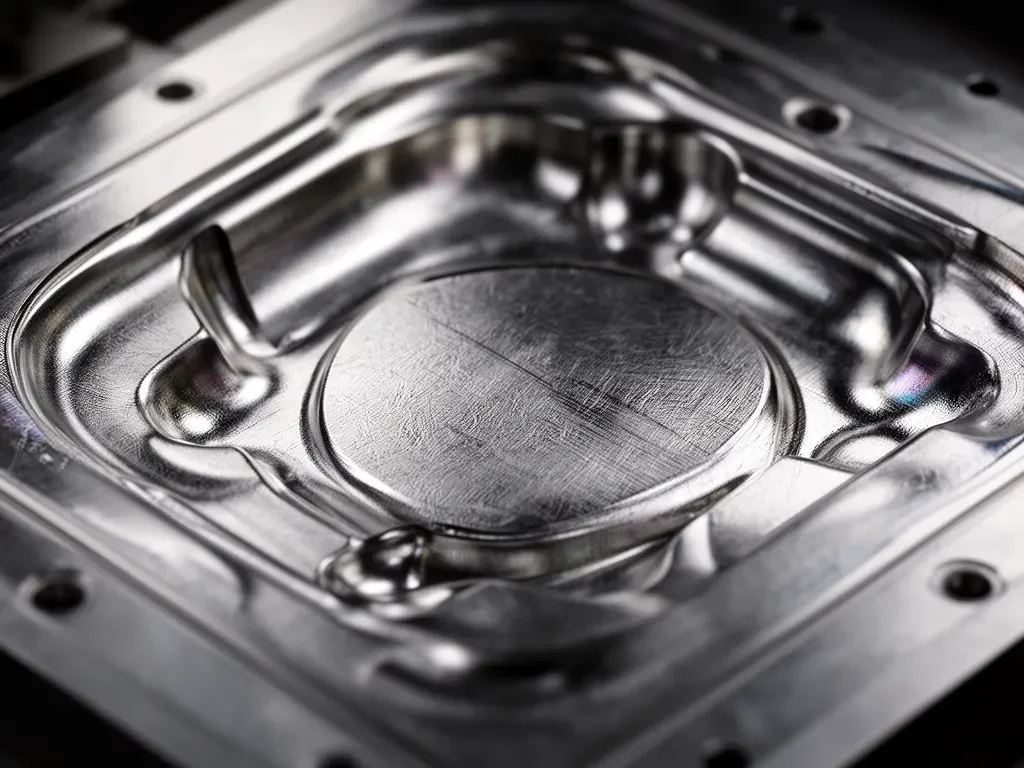
A steel insert like this should be listed by number as buyer property, with its removal and handover stated in writing.
One question you can send now:
Which ownership model does this quotation use, and when exactly does title pass?
Build the asset record
A mold you cannot identify is a mold you cannot easily inspect, recover or move. Build the record before the deposit goes out.
The asset list should have one row per tool: mold number; part name and number; cavity count; cavity and core steel grade; mold base size; dimensions; approximate weight; material; hot or cold runner; completion date; maker; price paid; photos from multiple angles; current storage address; design files; and machine-compatibility details.
Identification should go beyond a line in a spreadsheet. Assign a permanent asset number, add durable buyer marking, and use a stainless-steel owner plate showing the customer name, mold number and production date. Marking helps matching, audits, custody records and transfer. It does not establish every legal right by itself.
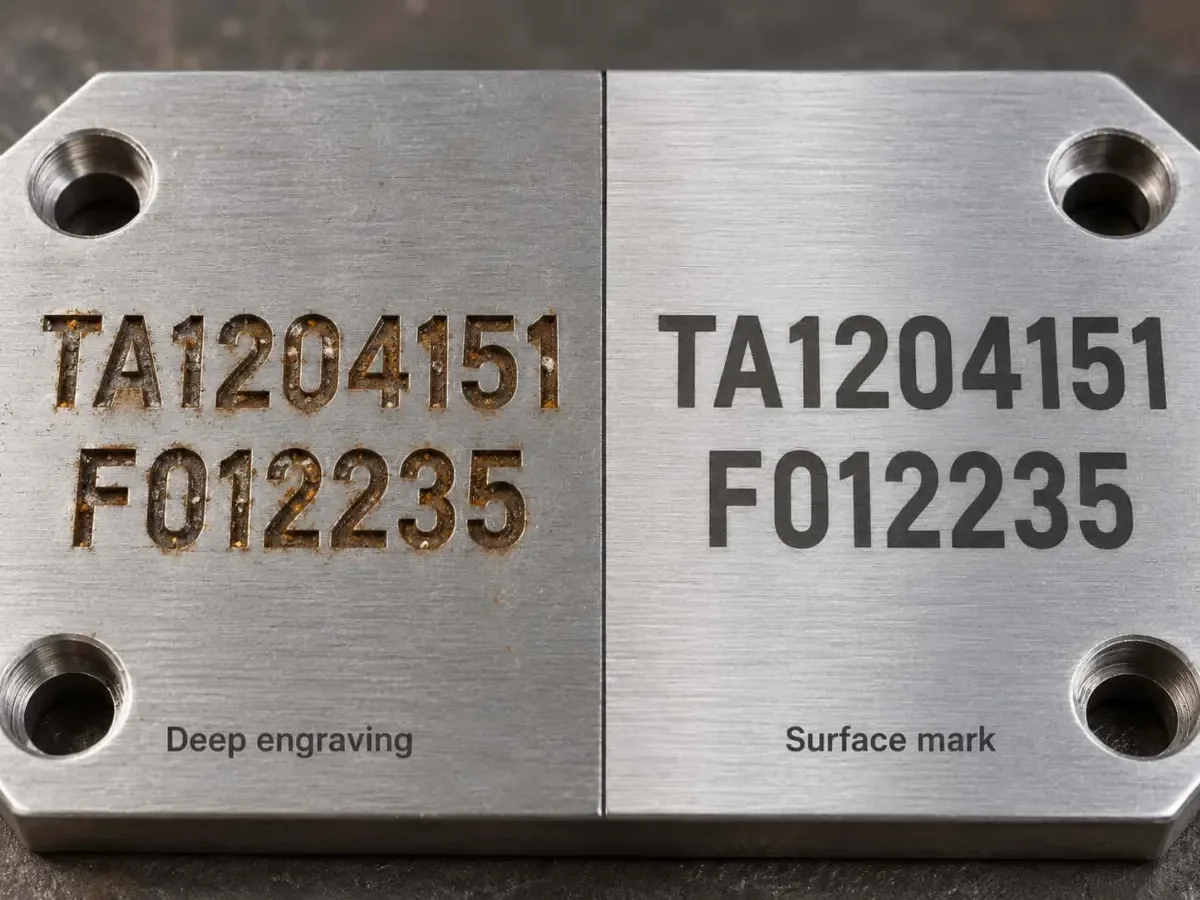
Deep engraving and surface marking compared side by side on a stainless-steel plate: durable serial codes that give a tool a physical reference to match against the written asset record.
Verify the actual mold shop, molding machines, material handling, inspection equipment and production route. The company that invoices you is not always the company that cuts the steel.
Verify the actual mold shop, molding machines, material handling, inspection equipment and production route. The company that invoices you is not always the company that cuts the steel.
For steel evidence, require the tooling quote to name steel grade, cavity hardness, expected tool life and warranty terms. Request a steel certificate and hardness report with delivery. For high-value jobs, consider a third-party inspector doing handheld XRF metal testing on site.
For files, specify editable CAD plus STEP files, 2D and 3D drawings, material and steel certificates, heat-treatment records, component lists, hot-runner information, qualification parameter sheets, maintenance instructions, trial reports and spare-part details. Set delivery milestones and revision-control rules.
Engineering gates matter. Approve the DFM conclusions and the final mold design as separate milestones before machining. Require design review, tooling drawings, build updates, component records and a realistic trial schedule as the project moves. Record every approved change and keep buyer-controlled copies outside the supplier's messaging system.
Finally, define who owns CAD, steel, inserts, spare parts, maintenance records and improvements made during trials or production. Owning the steel alone does not guarantee repair or transfer.
Access, maintenance and modification rights
The supplier will usually hold the mold. Access and record-keeping belong in the asset terms.
Give the buyer or a representative a right to inspect the mold, records, storage conditions, identification and production use with reasonable notice. Also define what evidence the supplier must provide remotely between visits.
Custody should be controlled. Write down the storage address. Require written approval before any change in who holds the mold, and make the contracting supplier responsible for approved subcontractor actions where legally appropriate.
After each production run, ask for the date, quantity or shot count, cavities used, process issues, maintenance performed, parts replaced, modifications, damage, condition photos and current storage location. Link the record to the purchase order and product revision.
A buyer-controlled asset register should be updated after every move, repair, modification or production run. Include location, custodian, photos, shot count, condition, files, spare parts, maintenance, last inspection, authorized products and next service date.
Allocate the cost buckets: routine maintenance, preventive maintenance, consumables, storage protection, accidental damage, misuse, corrosion, major repair and end-of-life replacement. One sample clause puts routine maintenance at the factory's cost and requires a written log plus a shot-counter reading with every order.
Set a guaranteed shot count and require repair or replacement at the factory's cost if the mold fails early under normal use.
Modification control is equally important. No welding, machining, polishing, parameter changes, cavity blocking or design modification without written approval. If a change affects dimensions, materials, appearance, function, safety, compliance, cycle time or packaging fit, repeat the relevant sample, testing and inspection approvals.
Maintenance intervals should follow actual use, material, production environment and manufacturer advice rather than a copied generic checklist. Some forum participants describe visiting the tool shop before business, during construction and during trials. One recommends a part-by-part tear-down audit. Those are individual experiences, not a standard, and travel costs need a budget.
If travel is not practical, use factory-profile review, live shop-floor photos or video calls during active production, and phased tooling milestones before committing to full production. DFM review, sample approval and phased tooling milestones can test communication, execution quality and process control before you scale.
Release, no-lien and transfer terms
The best time to negotiate release is before the supplier has your deposit and the launch date is close.
A sample no-lien and no-set-off clause says the factory may not hold the molds against any claim, including an unpaid production invoice, and that money disputes are settled separately. That is a sample clause, not a legal opinion. Whether it is enforceable, and what formalities apply, is a question for China-qualified counsel.
Restrict use. The tool should be limited to your authorized orders. No copies, modifications, relocation, scrapping, pledging, disclosure or use for another customer without written approval.
Record the address where the molds are kept and prohibit moving them to another plant or subcontractor without your written consent. Include a no-scrapping term: the factory may not scrap, sell or modify the mold without written consent, however long the gap between orders.
Set release mechanics. On written notice, the factory should hand over the molds within a fixed number of days, packed for export, for a handling fee agreed in advance. Drawings, spare parts and last-shot samples should travel with the mold.
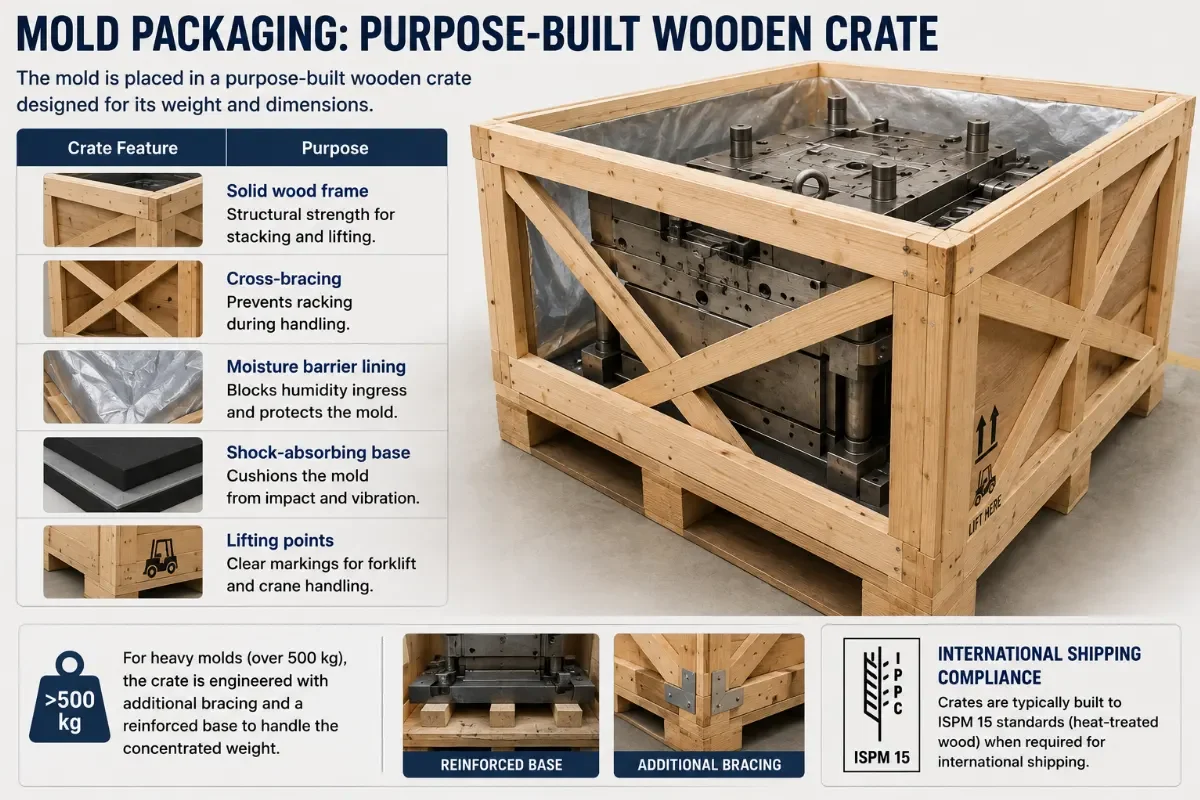
Handover terms should spell out how the mold is packed: this crate shows bracing, a moisture barrier and marked lifting points.
Send a written release request that cites the agreement and the asset list, and ask for a release letter stamped with the factory's company chop that names the molds and handover date. Clear open invoices or agree in writing how any balance will be handled before requesting release.
A practical transfer sequence looks like this:
- Settle invoices or agree the balance in writing.
- Send the release request with the agreement and asset list attached.
- Run a final trial and record condition, shot count, worn parts and photos.
- Crate and ship with export packing.
- Verify receiving-machine compatibility.
- Run first-article inspection and sampling before volume production.
Engineering review should come before the move. Check the 2D drawings and 3D CAD for gate location, runner balance, wall thickness and material shrinkage. The relocation plan itself should sequence disassembly, preventive maintenance, packing, freight and re-commissioning.
At the receiving plant, validate clamping force, hydraulic interfaces and hot-runner controllers. After mounting, first-article inspection and sampling re-qualify the parts on the new press.
Build in multiple T0, T1 and T2 sampling rounds. A new mold can preserve the visible shape while slightly changing outer dimensions, so check a revised sample against existing packaging and inserts rather than judging from a photo.
Require the supplier to declare tooling and production-location changes in writing and mark each item unchanged, changed or not yet confirmed.
Reliable figures for moving a mold between Chinese molders are hard to find, and original molders may impose their own release conditions. Ask for a written transfer quote and release terms instead of assuming a market standard.
Pre-payment checklist and payment gate
Start with a one-page tooling schedule attached to the purchase order. It should include:
- Asset list with mold number, part number, cavity count, steel grades, dimensions, weight, material, photos, maker, current storage address and compatibility details.
- Ownership model and the exact event that transfers title.
- The asset charge for each listed mold, tied to the mold number and title event, shown separately from the agent's coordination-service charge.
- Permitted use, location, no-copy and no-scrap terms.
- File package and delivery milestones.
- Maintenance, shot-count and modification approvals.
- Release conditions, handover timing and handling fee.
- Payment milestones tied to evidence.
Before the deposit, verify the contracting parties and the actual mold shop or toolmaker. Approve the DFM and tool design as milestones. Obtain a complete itemized tooling quote. On the schedule, state the coordination-service scope separately from the mold asset charge so the quotation and invoice do not collapse both into one unexplained number.
Before the final tooling payment, require an accepted production trial, dimensional and material reports, written sample sign-off, complete files, an updated asset register, durable marking, and maintenance and shot-count data.
Before shipping a new mold or releasing an existing one, request condition photos, shot-counter reading, spare parts and drawing handover. If the tool already exists, ask for its maintenance and shot history. Records can show what the supplier says happened, but they do not by themselves prove the full condition of a used mold.
A copy-ready request:
Please confirm in writing the ownership model, mold number, storage address, file package, maintenance log, release conditions and any tooling or production-location change, marked unchanged, changed or not yet confirmed.
Treat refusal as vetting information. If the supplier will not put basic ownership, access and release terms in writing, pause the deposit rather than relying on the invoice.
Before the next tooling deposit, attach the schedule, ask which ownership model applies, and require files, markings, maintenance records and release terms in writing. If the supplier cannot identify the asset, say who holds it, or explain how you would get it out, you do not yet have a tooling deal. You have a payment with an unanswered question.