
A printed invoice is held beside a tablet displaying cash-flow bars and upcoming payment categories.
Three requests land in the same week. One invoice arrives with a PayPal link. A bulk quotation names a bank account and asks for a deposit. A third supplier wants the order routed through Alibaba Trade Assurance.
All three are normal answers to "how do I pay a Chinese supplier." None of them answers the question that decides the outcome: which route fits this payment, at this stage, with this much money exposed?
Each route has its own fee structure, its own per-payment limit, and its own open question about what happens when goods arrive late, short or off-specification. So when you compare China supplier payment methods, start with the payment stage rather than the logo on the checkout page, and total up the supplier payment fees from there.
The practical answer for most buyers is a split. Use the cheapest traceable bank route for the deposit and balance, where a fixed wire charge is small next to the amount in flight. Use a card or platform route for samples and small top-ups, where a percentage addition is easier to absorb than a flat bank fee. That answer holds under two conditions: you have confirmed who actually charges each fee, and you have written down what evidence releases the next payment.
Confirm the payment method, currency, payee and fees in writing for your specific order. If you are paying Surmount, use the contact details on the official website to confirm the instructions before sending money.
The sections below take the order apart in the sequence money leaves it: the three payment moments, the routes side by side, sample and bulk arithmetic, payee checks, and the point where the word "protection" stops being useful.
First decide what you are paying for: sample, deposit or balance
Map the order into three payment moments: sample, production deposit and balance. A route that suits a $300 sample may not suit a $12,000 balance. Write down which moment you are paying before comparing fees.
The deposit moment is where schedule risk sits. The money leaves before any goods exist, and what you are buying at that moment is the supplier's commitment to a date. The balance moment works differently: it is the last leverage you hold before the goods move. At the second and third moment, ask what this payment releases before asking what it costs.
What offsets the exposure is written evidence. An inspection result, a corrected-stock confirmation, a document you agreed in advance: each of these makes the later payment conditional on something you can check rather than on a promise. Surmount's quotation guide calls 30% deposit with the balance paid before shipment, against a copy of the bill of lading, a common term to negotiate. It also flags that a supplier asking for the entire amount before production starts sits in a different risk category from one accepting a split. Read that as a comparison of exposure, not a verdict. A 30/70 schedule is not safe by definition, and 100% upfront is not automatically unsafe. What changes between them is how long your money sits outside your control and whether the later payment is attached to anything verifiable.
The same guide notes that payment-method fees can add up, especially on smaller orders, so the fee belongs in the quote conversation rather than in a footnote. It puts the question plainly: "What is the payment term structure, and are there any fees associated with the payment method?" Ask it before comparing unit prices, so the quote reflects the money route and not only the product.
Put product specifications, pricing, payment terms, delivery schedules and quality-control procedures in one written agreement. If the balance is tied to acceptance, that agreement has to describe the sequence in the order you will actually follow it. Treat the schedule as a risk-control term: it changes when money leaves, not what a platform or bank will do if the goods disappoint.
Compare wire transfer, PayPal and Alibaba Trade Assurance
These are three routes buyers may encounter. Availability and fees depend on the order, the provider and the written quote.
Wire transfer: ask both sides who pays any sending, intermediary or receiving bank fees, and confirm the currency.
PayPal: check whether your supplier accepts it for the order and whether processing or currency conversion is charged separately.
Alibaba Trade Assurance: check the order and payment instructions within your own Alibaba account, including any limits and fees.
| Route | What to verify | Where to confirm |
|---|---|---|
| Wire transfer | Currency, bank fees and legal payee | Written invoice and your bank |
| PayPal | Availability, fee and currency conversion | Written quote and PayPal checkout |
| Alibaba Trade Assurance | Order amount, fees and payment limits | Your Alibaba order and checkout |
Three lines are worth comparing side by side: the fixed charge, the percentage addition, and the cap or approval rule. A method can look cheap at the headline and become expensive once your own bank or card cost is added. Ask whether the quoted fee is charged by the bank, the platform, the agent or the supplier.
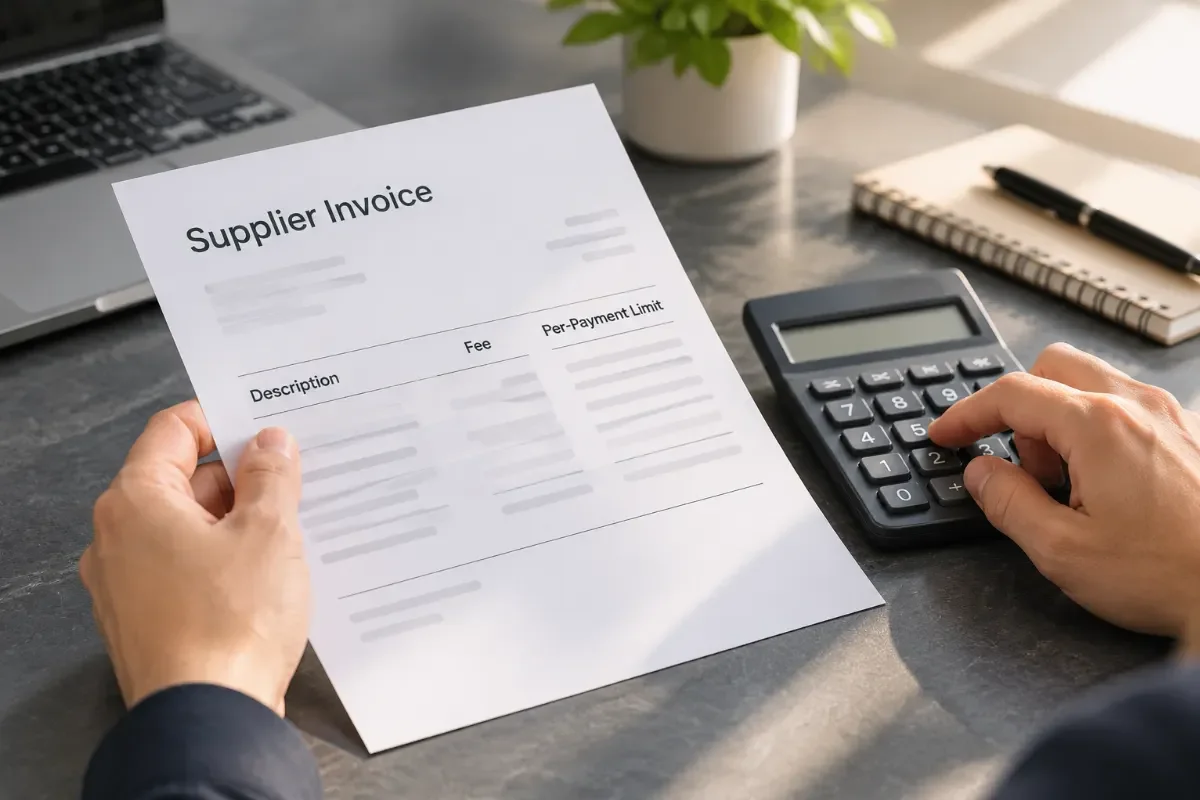
A printed supplier invoice with fee and per-payment-limit headings sits beside a calculator on a desk.
The cheapest headline and the cheapest total are frequently different lines, and the cap is what decides whether a large balance can move at all.
Small sample payments: where fixed fees distort the comparison
Surmount's sample guide suggests PayPal for smaller amounts and bank transfer for larger sample fees, and says the method should be secure and traceable. Read it as guidance for choosing a sample payment route; it says nothing about protecting you if the sample is wrong. Ask for a proforma invoice that itemizes the sample price and international shipping before paying, so the product cost is separated from the courier cost.
Compare total fees using the same amount and currency. A fixed fee can weigh more heavily on a small sample order than a percentage fee. Ask for the exact total before approving the payment.
Small orders are where fixed bank charges and percentage surcharges distort the comparison most, which is why the quotation guide's warning about fees adding up on smaller orders lands here. Write the expected total into your approval note before sending money.
A sample payment is also the cheapest place to test the administrative side of a supplier. You learn whether the proforma invoice matches what was agreed, whether the payee name on the invoice matches the account you are asked to credit, and how quickly a confirmation comes back. A supplier that muddles a $300 payment has told you something useful before a $30,000 one is on the table.
A familiar payment logo or checkout link is not proof of a remedy. Ask what happens if the sample is late, wrong or off-specification before treating that route as protection. If the answer is vague, keep it as an open question.
Bulk orders: confirm limits and approvals before the balance is due
If a payment exceeds the limit quoted for your order, agree any split in writing before the balance is due and confirm the cost of each transfer.
Build any payment split and settlement time into the production schedule, so the shipment release is not delayed at the last minute.
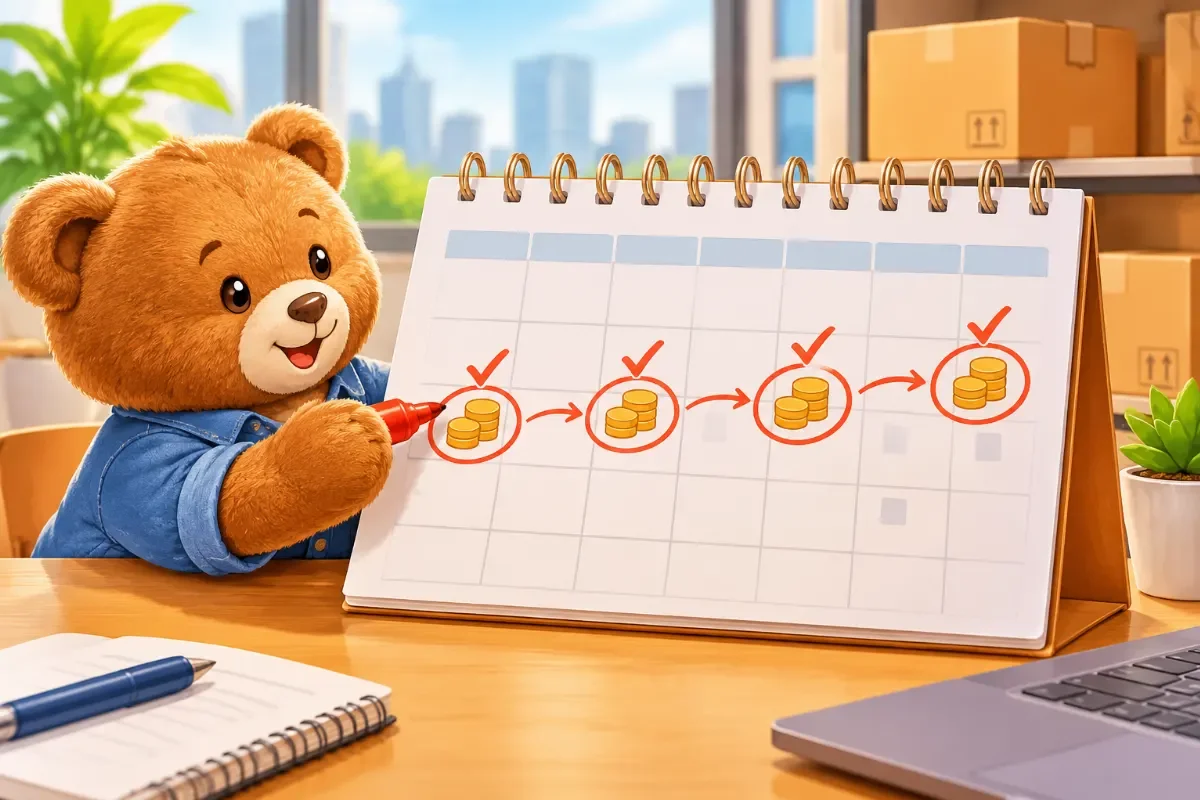
A desk-calendar illustration marking a sequence of checked payment steps.
If you plan to use PayPal for a bulk order, confirm that it is accepted and ask for the total cost first.
If you plan to use a wire transfer, confirm the accepted currency and who pays each bank fee.
Verify the payee before you send anything
Before paying, verify the method, confirm any exceptions and independently check any change.
Match the payment method and legal payee against the written invoice or order confirmation.
Obtain written approval for nonstandard payment methods or instalments.
If you receive new bank or payee details, pause and confirm them through Surmount’s official email address. Use a contact you already trust, rather than the details in the message announcing the change.
Keep the invoice, written payment instructions and confirmation together so you can check the amount, currency, payee and method later.
Write the payment-to-inspection sequence into the order
Use one written agreement for product specifications, pricing, payment terms, delivery schedule and quality-control procedures. Payment timing should not live only in a chat thread. Surmount's supplier-verification checklist says the final agreement should set those items together. That is a documentation control, not a promise about the goods.
Track production completion, inspection and release as separate fields. Packed goods can still be awaiting inspection or a decision on defects, so "finished" is not the same as "released." Surmount's production-delay guide keeps inspection and release status separate from production completion for exactly that reason.
On a failed inspection, the practical sequence is rework, verification of corrected stock and controlled shipment release. Do not send the balance merely because the production line has finished. A holdback or milestone tied to inspection is a term for this order; no percentage or release trigger is standard practice, so negotiate both and write them down.
The release side of the order needs five answers in writing before the balance moves: which payment stage this is, what inspection event triggers the next payment, what evidence satisfies the trigger, who is authorised to release the shipment after corrective work, and what counts as a completed corrective-work result. Surmount's sourcing-agent fee guide makes the last two explicit, and adds that an acceptance-linked final payment must have that sequence described in the agreed terms.

A clipboard checklist with ticked boxes and open lines lies on a desk beside a pen.
A payment-release note can look like this:
Payment stage: sample / deposit / balance Route and currency: ______ All-in fee estimate: ______ Per-payment cap or approval: ______ Payee verified through a trusted channel: yes / no Inspection and release trigger: ______ Evidence required: ______ Person authorised to release: ______ Corrective-work sequence: ______
Fill the note before the balance is requested, not after. Each blank is a question you can still ask while the goods are in production and the supplier is still motivated to answer.
What 'protection' can and cannot be promised here
A written payment instruction may explain how to pay, but it does not establish what happens if goods are late, short or off specification. Check the order terms and the payment provider’s dispute rules before relying on any protection.
The distinction matters in practice: a route can be excellent at moving money and silent about what happens after the money has moved. Protection is a term you negotiated and can point to. The rail you chose does not supply it.
Before choosing a route for protection, ask the provider and the supplier in writing: what failure triggers a claim, what evidence is required, what deadline applies, who decides, and what remedy is available. Treat custom-order exclusions as a question to confirm, not an assumption. If the answer is only a marketing phrase, do not treat the method as protection.
As Surmount's own service terms, defects found at its inspection bring same-day photos and factory rework or replacement under warranty, and suppliers it selects add free replacement or compensation when defects are confirmed. Its general warehouse inspection follows Level II at AQL 2.5, with a 15-day claim window after receipt for qualifying defects. Attribute those terms to Surmount's service. Do not convert them into platform protection, bank protection or a universal supplier obligation. The inspection remedy also addresses defects found at inspection, not every possible late or short shipment.
Before the next payment, put six items in one note
Write down the payment stage, chosen route, all-in fee estimate, per-payment cap or approval, payee-verification step, and inspection and release sequence. Send it to the supplier or agent and ask for written answers.
If the reply is vague on a platform's dispute route, keep that as an open question rather than treating the method as protection. Then choose the simplest route that fits the stage and the written terms, even when another route has a smaller headline number. Send the note before the balance is requested, and keep the reply with the invoice and the payment confirmation.