Before ordering “eco-friendly” packaging from China, ask three questions: how much recycled material went into it, whether your customer can recycle it, and what conditions it needs to become compost. Those are different claims. Choose the one you can support before putting a recycling symbol or an environmental promise on the artwork.
You can begin with a photograph of the complete pack and one direct request: “Please show me what each part is made from.” Let the supplier identify the layers before you choose the materials.
What do recycled, recyclable and compostable mean?
| Term | What it tells you |
|---|---|
| Recycled content | Recovered material was used to make a specified part. |
| Recyclable | Consider collection and processing after the customer uses it. |
| Compostable | Ask under which composting conditions it breaks down. |
A recycled-content percentage answers a question about the material going into manufacture. It does not tell your customer which bin to use. Likewise, a recycling statement does not tell you how much recovered material the factory used.
Start by deciding what matters for your sales market. You might want a documented recycled-content percentage, or packaging that customers can put into an available recycling collection. Ask for each separately if you need both. Brown paper, a green design or a material name cannot make that decision for you.
What would you check on a paper mailing bag?
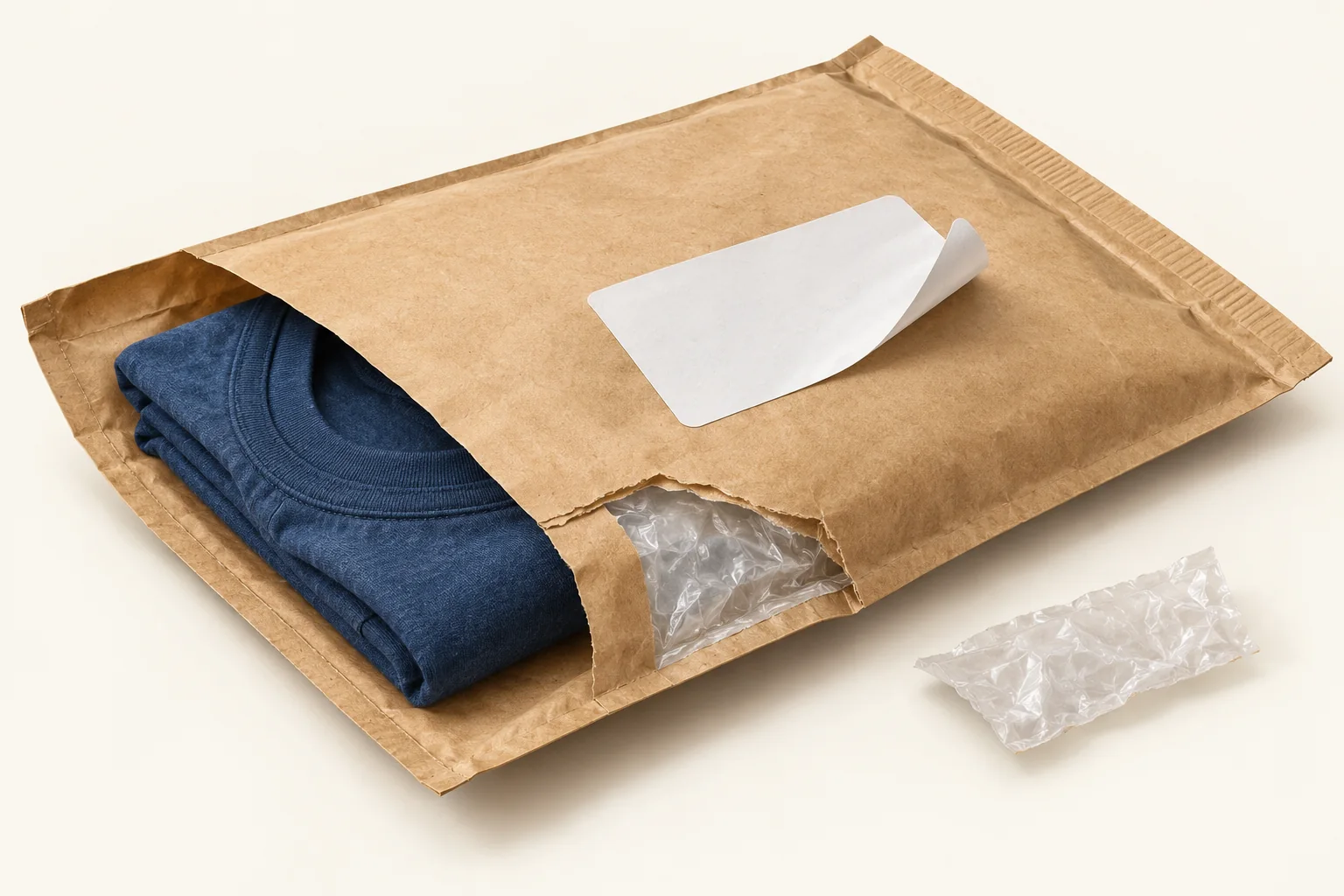
Imagine you are buying a padded mailing envelope for a folded shirt. It has brown paper outside, a plastic cushioning liner inside and a white adhesive label. This is a hypothetical example, not a Surmount customer order. We will keep using it to show how the purchase decisions connect.
First, ask the supplier to mark the paper, liner and label on a photo. Request the material of each part, including coatings or adhesive. If the supplier replies “recycled paper bag,” you still need to know whether that describes only the paper or the complete envelope.
Suppose the next answer is “the outer paper contains 50% recycled fiber.” Keep that wording in your notes. Do not turn it into “50% recycled packaging” when you send the file to a designer. The plastic liner and label are also part of the finished pack. The percentage here is only an example, not a recommended target or a legal requirement.
Follow up with: “What is the percentage based on, and which material record supports it?” Also ask whether the recovered material is from before consumer use or after it. A supplier saying “recycled” has not necessarily promised post-consumer material, which is material recovered after consumer use.
Then connect the answer to your order. Ask which incoming paper record will be used for this production batch. A packaging converter, the business turning material into your finished envelope, should explain how its records connect the material to the goods you receive.
If a certificate is offered, open it and check the named holder, covered product, issuing organisation and validity. Ask how the supplier fits into that supply chain. A document for a different business or material needs an explanation before you rely on it. Seeing a badge in a quotation is not the same as checking its scope.
Keep the outcome short: “Outer paper: stated recycled-fiber percentage; liner and label: still to be confirmed.” That is easier for a buyer, designer and factory to use than a general instruction to “check sustainability.”
Can your customer follow the disposal instructions?
If you want to say “recyclable”
Give a local packaging specialist or recycling service the same photo and material list. Tell them where the envelope will be sold. EPA guidance recommends checking local recycling acceptance; a supplier's opinion about the raw material does not settle what happens to the finished envelope at your customer's address.
Ask a practical question: “Can this paper-and-plastic envelope go into the relevant collection as one piece, or do the parts need separating?” If separation is required, try it on a sample. Can you identify the liner and remove it without special tools? Does the label or coating change the advice?
Keep two findings separate. “The liner is easy to remove” is an observation about using the pack. “The local service accepts the separated material” needs confirmation about that service. Peeling two layers apart at your desk does not prove that either will be recycled.
For several destination markets, save the advice against each market. If the wording differs, give the factory clearly named artwork versions and tell the packing team which version belongs to which order.
If the offer says “compostable”
Ask: “Does that mean industrial composting or home composting?” The European Commission explains that compostable plastics typically need industrial composting and collection. A document about industrial treatment does not establish that the material will compost in a customer's garden.
Now return to the exact envelope. Is the evidence for a raw material, an unprinted liner or the complete printed bag? Ask whether it covers the thickness, ink, adhesive and other parts in your version. Give the documents and specification to a competent reviewer if the scope is unclear.
Even with matching evidence, investigate the collection and treatment route available to the customer. The instruction needs to be usable in the destination. Do not print a home-composting claim or a convenient disposal route that you have not established for the pack.
Will the new pack still protect the shirt?
Put the actual shirt, or an agreed representative sample, into the envelope. Close it and handle it as intended. Look for pressure on the seams, sharp product edges and an opening method that could damage the contents. An attractive empty sample can hide a poor fit.
If you are comparing two envelopes, use the same product dimensions and weight. Agree the checks and pass criteria before choosing the supplier. For transport testing, involve the testing provider rather than inventing a universal drop height. Our packaging-test report guide explains how to match the test to the contents and construction.
Compare the price on the same basis too. Does each offer include the label, printing, sample cost, tooling and delivery to the packing location? If one design needs an extra manual packing step, include that work. A plain stock envelope and a fully printed custom envelope are different offers.
You can choose a suitable protection level and a supported environmental statement without claiming to have measured the entire environmental footprint. A desk comparison cannot establish that one packaging system is better overall. Record the specific benefit you can support and the protection you have checked.
What should be approved before printing?
Send the designer the exact sentence you have reviewed, including the component name and any limits. For our example, a statement about the outer paper must stay about the outer paper. It should not appear to describe the shirt or every part of its packaging.
The US FTC cautions against vague “green” claims and recommends qualifying partial recycled-content claims. Have the complete wording and visual presentation checked for your destination market. A broad “eco-friendly” headline can say more than the narrower sentence beneath it.
Check translated proofs as carefully as the original. Did “outer paper” disappear? Did “industrially compostable” become simply “compostable”? A symbol resembling a certification mark can also alter the impression. Make these checks before print production, when a correction is easier to handle.
For EU sales, the Commission's PPWR announcement describes phased application from August 12, 2026. PPWR means Packaging and Packaging Waste Regulation. Its small-business resource is a starting point for further information, not approval of your envelope. Check requirements and dates for the actual packaging and market.
Keep the approved sample, artwork and material documents together under one version. Tell the supplier to propose changes to paper, liner, adhesive, print process or sub-supplier before using them. A visually identical replacement may need a new review. For repeat orders, our change-control guide explains how to carry the approved version forward.
What can you send the supplier today?
Attach the envelope photo and adapt this message to your product. Replace the destination with your actual market:
We need a padded mailing envelope for this product, for sale in [destination market]. Please identify the outer material, liner, label, coating and adhesive on the attached photo.
If you offer a recycled-content percentage, please state which component it covers, how it is calculated and how your material records will connect it to our order.
For any recycling or composting statement, please send the supporting documents, exact product covered, conditions and exclusions. Please confirm whether the documents cover our finished printed version.
Please quote the complete construction, provide a production-equivalent sample, and propose protection checks. Obtain our written approval before changing materials or processes, and explain who will provide updated evidence.
Read the answers with the same component photo beside you. If the paper information is complete but the liner information is missing, keep the whole-pack statement pending. You can still discuss cost and examine samples while the missing review is completed.
For help coordinating the suppliers, send Surmount Sourcing your product, packaging idea and destination market. We can discuss supplier communication, samples and inspection scope. Environmental statements and legal duties need review for the actual pack and its sales market.