
Export cartons and a shipping checklist at the handoff point between supplier work and cargo movement.
Your supplier quotes a unit price and an MOQ. Your forwarder quotes a freight rate and calls it door to door. Both may introduce themselves as your contact in China. Neither quote says who approves the sample, who sends the final carton dimensions, who books the vessel, or who answers for the customs entry.
Picking one job title and hoping it covers everything rarely works. Split the order into two workstreams: the product and supplier side, and the cargo and transport side. Then mark the jobs that stay with you, your customs broker or a separately appointed inspector. Below is the usual split, the seams where it breaks, and the questions to put in writing before you approve either quote.
Start with two workstreams
A sourcing agent works closer to suppliers: product briefs, factory questions, samples, product requirements, production updates, inspection preparation and shipment readiness. A freight forwarder works closer to the transport route: booking, warehouse handover, shipping documents and cargo movement.

Cartons packed with folded clothing sit beside a clipboard checklist with green check marks — the product side of the order, checked item by item before transport takes over.
That is the ordinary division of labour for a small or mid-sized China order. Neither provider replaces your importer, customs broker, legal adviser or testing laboratory. Keep those four seats separate from day one. One failure mode is a buyer assuming "my agent handles China" and later discovering that the customs entry has no owner.
The labels also drift. The term shipping agent is not used the same way by every logistics company or in every market. One provider may handle a booking or carrier communication, another may offer a much wider logistics scope. A provider's name is only a starting point; the service scope determines what you are actually buying.
Treat the two-workstream map as a worksheet. Write the split for this order, this supplier list and this destination. Two orders placed with the same provider can end up with different boundaries once a warehouse, an inspector or a destination broker enters the picture.
The product side: what a sourcing agent normally owns
The product side starts before cargo exists. Typically a sourcing agent or procurement partner:
- turns your brief, part numbers, drawings, photos and quantities into an RFQ;
- compares suitable factories and trading sources;
- checks supplier identity and available documents;
- coordinates samples, product questions and packaging requirements;
- follows production milestones and prepares the inspection;
- aligns several supplier orders for export preparation and hands over shipment-readiness data.
Two things sit outside that role: freight carriage and destination customs authority. An agent can coordinate product and shipment information, but classification, duty, compliance and clearance are confirmed by you as importer or by a licensed destination broker.
Some providers bundle more. Surmount, for example, describes its sourcing offer as running from supplier search and production follow-up through quality inspection, warehousing and worldwide shipping. That places shipping inside the sourcing scope. Its published workflow splits a buying project into brief, supplier shortlist, sample and quote, inspection, and shipment handoff. Both readings fit the same company: the sourcing work ends at a defined handoff, and shipping is a service line sold alongside it. Your quote has to state which model applies to your order.
The cargo side: what a freight forwarder normally owns
On the other side of the map, a forwarder's scope may include:
- origin pickup or warehouse delivery instructions;
- booking by air, sea, rail, courier or multimodal transport;
- export transport documentation;
- consolidation or container loading;
- carrier communication;
- cargo insurance when requested;
- destination-agent coordination.
To do any of that well, the forwarder needs accurate inputs from you: product descriptions, carton counts, dimensions, weights, pickup location, destination and Incoterm. For batteries, aerosols, liquids or regulated chemicals, it may also need dangerous-goods information. Changed or late cargo data can lead to a revised charge.
Two limits matter here. First, the forwarder's main role is cargo movement. Some offer limited receiving or photo services, but product identity, fitment, quality and supplier correction require a separately agreed scope. A booking confirmation proves transport was arranged; it does not prove the supplier shipped the correct part.
Second, export customs clearance may be inside or outside the freight quote. Give it its own line instead of assuming the word "freight" covers it. A factory can arrange freight too, but you still need to know what the quote includes, where handover occurs and who owns each risk.
Where handoffs break down: inspection, consolidation and dispatch
At the seam, split ownership before naming a coordinator. The sourcing side should identify who releases product for shipment. The cargo side should identify who controls the booking. One coordinator then records the acknowledged handoff between those two owners. Suppliers, the warehouse, a sourcing agent and the forwarder may each handle a different step, so without that record, three vendors in three cities can each assume somebody else signed off.
The release test should be run as two workstreams rather than one general "ready to ship" email.
On the product side, confirm that the actual shipping list matches the orders line by line, every agreed inspection is complete, shortages, overages and damage decisions are settled, and final packing data is confirmed. Each line should name the provider supplying the evidence.

Cartons on a pallet are checked against the paperwork on a clipboard before the shipment is released.
Who inspects is a different question from who ships. An inspection can be booked by you, by a sourcing partner or by the supplier, but the checklist and the release authority should stay tied to your purchase specification. Do not assume a forwarder will inspect product quality; any inspection scope has to be agreed separately.
Who inspects is a different question from who ships. An inspection can be booked by you, by a sourcing partner or by the supplier, but the checklist and the release authority should stay tied to your purchase specification. Do not assume a forwarder will inspect product quality; any inspection scope has to be agreed separately.
Consolidation also carries two meanings that can be confused. Commercial consolidation is the decision about which supplier goods belong in one shipment, what is ready, what is missing, and how the invoice and packing data should describe the batch. Physical consolidation is receiving, storing, repacking, palletising or loading the cargo at a warehouse. The party performing that physical work must be named in the shipment plan. They are different services, often performed by different companies, and both belong on the scope page.
Use one test for every handoff: the next owner has the information and the responsibility needed to continue. Keep ownership visible until the handoff is acknowledged, and record separately what has been approved and what is still outstanding.
Customs and importer of record: the gap neither provider fills
It is a part of the map buyers can leave blank, and it carries legal consequences.
Start with the general rule: do not ask a China-side sales contact to make the final legal customs decision for another country. Sourcing, transport, customs and import responsibility are separate services. A sourcing agent can coordinate product and shipment information; the importer or a licensed destination broker confirms classification, duty, compliance and clearance.
Take the United States as a written example. Under 19 CFR 141.1, duties and the liability for paying them accrue when the imported merchandise arrives at a Customs port with intent to unlade, or otherwise on arrival within the Customs territory. That liability is a personal debt owed by the importer to the United States. Paying a broker who then fails to remit the duties does not relieve the importer, and posting a customs bond protects the revenue of the United States without removing the importer's liabilities. The importer may pay duties directly to Customs or through a licensed customhouse broker.
Commercial guidance on US entry adds the operational picture. The importer of record is the legal entity responsible for the import, its declarations, duties and compliance. A customs broker is a licensed agent who files the paperwork; the broker executes, the importer is liable. Guidance summarising 19 USC 1484 and 19 CFR 141.1 puts it narrowly: only the owner or purchaser of the goods, or a licensed customs broker acting for one of them, may file an entry, and whoever takes that role is legally liable for the duties. Post-entry reassessment follows the same logic: additional duties, interest and any negligence penalty land on the importer of record, who may then pursue the broker contractually, although the customs authority is not a party to that dispute.
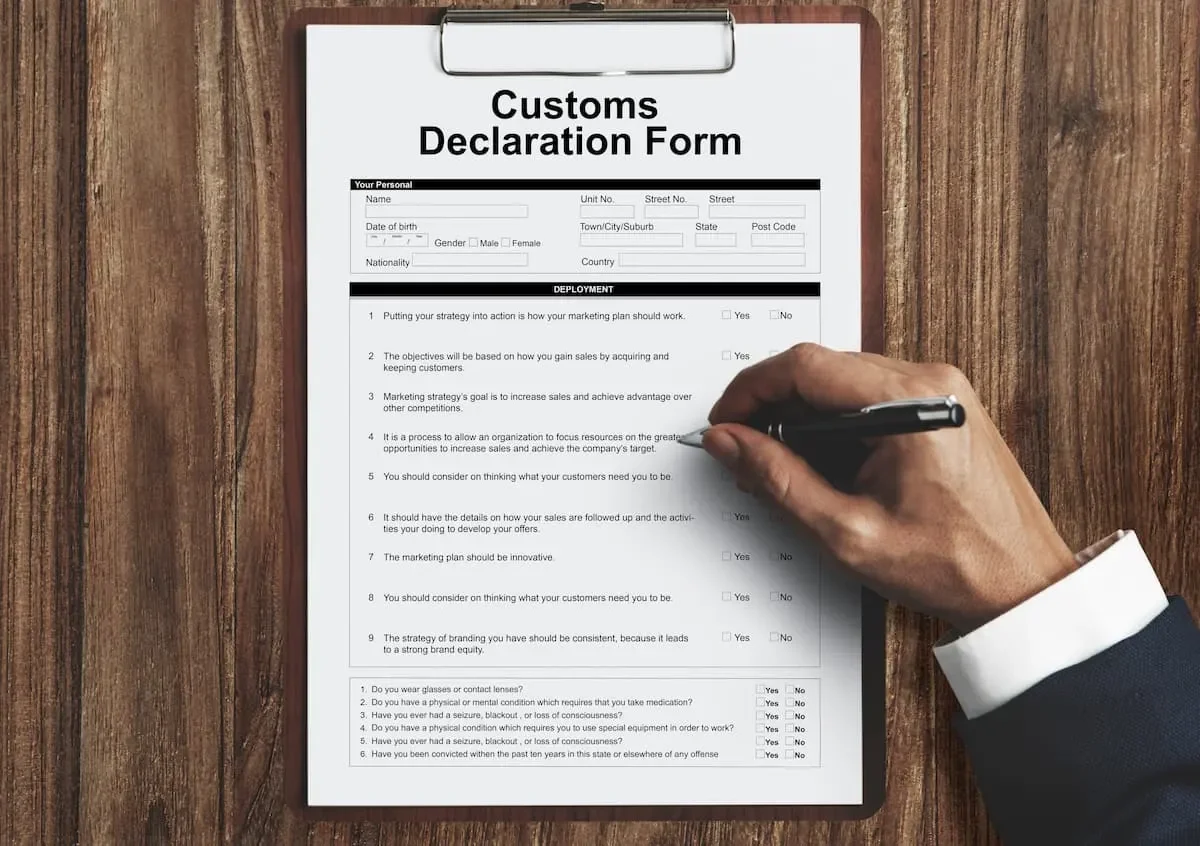
Filing the customs declaration is the importer's legal responsibility, with a licensed broker acting on their behalf.
None of this turns on the Incoterm label. The party named on the entry holds the role. DDP and DAP allocate commercial clearance and duty payment between buyer and seller. Under the standard DDP rule the seller handles import clearance and bears applicable import duties and taxes; under DAP the buyer does. But the DDP term does not by itself decide who the legal importer of record is. Being importer is a regulatory requirement, so every shipment needs a legally recognised party. That party can be the buyer, the seller or a qualified third-party entity, depending on local rules. Some countries let a seller act if it meets local requirements; others require the buyer or a third party. US guidance states that a forwarder does not become importer of record merely by booking the container. The consignee can be a different party from the importer.
For your actual shipment, the destination country, your legal entity, the entry naming, the bond and the power of attorney still need confirmation with a destination broker or adviser. Do not assume a China sourcing agent can act as your importer of record.
Read both quotes as service descriptions
Once the responsibility map is clear, price the same work on both sides of it.
Start with agent fees. A percentage needs a defined base. Put the same illustrative goods figures against both possible bases: 3% on $10,000 of goods is $300; apply 3% to $10,000 of goods plus $2,000 of freight and the fee is $360. The difference is the base, so both quotes should state whether freight sits inside the commission calculation.
On the agent quote, ask which minimum event applies: per order, per supplier or per shipment. On the forwarder quote, ask whether its charges apply per shipment or per bill. Three small supplier orders consolidated into one shipment can trigger three minimum fees if the agent prices that way. Put the answer in the two-workstream comparison.
Keep a separate line for every cost, with its payer, currency and due date. Separate goods, agency services and third-party costs, and state currencies and validity. Put a mould fee and the fee for coordinating that mould on different lines even when one invoice collects both. They are two different charges. Ask whether the agent also receives supplier rebates; a straight answer is more useful than the smallest headline percentage.
On the freight side, ask the forwarder to show the original and revised dimensions, gross weight and chargeable weight, plus the divisor and rounding applied. Confirm the service, units, rounding, and whether chargeable weight is calculated per carton or across the shipment.
Ask separately about origin charges: terminal handling, documentation, customs brokerage, because they may be included or excluded. Read the quote as a description of a service with a price attached. A freight quotation that appears to cover international transport may exclude factory pickup, export customs clearance, destination charges, warehousing and final delivery. A low headline rate can misstate the real shipping cost once those items are added.
Before comparing anything, make both providers answer the same four questions in writing:
| What to align | Question to put to each quote |
|---|---|
| Delivery point | Where does the provider's responsibility end: your warehouse, the destination port, or another point? |
| Cargo data | Which dimensions, weights, carton counts and service assumptions is the price based on? |
| Included services | Which pickup, export, destination, warehousing and delivery tasks are inside the price? |
| Quote validity | Until what date does the price hold, and what triggers a revision? |
Mark every mismatch before you compare the agent and forwarder quotes. A quote to your warehouse cannot be compared with one that ends at the destination port.
Write one scope page before you approve either quote
Here is the page to build. Build it as a list of lines to fill, then adapt the wording and add the fields your own order needs.
- Commercial terms in writing. Require a written quote that states scope, cost and timeline. If a line says "included", ask for the quantity, limit or definition behind it.
- Role-boundary record for the handoff. Identify the sourcing-side release approver, the cargo-side booking owner and the person who acknowledges the handoff. Write down how dispatch approval is recorded and who gives it.
- Named approvers. Name the person authorised to approve a sample, change a requirement or advance the purchase. Without that name, a useful supplier contact gets restarted as a vague enquiry.
- Cargo and warehouse details. Assign the receiving confirmations to one named provider: the receiving documents, the checks included, warehouse cut-off arrangements, who reports delays or discrepancies, and how extra charges are approved. The other provider should acknowledge that boundary.
- Exclusions and the responsibility boundary. Identify excluded freight services and where each provider's responsibility ends. Ask who handles cargo pickup, export customs clearance, final delivery, delays, documentation problems and customs issues.
- Documents, one by one. For each document the shipment actually uses, write down who prepares it and who sends it. Do not assume one provider owns the commercial invoice, packing list, transport document, certificate of origin and customs declaration just because the quote looks complete.
- The handoff test. The next owner has the information and the responsibility to continue; ownership stays visible until acknowledged; approved items and outstanding items are recorded separately.
The next step
Put your current order on one page: product and supplier tasks, cargo tasks, customs owner, cost lines, named coordinator and dispatch approver. If a line says "included" without a scope, ask for the written detail. If customs is unresolved, do not let a forwarder's booking confirmation or an agent's shipping promise fill the gap. Confirm the importer of record and destination broker first.
Then send the same page to both providers and require each to confirm its own line in writing. A clear acknowledgement is worth more than a lower headline number.