
Ask for a photo of one unit exactly as the store will sell it. Can the ultimate purchaser see where the product was made? Start there before deciding whether the supplier should mark the item, the retail pack or both.
Other content can include identity, responsibility, net quantity, warnings and tracking. Which items apply depends on the product and the agency with jurisdiction. A 'Made in USA' claim is a separate FTC question. Treat this as a verification framework; your product still needs a product-specific legal determination.
The short answer: build the label by package layer
Name three layers before naming any label: the imported article; the retail package or container that reaches the consumer; and the outer shipping carton. The first two usually carry the origin question. The carton is a transport layer unless it is the container that reaches the ultimate purchaser.
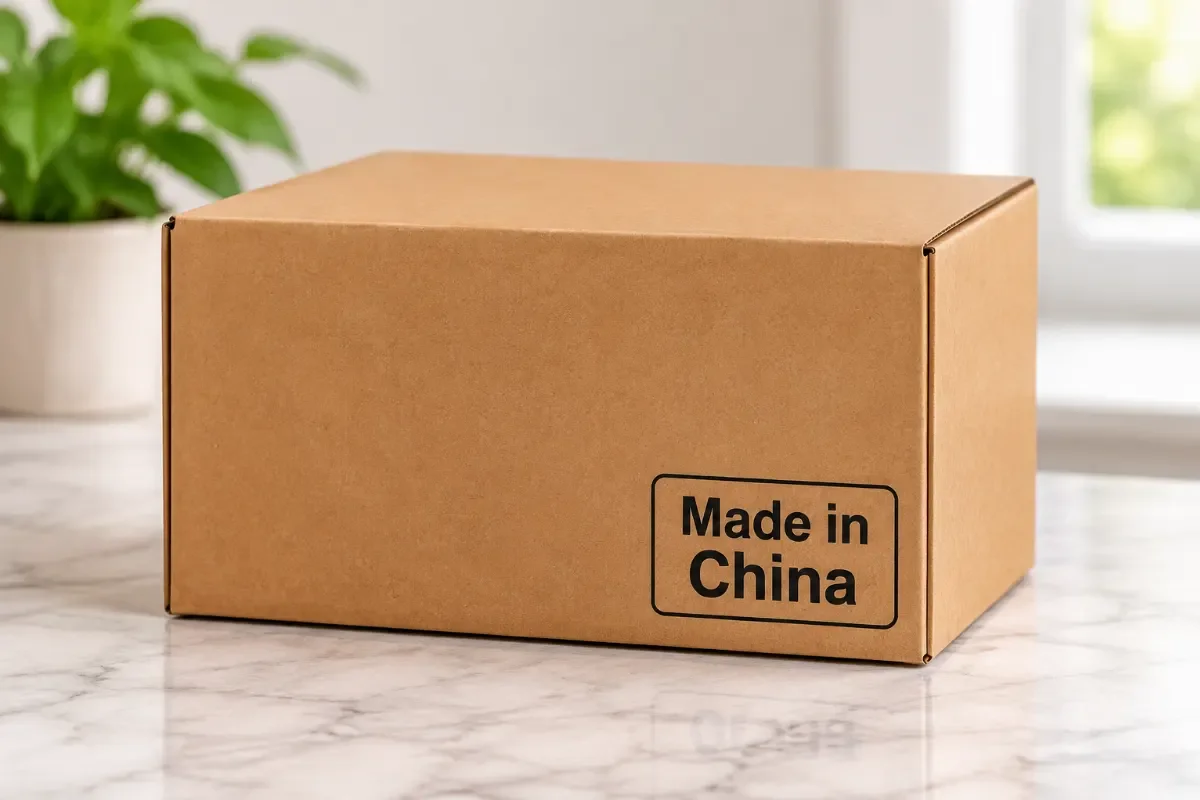
A plain package shows a clearly visible "Made in China" marking on its front panel.
The CargoTrans table for a retail product sold as imported lists the article as marked and the container as marked if it hides the article mark. That is a general allocation. It does not mean every retail box needs a second country mark. The regulatory word is container. A box, blister, bag, sleeve or hangtag matters when it is what the buyer receives. Whether yours qualifies depends on the sales unit and package design.
Other label content does not follow automatically from the origin rule. It depends on the product category and the agency with jurisdiction; the routing method appears below. A carton-matching worksheet also does not define all transport or regulatory markings. Origin, handling and other required marks must be confirmed for the product and route, as Surmount's carton-mark guide warns.
If you cannot describe the sales unit in one sentence, the label decision is not ready. Do not ask a printer to resolve it.
Who is the ultimate purchaser? Start with the sales unit
Before choosing a panel, answer what one consumer buys and how it is packed: a sealed retail box, blister, bag, multipack, display case, or a loose unit repacked in the US. The answer changes which layer must carry the mark.
Under CargoTrans's summary of 19 CFR 134.1(d), the ultimate purchaser is generally the last person in the United States who receives the article in the form imported, and the mark must reach that person. For retail sale as imported, the retail buyer is the ultimate purchaser, so the article or its retail package must be marked. Do not rely on a marked master carton when individual units are sold separately. Under 19 CFR 134.22, the container that must be marked is the one in which the article ordinarily reaches the ultimate purchaser.
A container normally not opened before sale must state the origin of its contents. If the article itself cannot be marked, a liquid for example, the article may be exempt, but its container must be marked. Under 19 CFR 134.22(a), that exception almost never extends to the outermost container that reaches the ultimate purchaser. Keller and Heckman's overview covers these container rules.
Reusable containers need their own origin mark. Containers not intended for reuse generally do not need a separate container-origin mark. Keller and Heckman makes the distinction. Identify the package type before assuming every box needs two country marks.
If a US co-packer will put loose units into retail containers after customs release, plan the new-container marking and the certification or written-notice condition before import. CargoTrans summarizes 19 CFR 134.26: the importer must certify that the new container will not obscure the article mark or will itself be marked, or that the buyer or repacker will be notified in writing.
Country-of-origin markings on the product, package and carton
Suppose a shop orders 24 individually sold tools. If staff discard the marked carton and hang the bare tools on a peg, the carton tells shoppers nothing about origin. For a tool sold in a marked retail pack, document how it reaches the shopper and check whether the container reasonably indicates the tool’s origin under § 134.32(d) before approving box-only printing. Read the US container-marking exception
Use this table as an allocation map. The sales unit still controls it, so confirm the package facts before treating any row as a conclusion.
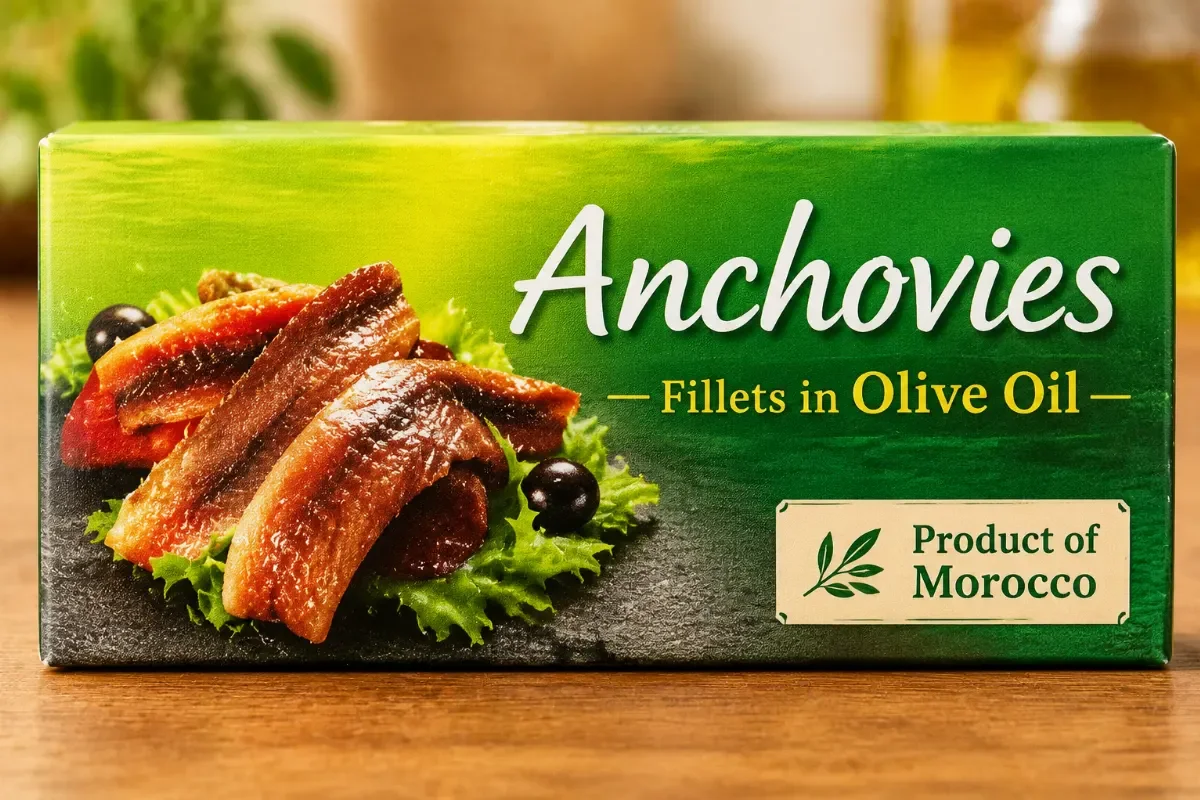
A retail anchovy package with “Anchovies — Fillets in Olive Oil” and a printed “Product of Morocco” block. The image shows one visible package layer, not a conclusion about which layer or sales unit must carry the origin mark.
| Situation | Article | Retail package or container | Outer shipping container | Still to confirm |
|---|---|---|---|---|
| Retail unit sold as imported; article visible | Mark the article. | Mark the package if it conceals the article mark, is normally not opened before sale, or is reusable. | Treat as transport unless it is the container that reaches the buyer. | Sales unit and package construction. |
| Sealed retail package normally not opened before sale | Mark the article as the article permits. | Mark with the contents' country of origin. | Not a substitute for the retail unit; confirm any separate requirement. | Whether the package is normally opened before sale. |
| Article incapable of being marked, such as a liquid | May be exempt. | Mark the container with the contents' country of origin. | Mark if it is the outermost container that reaches the buyer. | Applicable article exemption and container design. |
| Reusable container | Apply the general article rule. | Mark the container's own country of origin. | Confirm separately. | Whether the container is reusable. |
| Non-reusable container | The article still needs a mark or an applicable exemption. | Generally no separate container-origin mark. | Confirm separately. | What makes the article mark visible. |
| Loose units repacked after customs release | Marked, or covered by an exemption. | New container marked unless it will not obscure the article mark; certification or written notice. | Confirm the co-packer's plan. | Entry and repacking plan. |
| US place name, 'USA', another country name or importer address on the item | If the wording could mislead, put the origin near it, in comparable size. For an importer or distributor address, state the contents' origin near it. | Same if the trigger appears on the package. | Same if the trigger appears on the carton. | Exact artwork and address placement. |
China-origin wording: Keller and Heckman gives 'Made in China' and 'Product of China' as examples. Use the English country name. When 'United States', 'American', 'USA', a US city name, another country name or a US importer or distributor address appears on the article, package or carton, check the proximity rules. Under 19 CFR 134.46, a place name that could mislead requires the country of origin in close proximity, in at least comparable size and preceded by 'Made in', 'Product of' or similar words. Separately, 19 CFR 134.22(c) requires a container bearing a US importer or distributor address to state the contents' origin near that address; CargoTrans's summary gives 'Contents made in Vietnam' as the container example. Confirm the size and wording for each provision instead of treating them as one formula.
Treat the outer-container column as a prompt, not a conclusion. A transport carton may be only a carrier, and a retail pack may not be the only container. Confirm which package ordinarily reaches the buyer.
Made in USA is a separate claim from origin marking
Foreign-origin marking and US-origin marketing run on different tracks. For many goods, the origin for marking is the country where the product was last substantially transformed, which is not always the country it shipped from (Dedola's guide). For a 'Made in USA' claim, the FTC applies its own standard.
An unqualified 'Made in USA' claim requires the product to be 'all or virtually all' made in the United States. A qualified claim describes the extent, amount or type of US content or processing and indicates that the product is not entirely domestic.
A CBP finding that no foreign origin mark is required does not by itself authorize a 'Made in USA' promotion.
Most products sold in the US are not legally required to carry a Made in USA label or disclose their amount of US content, although other rules can apply to specific categories.
'Designed in USA — Made in Finland' can be a truthful process claim, but CBP still requires the product to be marked as made in, or a product of, Finland.
An unqualified Made in USA label on a product that is not all or virtually all US-made can result in civil penalties, including in catalogs or online. FTC guidance is staff guidance and not binding on the Commission.
Other required label content depends on the product and the agency
Once origin is settled, product label requirements are a separate routing exercise. Many regulations may require a label or markings to comply before sale in the US. Start with function, materials and components, intended user and age, electrical or radio features, food, drug, cosmetic or device status, package layers, destination state and marketing claims.
CPSC's Regulatory Robot is a routing check, not a compliance certificate. CPSC says labeling requirements vary with the product type, specific design and component parts, and the age group for which the product is intended. Other federal or state requirements may apply depending on function and composition, and CPSC does not regulate all products sold in the US. CPSC labeling overview.
Check whether the Fair Packaging and Labeling Act (FPLA) applies. NIST lists its declarations as identity; responsibility, with the manufacturer, packer or distributor name and address; and net quantity, servings or uses. FDA administers FPLA rules for foods, drugs, cosmetics and medical devices; FTC administers them for other household consumer commodities. The UPLR has been adopted in 45 of the 50 states, and all 50 states have some packaging and labeling rules requiring identity, responsibility and quantity. State requirements can still apply when a product is exempt from the FPLA.
The same FPLA and UPLR requirements apply to imports. Imported products also need CBP country-of-origin marking under 19 USC 1304 and 19 CFR 134, and a product may have to satisfy several agencies at once. NIST packaging and labeling FAQs.
Use examples narrowly: children's products must carry tracking information on the product and packaging where practicable; hazardous household substances need precautionary labeling on the immediate container under the FHSA. Exact warnings, care or fiber content, nutrition, children's-product and state-specific content, type size and placement need product-specific confirmation with the responsible agency or adviser.
Placement, durability and document consistency
Make the origin mark practical. CargoTrans's summary of 19 CFR 134.41 says it must survive normal distribution and store handling, remain on the article until the ultimate purchaser unless deliberately removed, and be easy to find and read.
Match the method to the product: molded, printed, sewn, a label or another permitted method. Ask whether your product class prescribes a method before making a sticker the default. Mark the exact panel on a product photo, dieline or packaging drawing. 'On the back' is ambiguous on a multi-panel pack (Style Sourcing).
Check proximity rules whenever a US place name, 'American', 'USA', another country name or a US importer or distributor address appears. For a misleading place name, 134.46 applies. For an address, 134.22(c) applies.
Keep the product mark, commercial invoice and customs entry naming the same country. When they do not, CBP has reason to ask questions. The importer of record must use reasonable care on every entry, including origin information supplied by the supplier. Dedola's origin-document guide summarizes these checks.
Goods that arrive unmarked owe an additional 10% duty on top of regular duties unless marked under CBP supervision, exported or destroyed before liquidation. A full detention or penalty procedure is outside this guide.
From rule to print: build one label record and prove it
Turn the rules into a production instruction. Build one label record per SKU or variation. It should pin down the sales unit, each package layer, the exact origin wording and placement, every unresolved trigger item, and who may change it. Style Sourcing's packaging approval checklist treats a controlled record as the handoff; the record identifies the product, variation and current file version.
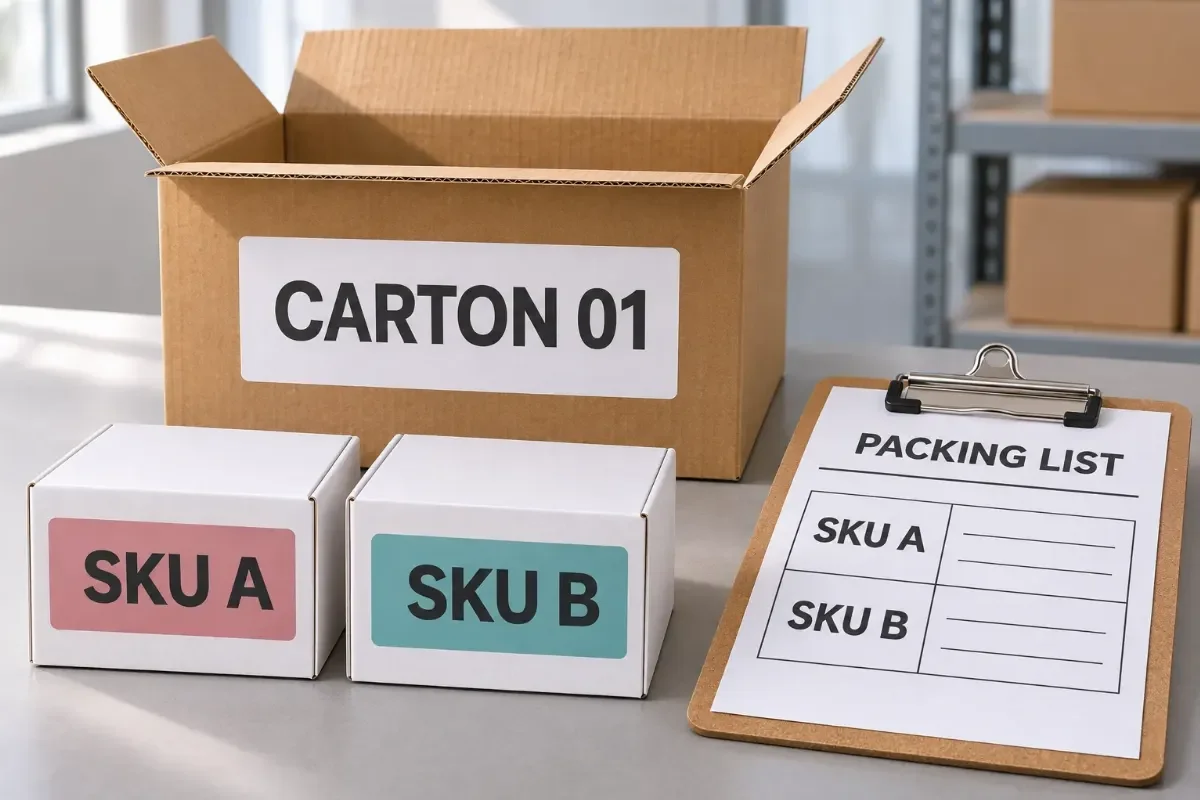
A carton labeled 'CARTON 01', two small retail boxes marked 'SKU A' and 'SKU B', and a packing list on a clipboard.
Start with the product facts that determine the rule, record the official source and effective date, then carry approved requirements into the specification and inspection checklist. LifaSourcing's guidance puts the same sequence ahead of artwork approval.
Use a layer matrix with columns for product, retail package, inner pack and master carton. For each row, record exact text, language, print method and color, panel or placement, rule source or reviewer, and status. Add barcode mapping and a named approver. CargoTrans recommends putting the origin, its method and location, whether the retail package or only the master carton is marked, and any address or place name that triggers the proximity rule on the purchase order and packaging approval form.
Surmount's carton-mark guide treats controlled paperwork as part of the supplier handoff: one identified, dated label revision, the packing-list revision that matches it, and an agreed change authority. Apply that discipline to the label record. One approved file should tie each package layer to its exact origin statement and placement, show which layer-matrix row it implements, and list any pending trigger item.
Split sign-off into content and application. Content sign-off asks whether the country wording, any proximity text and all other approved copy are correct. Application sign-off asks whether that mark sits on the layer and panel the matrix requires, at the intended size, and whether it survives handling. Style Sourcing makes the same separation between approving copy and layout and accepting how the label appears on the real package. Record both against the same layer row.
For the print itself, specify method, exact location and ink colors with Pantone codes where relevant, and mark placement visually. Surmount's product-specification guide advises the same detail.
Use this template; replace the blanks and remove fields that do not apply:
For SKU: [fill], destination: [fill], list each package layer, exact text, placement, print method and file version. Identify any category rule source and every pending item. Confirm which file the printer and packing team hold.
Send regulated wording to a compliance adviser or official destination-market resource before production. Give the product, destination, intended use, materials and exact statement, not just 'Is this compliant?' Style Sourcing recommends that specific request.
To prove the print, start with a full-face image of a printed carton label. For origin marking, go further: ask for a full-panel photo of the actual retail unit, showing the origin mark and any proximity trigger at readable scale, and identify the layer-matrix row and file revision the photo proves. Surmount's carton-mark guide recommends the full-face carton photo.
Request a structured first-production photo set as well: product and SKU identifier; package sides; label and barcode close-ups; insert before and after placement; inner packing; open and closed carton; carton sequence; and a wider production-context image. Style Sourcing's checklist recommends this sequence.
Check more than the barcode's readability. Ask for the decoded value and verify the product-to-code link, because a clear label can still identify the wrong color, size or sales unit. A successful scan proves that link, not that the required origin wording or placement is present. Record the scan result against the approved artwork and the layer row it is meant to satisfy. If the receiver scans, arrange a scan test under that receiver's requirements; a clear picture is not a system acceptance test. Surmount's barcode guide.
State exactly what is pending by variation or component. Never assume a revised file cancels an old one; make the printer and packing team confirm the version they hold. Name one buyer approver with access to the current product, SKU, barcode, destination and artwork records. Style Sourcing notes that unclear ownership creates conflicting approvals.
Verify the approved file, packing instructions and physical package before export cartons are sealed. Surmount's barcode guide puts the approved label file, product-to-code mapping and physical packaging check into packing instructions and says to check them before the supplier seals export cartons.
Photo proof is selective evidence from one moment: it does not prove every unit is identical and does not replace a defined inspection or receiving process. Style Sourcing.
Before the print run
Fix the sales unit and package layers. Allocate the origin mark to the layer that reaches the buyer. Check any category-specific content with the responsible agency. Then issue one dated label file, approve the applied sample, reconcile the mark with the invoice and entry, and hold the print run on any unresolved item.
If the product falls into a regulated category, or the package configuration is still unclear, get product-specific review before production. Use the table as a map and confirm the result before printing.
Next step: send the template to your supplier with your product photos, dieline, barcode mapping, destination and current file. For the handoff after printing, our barcode guide and product-specification guide cover the next checks.