
February 2027 sits at the front of this monthly desk planner set, with a to-do column beside the grid.
China’s 2027 Spring Festival holiday runs from February 5 to 13. For a shipment that has to leave before the break, start with the forwarder’s confirmed cargo and paperwork cutoffs. Work back through pickup, inspection and time for rework, then ask the factory to confirm the last date it can take a complete order for your SKU. The public holiday is a calendar reference; the resulting order deadline is specific to your shipment.
Start with the official 2027 dates
China’s State Council General Office published the 2027 calendar on November 5, 2026. The Spring Festival holiday is February 5–13, inclusive. Lunar New Year’s Day is February 6. January 31 and February 14 are adjusted workdays. official notice.

A February 2027 calendar page anchors the official holiday dates; each supplier’s production cutoff still has to be confirmed in writing.
Use these dates as the common calendar anchor, not as your order cutoff yet.
What a factory means by “closed 5–13 February”
What to do if the supplier will not allow inspection
Ask the assembler which outside process could make it miss the deadline. If a printer must finish the cartons before the order can be packed, get the printer’s last deliverable date from the supplier as well. A factory that reopens on February 14 may still be waiting for those cartons.
The official dates do not establish a particular factory’s closure, reopening or full-capacity dates. A supplier saying it is closed 5–13 February is giving you the official answer, not necessarily the production answer.
A supplier may not yet know its line schedule because it depends on orders still being booked, while the public holiday date is already fixed.
Ask for the supplier’s own dates in writing: the last loading date and the full-capacity restart date. Add the last production day for your line, the last date for materials and packaging to arrive, the line reopening date and the expected return of key staff and subcontractors.
Closing and restart dates depend on factory location, product category, workforce availability and outstanding production commitments. They also depend on the suppliers behind the factory. The main factory may be open while a critical material supplier, packaging printer, surface-treatment subcontractor or component supplier is not.
An order needs one custom-printed carton and one plated metal part. The assembly factory can reopen on February 14 and still ship nothing, because the printer is still clearing its queue and the plating shop has not restarted.
Reopening is not the same as full production. A factory can reopen while lines, material suppliers or subcontractors are still below normal capacity. Reopening and return to full production depend on each supplier’s staffing and order backlog; these are not government-confirmed dates.
There is no universal January cutoff. Orders may need locking much earlier depending on materials, production time and the factory’s own closure. Use one written last production date per supplier. Do not average dates across suppliers: the slowest supplier sets your plan, not the average, and certainly not the most optimistic reply in your inbox.
What the factory window usually looks like
Factories in China commonly begin reducing production one to three weeks before Chinese New Year. Another inspection-firm view is that production slows and stops one to two weeks before New Year’s Eve, offices stay open a little longer, and most suppliers are not running again until two or three weeks after it. Those descriptions differ because factories differ.
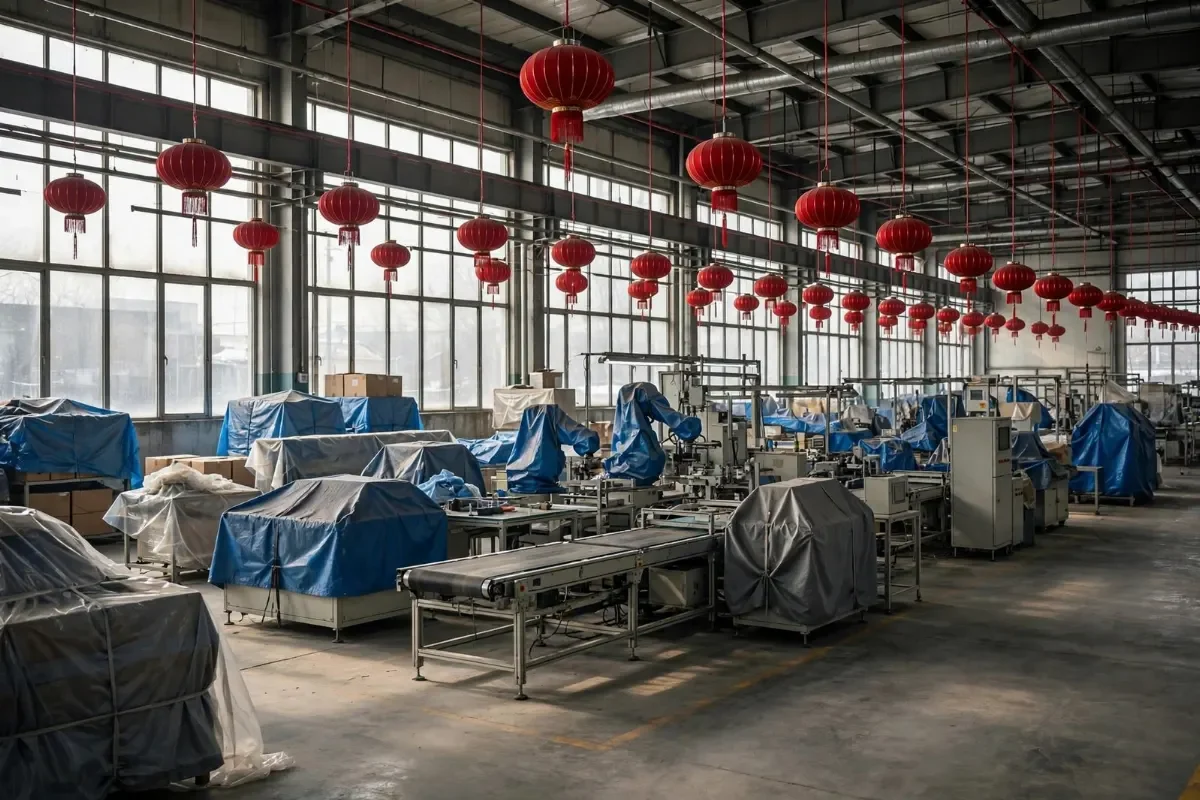
Machinery stands covered and the conveyor is empty, a visual cue of a factory floor during a production pause.
Published 2027 timelines also differ, but they overlap. These are planning ranges, not named factory schedules:
| Planning reference | Wind-down | Closure | Ramp-up |
|---|---|---|---|
| Headwind Group, typical China/Vietnam pattern | January 16–February 4 | February 5–20 | February 21–March 20 |
| Importivity, mapped to 2027 | lines wind down about January 22–29 | idle until around the Lantern Festival on February 20 | ramp back into March |
| Easy Imex, furniture-sector guide | from mid-January | approximately February 5–12 | 2–4 weeks, with recovery by early-to-mid March |
Read the table as a spread, not a schedule. Three published sources put the start of the wind-down anywhere from mid-January to late January, and the useful restart anywhere from late February to mid-March. Your supplier sits somewhere inside that spread, and only your supplier can tell you where.
Individual factory closures commonly last around two to four weeks. The wider disruption can last about six to eight weeks once pre-holiday slowdown and post-holiday recovery are included. Connected Sourcing describes that range. Full output can take up to a month after the holiday, or into March; there is no single number of recovery days that applies to every factory.
Regional figures need the same caution. One furniture-sector guide estimates Guangdong factories at three to four weeks to full capacity, Anji/Zhejiang marginally faster, and Fujian at two to three weeks of reduced capacity. Those are one sector’s estimates, not verified dates for all factories or regions. If you buy furniture, they are a reasonable starting assumption. If you buy electronics, they describe someone else’s supply chain.
With 30 to 45 days of production, one sourcing calendar says buyers usually confirm orders by November or early December 2026. Treat that as a planning example, not a universal deadline. The useful output is a date range per supplier, with a March fallback if the pre-holiday window cannot be met.
Confirm the forwarder dates before you book
“Book early” is not a date. Work backward from the date you need the goods, and let each party give you its own date. A useful backward plan includes destination clearance, international transport, the carrier’s cargo and document cutoffs, export documents and production completion.
Ask your forwarder for the 2027 sailing schedule, the booking deadline or booking window, available capacity, the cargo-ready date, the carrier cargo cutoff, the document cutoff, the actual booking confirmation and the roll-risk plan. Titoma recommends confirming the actual booking rather than assuming normal service resumes after the holiday.
The booking window tells you when space is still being sold. The roll-risk plan tells you what happens if your container is bumped. Ask about both before you commit to a cargo-ready date you cannot move.
Pre-holiday cargo and document cutoffs usually move earlier. Confirm them for the specific departure rather than from a normal-service assumption: a cutoff that applied in October is not evidence of the cutoff on a February sailing.
Book freight ahead of the rush, not into it. SEKO Logistics advises securing bookings at least three weeks before cargo-ready and adding one to two weeks to ocean transit plans. Those are planning recommendations, not a guarantee that space will be available.
Do not fill backward-plan rows with a standard number of days. If a date lands inside the supplier’s shutdown, the plan does not work and an earlier step has to move. A schedule that only holds when everything is normal is not a February schedule.
Air freight can bridge an urgent gap at higher cost. It is a fallback, not a substitute for a realistic pre-holiday plan.
Book the inspection before the inspection window closes
Ask the inspection company for availability for your factory and the agreed lot. Confirm the first visit and a backup visit if the goods need rework. You can then tell the factory how many days it has between correction and pickup.

A worker records carton details during a warehouse check.
Inspection slots fill fast. A pre-holiday inspection not booked by early December 2026 risks having no pre-shutdown option. Book capacity before the window closes, the same way you book the freight and for the same reason.
Inspection must happen early enough for corrective action. Waiting until the final production day leaves little time to put defects right, correct packaging or finish incomplete orders.
An inspection performed immediately before the holiday is not a recovery plan; it is a report you will read while the people who could fix the problem are travelling.
If an inspection fails, the schedule becomes the problem, not only the goods. Put the affected stock on hold and ask for a written correction plan: what will be fixed and how it will be checked, who owns each step and when it finishes, and what changes before the next run. Surmount’s failed-inspection guide walks through the full checklist for that document.
For your cutoff, one question decides the order: can the corrected stock be re-inspected and approved before the supplier’s written last production and loading date? If yes, book that verification slot now, while inspection capacity still exists. If no, or if nobody can name a booked date, the order has no pre-holiday dispatch, and March is the honest plan. A rework promise does not create a verification slot; only a scheduled, independent re-check produces the evidence you need to release goods.
The inspector decides how that re-check is scoped: a follow-up limited to the corrected units, or a new random sample drawn from the corrected goods. Either method must be finished and approved inside the remaining window. Keep the original report, the follow-up report and the quantity reconciliation together, so the release decision rests on documents rather than on a conversation.
Keep release separate from commercial relief. An invoice credit, discount or supplier assurance does not approve a shipment; release requires inspection evidence in hand before the written cargo handover date.
A worked backward plan, illustrative only
Here is a hypothetical order with a cargo-ready target of January 15, 2027. It is an illustrative backward plan, not a universal purchase-order deadline or a client case. If the specification is not locked, the example is already behind.
| Milestone | Illustrative target |
|---|---|
| Production order and specification locked | November 20, 2026 |
| Pre-production sample approved | November 27, 2026 |
| Materials, packaging and components available | December 18, 2026 |
| Production completed | January 5, 2027 |
| Inspection and corrective-action window | January 6–13, 2027 |
| Cargo-ready and handover confirmed | January 15, 2027 |
Read it as a chain, not a list. Each row only holds if the row above it held. A sample approved a week late pushes the material date, the production date and the inspection window in the same direction, and the inspection window has the least slack.
After January 15, add the forwarder’s booking and cargo/document cutoff dates. Finishing at the factory is not the same as being shipment-ready. Production, inspection and the move to the port all have to fit inside the same pre-holiday window, and the supplier’s written last production day is the outer edge of it.
If any date lands inside the supplier’s shutdown, move an earlier step. An order that cannot make the pre-holiday sailing needs a written March production and inspection plan rather than a squeezed February promise.
The written confirmation you should get from each supplier
Before you accept any cutoff, get dates in writing. Request:
- the last production day for your line
- the last loading or cargo handover date
- office and line reopening dates
- the expected full-capacity return
- who stays reachable during the break, by name
- raw-material and subcontractor status for the first run after the holiday
Confirm order cutoff, production completion, inspection and dispatch dates before the supplier closes. Confirm the actual freight booking at the same time rather than assuming service resumes after the holiday.
Record the dates that support the plan: sample or artwork approval, deposit and balance timing, packaging and label ready dates, inspection booking and forwarder cutoff. One dated page beats six chat threads, especially when half the people in those threads are on holiday.
If a supplier will not provide dates in writing, treat the cutoff as unresolved and plan earlier or choose the March fallback. An unwritten date is a date you cannot check when the schedule slips.
You can adapt this request:
Please confirm in writing, for our order:
- The last production day for our line.
- The last loading or cargo handover date.
- Office and line reopening dates, and the expected full-capacity date.
- Who remains reachable during the break.
- Raw-material and subcontractor status for the first run after the holiday.
- The cargo-ready date.
If these dates cannot be met, please send a written March production and inspection plan.
The forwarder, not the supplier, confirms the booking, cargo cutoff and document cutoff. Send that request separately.
The cutoff you can defend
Start with the official dates. Replace them with the supplier’s written production and restart dates. Insert the inspection and rework window. Then add the forwarder’s cargo and document cutoffs.
If any date lands inside the shutdown, move it or plan for March. That cutoff is defensible because every date in it came from the party responsible for meeting it.
Next action: send one written request to the supplier and one to the forwarder asking for the three dates that turn a copied cutoff into a workable plan: last production day, inspection and verification dates, and cargo/document cutoffs.