
Printed records, a calculator and an open laptop on a desk while a person reviews the paperwork.
The deposit cleared on a Tuesday. For two weeks the sales rep answered within the hour, sent photos of the sample room, and promised a production start date. Then replies slowed. Then stopped. The messages now show as delivered but unread.
That scene is a composite, not a client case. The first answer is uncomfortable: silence after payment is a warning sign. It is not proof of fraud and not an automatic right to a refund (Bizlawyerchina). It is, however, a reason to stop guessing and start documenting.
Before you escalate, verify three things: who received the money, what the contract and payment record show, and whether the supplier has answered through any channel you can check. Keep the bank-level payment record and the order file. Work out which legal entity was paid. Then make contact through channels you can verify. Only after that does the escalation question appear: a formal notice, a scoped site check, or China-side counsel? The sequence below gives you a checkpoint to write down at each stage.
First, classify the payment before calling it fraud
Start with the payment route, not an accusation. One factual question decides it: did you intend to pay the account that received the money?
If a familiar salesperson suddenly sent 'updated' bank details, if the email domain changed by one character, or if the beneficiary name and country do not match the transaction, treat it as possible business email compromise. Call your sending bank's fraud or wire team immediately and ask it to contact the receiving institution. Preserve the original emails with full headers next to the false instructions (Kelly Zhang Law).
If you knowingly paid the account the supplier had consistently designated, and the problem appeared afterwards (no shipment, a delay, defective goods, a refusal to refund), describe it accurately as an authorized payment followed by a supplier dispute. Ask for a recall anyway. Do not tell the bank the transfer was unauthorized; a false fraud description can undermine the contract case you may need later.
Give the bank a complete written request instead of 'please reverse my wire': wire confirmation and amount; beneficiary name, account, bank and country; the original instruction reference; the SWIFT UETR if you have it; the reason stated precisely; a request for immediate cancellation or recall; a request that the bank contact the beneficiary bank and any intermediary; and a request for written status. Then follow that reference. A submitted recall is an open item, not recovered money, until the bank records a completed return, a rejection or a refusal.
One rule holds in every version: do not send a release fee, a replacement deposit, a tax payment or the balance merely because a supplier says it will unlock the goods or the refund. If a new contact asks for money to release a shipment, verify who that person is and what the contract says before authorizing anything (Bizlawyerchina).
Record the description you gave the bank, the UETR, and the recall reference.
Build the file a lawyer or platform will ask for
The gap between a frustrating month and a workable claim is usually one indexed document set. Build it before you escalate, because listings, chat profiles and websites change while you argue.
Start with a one-page chronology: when the order was agreed, what the supplier promised, the payment date and amount, the account paid, the agreed production, inspection and delivery milestones, the last meaningful response, missed deadlines, every contact attempt, and the outcome you want. That page is what a lawyer, a platform dispute team or a future arbitrator reads first (Kelly Zhang Law).

A lined sheet on an open tabbed binder is a practical place to begin the one-page chronology for a supplier-dispute file.
Then assemble four groups:
- Commercial record: contract, purchase order or proforma invoice, quotation and supplier terms, specifications, drawings, approved samples, photos, inspection reports, commercial invoice, packing list, bill of lading or airway bill, warehouse records.
- Bank-level payment proof: debit advice or transfer confirmation, beneficiary details, payment purpose, SWIFT message or equivalent, UETR, intermediary-bank information, your recall request and every bank response. A spreadsheet row or cropped screenshot is not a substitute for the underlying bank record (Kelly Zhang Law).
- Complete communications: exported email and chat threads with account identifiers, timestamps, attachments, voice messages, delivery promises, admissions, excuses, refund promises and refusals. Keep the original devices and accounts, not only forwarded copies.
- Entity and loss material: the supplier's Chinese legal name, Unified Social Credit Code, registered address, registration record, known asset clues, and, if you intend to claim consequential loss, a loss table with receipts and the steps you took to limit the damage, not a round number (Guangdong Pingwei Law Firm).
Do not wait for a perfect file. Payment confirmation, the PI or contract, and the messages where the supplier promised a date are usually enough to make the first written contact credible.
Record the three items you already hold, and the two gaps only the supplier can fill.
Map who contracted, who invoiced and who received the deposit
This is the step most buyers skip, and the one that decides who you can pursue. Put five lines on one sheet (ChinaValidate):
| Node | What goes on the sheet |
|---|---|
| Registered supplier | Chinese legal name, USCC, status, registered jurisdiction |
| Contract seller | The entity that accepted the specifications, remedies and signatures |
| Invoice issuer | The entity named as seller on the invoice or VAT invoice |
| Ultimate beneficiary | The account holder credited, not the bank |
| Bank jurisdiction | Country or region of the receiving bank and any intermediary route |
Draw a line between two nodes only when a document explains the connection. If the contract seller and the beneficiary differ, label the relationship (parent, subsidiary, common-owner affiliate, export company, disclosed factory, payment agent, platform collection account) and attach the evidence and the approval for that label rather than calling it a spelling issue.
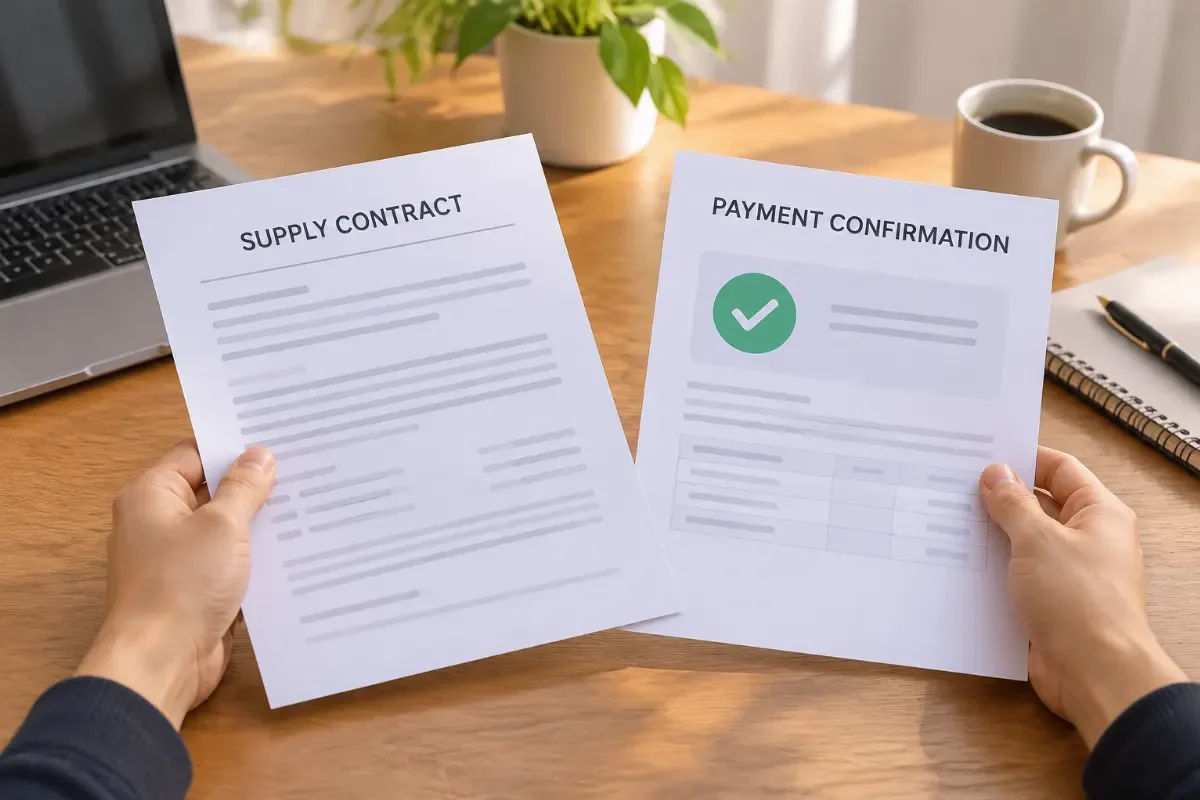
A supply contract page and a payment confirmation page held side by side for comparing the parties named on each.
Do not collapse these names into 'the supplier'. An English trade name, a Shenzhen sales company, a Dongguan factory, a Hong Kong payee and an individual salesperson can be five different legal persons. A third-party payee creates a proof problem about why that account was authorized and which entity should return the money (Kelly Zhang Law).
Three field-level checks matter here:
- Preserve the beneficiary name exactly as shown on the instruction. If it uses Latin letters, ask for the Chinese legal name and the document that connects the two. A close-looking translation is not an identity key.
- Do not confuse the bank with the account holder. The bank, branch and SWIFT/BIC identify the receiving institution and the route. A correspondent or intermediary bank is routing infrastructure, so the credited party is named separately.
- Treat a personal, employee or owner account as a hold. Do not normalize it as a shortcut. Require a corporate route or a documented, professionally reviewed exception.
For a mainland RMB settlement account, the People's Bank of China describes consistency between the account name, the depositor name in the account-opening proof and the name on the reserved company or finance seal. That supports a mainland corporate account. It does not establish ownership of a Hong Kong company, a foreign-currency arrangement, a collection agent or a Latin-character beneficiary. Each of those needs its own documentary link.
For a Hong Kong or overseas affiliate, request the affiliate's registration record, the ownership or control connection, written collection authority, how the invoice and contract treat that entity, and a statement that payment satisfies the mainland seller's receivable. A shared brand, email domain or director surname is not that relationship document.
One further control belongs on the same sheet: a beneficiary-change approval line. It records who confirmed the account name, number, bank, branch, SWIFT and USCC against the contract; which phone number or channel was used, established before the change instruction arrived; the date and time; and the second person who approved the change. A message carrying new bank details cannot supply its own verification contact. A reply or screenshot sent by that message never fills this field. While the line is blank, the change does not move.
This is a labeling exercise, not a rule or a client case. Take a hypothetical 1,000-unit order at USD 20 a unit: a USD 20,000 contract value and, at 30%, a USD 6,000 deposit. If the contract seller is a Yiwu company and the beneficiary a Hong Kong company, both names and the document linking them go on the same sheet before anyone sends another dollar.
A bank confirmation letter (a letter on bank letterhead confirming company name, account, branch, SWIFT and USCC) is something a supplier can request. Refusal or delay of more than a few days is a warning sign (ChineseCheck). Treat it as supplier-side evidence, not independent proof that the licensed company controls the account. No documented route was found for a foreign buyer to obtain or authenticate such a letter directly from the bank.
Record the five nodes, the document behind every line you drew, and the approval-line status.
Run a parallel-channel contact test
Once the file exists, test whether you are dealing with one unresponsive channel, a staffing problem, or full abandonment. Send the same short message, at the same time, through the company email, a second email address, WeChat, WhatsApp, the platform inbox and the office landline during China business hours. A landline that rings out is different information from a mobile going quiet.
Keep it civil and dated:
Hello [name], I have not heard from you since [date] about order [PO number]. Please confirm the order status by [date]. If I do not receive a reply, I will escalate through [platform] and the registered contact for the company.
Then ask three concrete questions: what is the production status, why did communication go silent, and when will the balance shipment be delivered (ChineseCheck).
For the production answer, do not accept 'about 80% done'. Request one dated update by SKU and variant with mutually exclusive stages (not started, in production, finished but unpacked, packed), with held or rejected units listed separately and photos linked to the order (Surmount Sourcing). Ask which task is blocking completion, which materials or approvals are missing, who owns the next action, the revised production, inspection, packing and collection dates with the assumptions behind each, and the name and date of the next updater.
Document every attempt and every delivery failure. One live channel may point to staffing or migration. Total silence is information too, but it is still not proof of fraud.
Record the channel, timestamp, delivery status, and the reply or silence for each.
Check the Chinese company record before spending on recovery
Now verify the entity. Ask for the full Chinese business licence and the 18-character Unified Social Credit Code before discussing price. A free online code validator catches a typo or an invented number in seconds, but it does not prove the company exists or that it is the one you are talking to. The registry does (Commercive).
Search the National Enterprise Credit Information Publicity System at gsxt.gov.cn, run by the State Administration for Market Regulation, by the code or the exact Chinese name. Read four fields:
- Status. 存续 or 在业 means operating; 吊销 means the licence was revoked and 注销 that the company was closed. Either of the last two is a stop.
- The Chinese name. It should match the licence, the contract and the bank account exactly.
- Business scope. A factory's scope usually includes 生产, 制造 or 加工; a trading company's shows 销售 or 批发 and no manufacturing terms.
- The abnormal-operations list. A company lands there for a missing annual report or for being unreachable at its registered address.
Record the result as four stop-or-continue lines, not a general impression: status operating, or revoked and closed; name matching all three documents, or not; scope carrying manufacturing terms, or only trading terms; abnormality hit, or clear. A stop on any line (revocation, an unreachable registered address, or an unexplained name mismatch between the registry, contract and payee) ends the payment question before a notice is drafted. A documented affiliate or third-party collection arrangement is not an automatic stop. Take it back to the five-node sheet, require the relationship document and the beneficiary-change approval, then decide whether to hold or proceed. A clean record, written down with its search date, is what makes the next notice, site check or further payment decision defensible.
The licence is also one of the most frequently forged documents in supplier fraud. Compare it against the registry rather than accepting the scan, and verify through official sites or a third-party service rather than the supplier's own paperwork alone (QCC).
Court and enforcement records are public but in Chinese and spread across several government sites. Search by the Chinese legal name, never the English trade name. If access is hard from abroad, ask someone in China to pull the record (China Agent).
Also ask, in writing, which business will issue the quotation and supply the order, and record any exporter's or trader's role and its link to the proposed manufacturer. A trader is not automatically a problem. A trader presenting itself as the factory is a mismatch to resolve (Surmount Sourcing).
Keep the boundary clear: this is a practical risk filter, not a formal factory audit or legal due diligence (Huang Sourcing).
Record the four lines, the search date, and the query you used.
Send a dated written request, then a bilingual formal notice
The status request comes first: verified channels, a dated answer, and proof of sending plus any delivery failure. If there is no substantive response, escalate to a formal notice addressed to the legal entity, not only the salesperson, in Chinese and English, with delivery records retained.
The notice should carry the transaction facts in this order: parties and order or contract reference; payment date, amount and the account paid; quantities ordered versus delivered; the specific obligation that was missed, with evidence references; the remedy you are asking for; and the next lawful step if it does not arrive.
At the buyer's stage, keep the notice to facts your documents support. The later lawyer letter is where the contract basis, the breach and your legal rights are argued in legal terms. A notice that misstates the amount or invents a breach can weaken your position (Guangdong Pingwei Law Firm).
Offer two measurable options instead of a vague demand:
Option A: complete production and ship the remaining [quantity] by [date]. Option B: refund [amount] for the undelivered goods by [date].
Set one deadline that you are prepared to act on. The commonly repeated 7 to 10 business-day figure, and the 7-day version in some playbooks, come from practitioner guidance, not a statutory rule in the material reviewed. Pick a date that matches your next real step, not a number copied from a blog (Kelly Zhang Law).
What to leave out: accusations your documents cannot support, contract or chat language quoted inexactly, amounts with no loss table behind them, threats of criminal reports, customs action or public exposure without a legal basis, waiver language in a partial settlement, and a notice sent only to a salesperson while the legal entity is ignored (Guangdong Pingwei Law Firm).
Two cautions before you send. A demand letter is not a compulsory preliminary step in every case, and urgent signs of asset dissipation may call for advice about protective measures before further contact. An unanswered message does not by itself establish valid termination, however silent the supplier has gone (Bizlawyerchina).
Send it in both languages. Your usual contact is probably the sales rep, who may not be the decision-maker. A Chinese-language letter is more likely to reach the person who can release goods or money (Kelly Zhang Law).
Record the date sent, the address used, the two options offered, and the deadline you set.
When to move from messages to an on-site order check
A site check becomes worth the money when the story stops matching itself: updates conflict with earlier reports, pickup dates repeatedly move without evidence, or you need facts instead of another promise. A physical visit can confirm whether the factory is operating, whether staff are present, and whether goods matching the order exist on site. No amount of remote messaging reproduces that information (ChinaBizAgent).
Specify the scope in advance, in writing. At the registered or AIC address, the checker should document whether it is a real industrial site rather than only an office or showroom; whether machinery, staffing, inventory and production records are present and consistent with the order's capacity; the worker count and production activity; the production status on your specific PO and SKU; and which stages run in-house versus subcontracted (SunLith, Procubility).
Do the cheap checks before the visit: AIC records, court records, ownership and address resolution can be pulled as desk work first (Procubility). After the visit, use what you found to decide whether to push, pause, escalate or stop spending.
State the limits plainly to whoever is paying. A scoped site check is not a product inspection, a formal audit or legal due diligence, and it does not guarantee a response or recovery. Inspecting finished goods answers a different question from how the factory manages its production process.
If silence continues: a lawyer letter, then a route you can enforce
If your own notice gets no substantive response, a lawyer letter is the next-stage option. Keep the same factual structure, but add the contract basis, the breach and the rights the agreement gives you. It is not a court order. Its value depends on the evidence, the supplier's circumstances and whether the next lawful step looks credible (Bizlawyerchina).
Before choosing a route, read your own contract: governing law, notice and cure periods, termination, payment terms, court jurisdiction, and any arbitration clause with its institution and seat. Then map the options: commercial mediation, arbitration and civil litigation. A contract without an arbitration clause may still be pursued in a Chinese court. Arbitration needs a valid agreement and a workable institution or seat (Fujian Budao Law Firm).

A desk consultation with a document in hand, a setting for reviewing contract terms before choosing a formal route.
For court or arbitration, work through the same list counsel will ask for: jurisdiction, the correct defendant or respondent, claim preparation, language and translation needs, cost, and whether the entity has reachable assets. A judgment or award gives you an entitlement; it does not collect the money. Compare evidence, deadlines, costs and enforcement prospects before committing to formal proceedings (HAIYU).
Two current legal details belong in that conversation, not in your own letter. The revised PRC Arbitration Law was promulgated on 12 September 2025 and took effect on 1 March 2026. Its ad hoc arbitration route is limited to foreign-related maritime disputes and disputes between enterprises registered in approved free-trade zones, the Hainan Free Trade Port or other designated areas (Harvard International Arbitration Law Students Association). Chinese courts also gained wider jurisdiction over foreign-related civil and commercial litigation under the 2024 Civil Procedure Law amendment, so future contracts may deserve an exclusive jurisdiction clause for a foreign court or a foreign-seated arbitration agreement (Debevoise & Plimpton).
Treat one common claim with caution: a Chinese law-firm page states that a demand letter tolls a three-year limitation period for international trade disputes. That is secondary commentary. Ask counsel to confirm it against the statute and your contract rather than relying on it (Fujian Budao Law Firm).
If the supplier looks like it is closing, moving assets or facing multiple unpaid claims, get China-side advice promptly instead of finishing a routine sequence of reminders and demands (Bizlawyerchina).
What to do, in order
Stop any further payment, including 'release' or 'unlock' requests. Capture the bank-level payment record and the order file. Map the five nodes and write down which entity was paid. Contact every known channel with one dated status request. Verify the Chinese company record and the beneficiary, and record the four registry lines. Send a bilingual notice to the correct entity with two measurable options and a deadline you will honor. Then decide whether a scoped site check or China-side legal advice is warranted.
None of this turns silence into a finding of fraud or guarantees that money comes back. It replaces guesswork with a documented record. Any notice, platform dispute, site check, lawyer letter, arbitration or court route will be judged on that record.