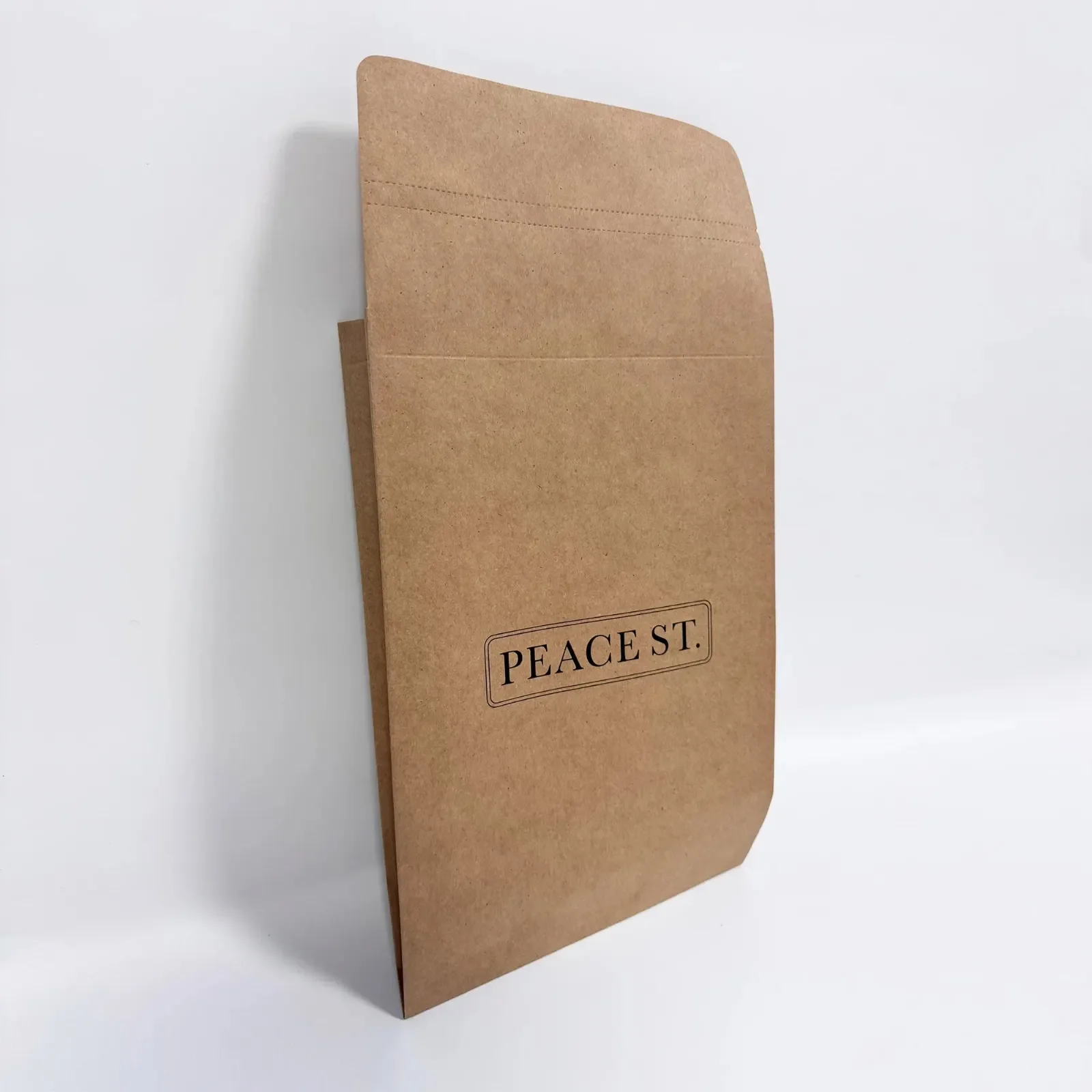
A plain kraft mailer with a small printed brand mark, the visible layer a small brand can add without a fully custom box.
If a custom box minimum is too high, quote a stocked box that fits your product and add the branding as a separate sticker, insert or sleeve. Ask for the minimum on each component and each artwork version. Then compare the cost per packed order, including application labour, protective fill and any packaging you must buy but won’t use right away.
Start with a stock package and add the branding separately
Start with a structure that already exists. A stock mailer, stock box, stock pouch or ready-made gift box carries no new dieline or cutting die. The customer-facing brand goes on a label, sticker, hang tag, insert card, thank-you card or sleeve.
All of those printed pieces still have their own minimum, set by the label or card supplier. A practical packaging cost guide describes a stock mailer plus a printed label or card as a sensible first branding step for this stage, and recommends starting with a stock structure and adding a label, sleeve, card or one-colour print.
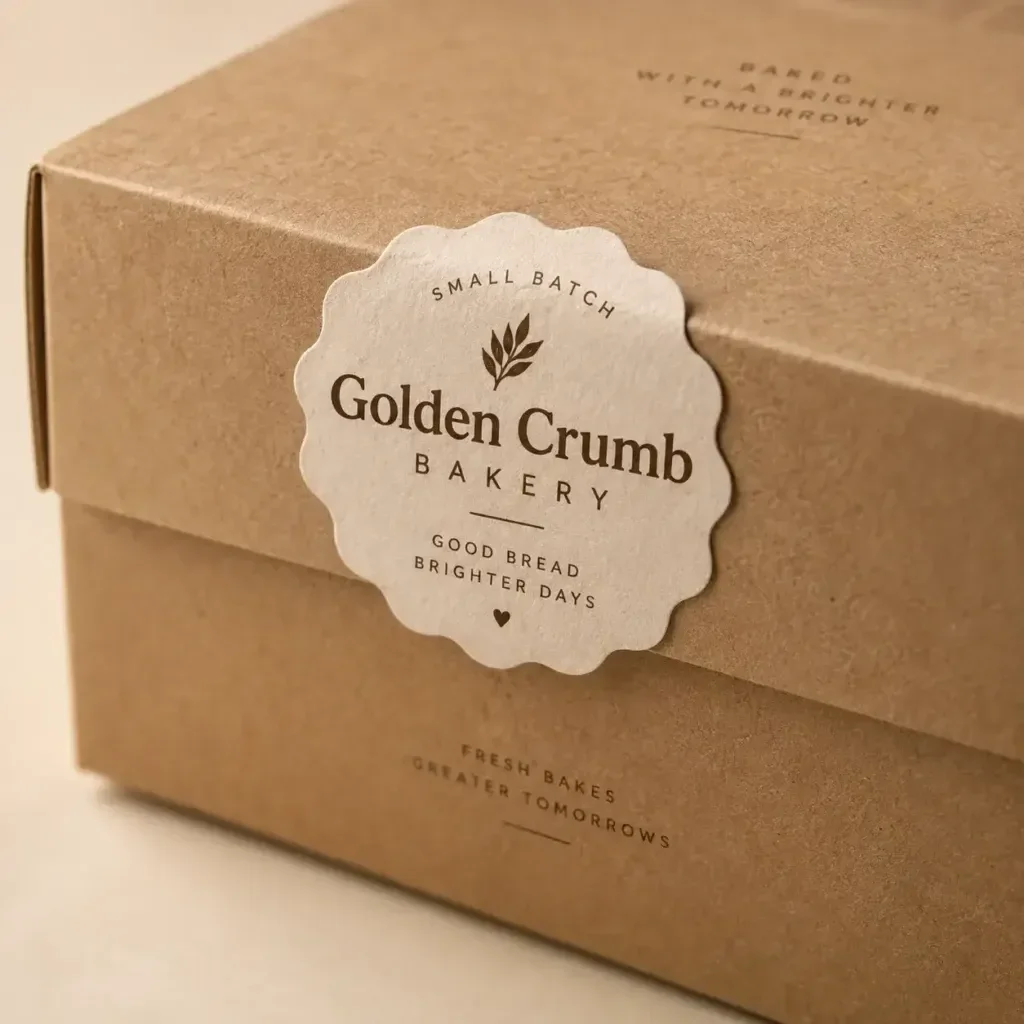
A plain kraft box with a separate scalloped 'Golden Crumb Bakery' label on the lid.
| Route | What is new | What sets the minimum |
|---|---|---|
| Full custom box | New structure, dieline, cutting die, print setup, finishing | Tooling, plates, material purchase, run setup, assembly |
| Stock base + printed label/card | No new box structure | The printed component's own material, print setup and per-design floor |
| Stock base + sleeve | Printed sleeve and possibly a die | Sleeve printing or format minimum, plus box size compatibility |
Stock packaging options are limited to available sizes. A stock-versus-custom comparison notes that a standard box is designed for a range of products, not yours specifically, so it may leave extra space to fill and more room for the product to move. That extra void fill, labour and dimensional volume can reduce the saving. Fit and protection still need checking; stock does not mean automatically safe.
Why custom packaging has an MOQ
What to approve before your packaging goes to print
Ask the quote to show the minimum per box size and per print design, with setup and application costs on separate lines. If you sell two colours in the same size, ask whether both can use the same unprinted box with different labels. That keeps the shared box order separate from the label minimum for each design. Reference: PackMojo.
A quoted 500-piece custom packaging MOQ can belong to the box, the printed label or card on it, or both. That changes what you compare. A stock mailer with a printed label is one purchase; a custom box built to your dimensions is another. The first lowers the upfront commitment without making the minimum vanish. The second adds new structure, tooling and print setup before the first packed order exists.
Custom packaging has no universal MOQ. The number is tied to how the item is made and to the supplier's economics. Before the first finished box exists, the supplier may need printing setup, cutting dies and other tooling, material purchasing, machine preparation, manual assembly and quality control. Those activities create cost even at small volume, as this MOQ cost guide explains.
Low volume spreads the same setup effort across fewer units. Setup expenses can remain similar whether the order is 100 boxes or 1,000 boxes. A press consumes a similar length of material reaching registration whether it then produces 2,000 or 20,000 units. That is why a supplier can quote a unit price that looks workable at 500 pieces but does not want to run 50.
Tooling is only one part. A custom box shape needs a cutting die: a plywood board with steel rule blades bent to the dieline. It is made once and reused, but someone pays on the first order. Offset, flexo and rotogravure printing put the artwork onto a physical image carrier first, such as aluminium plates or engraved cylinders, before it reaches the substrate. Finishing can add foil dies, embossing tools and extra machine passes, and each additional process can require its own setup, test sheets, registration and inspection. At low quantity, those steps are distributed across fewer units.
The box MOQ and the material MOQ are not always the same. A brand may want 500 boxes while the packaging manufacturer must purchase more material than exactly 500 boxes consume. If the specified paper, colour, texture or certification is not stocked, the material purchase can become part of the commercial decision. A supplier may also quote a lower minimum by changing material, dimensions or finish. That is a different product, so check fit, protection, information requirements and the packed sample before you compare it.
Digital printing can remove conventional plate setup. The job may still need cutting, special material, finishing and assembly. Compare quotes for the same packed specification and ask which of those operations sets the minimum.
MOQ is often assessed per SKU, artwork, colour or specification, not just on the total. Ordering 1,000 identical boxes may be more economical than ordering 250 boxes in four designs, because each design can need separate print preparation and production handling.
Which low-MOQ packaging pieces carry the brand best?
Start with the piece the customer's hands reach first. A label or sticker on a plain stock mailer gives you a visible brand layer with the smallest print commitment. A well-designed seal or front label can make a plain kraft box look deliberate before a custom box is justified.
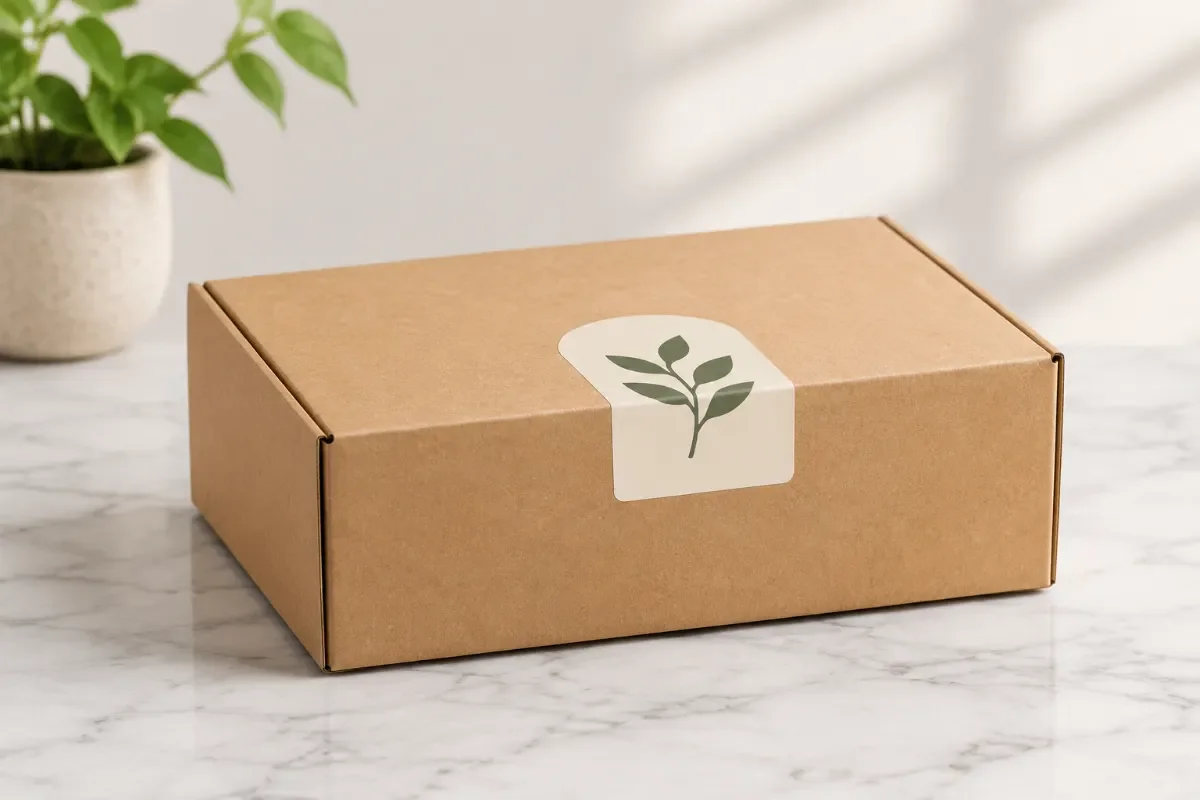
A plain kraft box whose branding sits on one separate printed sticker seal, rather than on a custom-printed box.
An insert or thank-you card carries the unboxing message and the practical details: care notes, a reorder code, contact information or a sizing note. A hang tag or sleeve adds a more tactile layer, but it is another printed component and another minimum to confirm. A custom-printed stock box is the next step up; it keeps the stock structure but changes the printing.
| Piece | Brand role | Minimum-order risk to check |
|---|---|---|
| Self-adhesive label or sticker | Seal, front mark, simple logo | Exact material, size, finish, number of designs; one supplier at 1,000 per unique size or design |
| Insert or thank-you card | Message, care notes, reorder code | Print side, card stock, size, folding, number of versions |
| Hang tag | Tactile label, retail finish | Thickness, hole or string, print method, separate design minimum |
| Printed sleeve | Wraps a stock box for a more finished look | Sleeve size versus box, assembly, print and die costs |
| Custom-printed stock box | Branding on the box itself | Box stock availability plus print setup; not a custom structure |
One low-MOQ guide argues that a plain white or kraft stock box, a full-colour insert card and a branded sticker can deliver about 80% of the perceived brand value at 20% of the MOQ commitment. That is the guide's commercial argument, not a measured result. Its practical point is sequence: get the visible brand layer right before paying for a new box structure.
Every option here still has a minimum. Ask for the exact floor for the chosen material, size, finish and number of designs. Do not assume a digital label makes the whole package tooling-free: digital print may avoid a plate, but the package still needs fit, protection and any required information. Stock sizes are limited, so a loose-fitting stock box can need more void fill and shipping space, and the branding saving can be offset.
Compare total cost per completed shipment, not per empty box
The box price is only one line. What matters is what it costs to pack and ship one completed order. A stock versus custom comparison puts it directly: total packaging cost should include the box, printing, tooling, freight, packing labour, void fill, storage, damage, returns and disposal. A quote-comparison checklist adds tooling amortisation, quality control, import duties and taxes and payment fees to the total-cost-of-ownership sheet.
Build the comparison line by line: packaging; printing; tooling; freight; packing labour; void fill; storage; damage and returns; disposal. Use the same product, packing method and delivery scope. A cost breakdown guide also shows why one neat per-unit average is risky: format, material, print method, finish, volume and freight all move the number.
Fixed setup is easy to see once amortised. Suppose setup is $600: at 500 units it adds $1.20 per box; at 5,000 it adds $0.12; at 20,000 it adds $0.03. A one-time $250 dieline fee adds $0.25 per unit on a 1,000-piece order. These are illustrative arithmetic, not current quotes.
A lower stock-box price can lose on the total. An illustrative comparison shows a $0.60 stock box costing more to use than a $0.90 custom box if the stock box needs $0.20 void fill, $0.15 extra labour and larger shipping, storage and damage costs. That is a teaching example, not a live supplier quote. The same logic applies to a stock base plus a label: the label adds a component, but the package may still need more fill or slower hand work than a fitted custom box.
Count unused packaging as part of the first-order commitment. Surmount's planning example has a supplier accept a 300-product order while requiring 600 printed boxes: after packing, 300 products ship and 300 empty boxes remain. That leftover is paid-for inventory. Do not assume you can recover its cost by ordering less later. Ask where it will be stored, who owns it if the order changes, how later use is recorded, and whether any re-credit applies. The months-of-stock calculation below should use the quantity you must buy, not only the quantity you expect to pack.
A line that reads "custom packaging included" is not a quantity. Until the box count sits beside the per-unit total, you cannot tell how many empty boxes you are paying for. Ask for the count before treating the line as priced.
Turn the MOQ into months of stock and a break-even quantity
A useful test is months of packaging inventory: MOQ divided by average monthly consumption. If the MOQ is 1,000 and you realistically pack 200 orders a month, that is five months of stock. No universal pass or fail figure applies; the calculation is a way to see cash, storage and design risk together. A larger run can lower the unit price while raising the total cash due before the first shipment and the amount left if sales disappoint.
For a rough break-even, divide custom fixed costs by the difference between stock total cost per unit and custom variable cost per unit. With an illustrative $800 fixed cost, $1.50 stock cost per order and $1.10 custom variable cost per order, break-even is about 2,000 units. Work from actual quotes and your forecast. No single break-even quantity fits every order. The figure moves with the gap between stock and custom variable cost, so rerun the arithmetic at each quantity break the supplier quotes.
Ask for several realistic quantity breaks rather than one "cheapest price". Compare 500, 1,000, 2,500 and 5,000 where those are realistic. If a lower quote changes material, dimensions or finish, it belongs in the pilot gate below, not in a like-for-like price comparison. If a supplier says "we can send 300 now", ask how many units the factory will make and how many you are agreeing to buy. Splitting deliveries alone does not reduce the purchase commitment.
Pilot-check the packed package before a larger run
Before production, make a physical prototype and check fit, look and function. A short-run packaging guide notes that a good prototype catches a box that is a few millimetres too tight, colour that looks different from the screen, text too small or too close to the fold, and structural weakness that only appears when the box is handled. Approve a proof or physical sample, especially for colour, and use the printer's dieline template so artwork fits the structure.
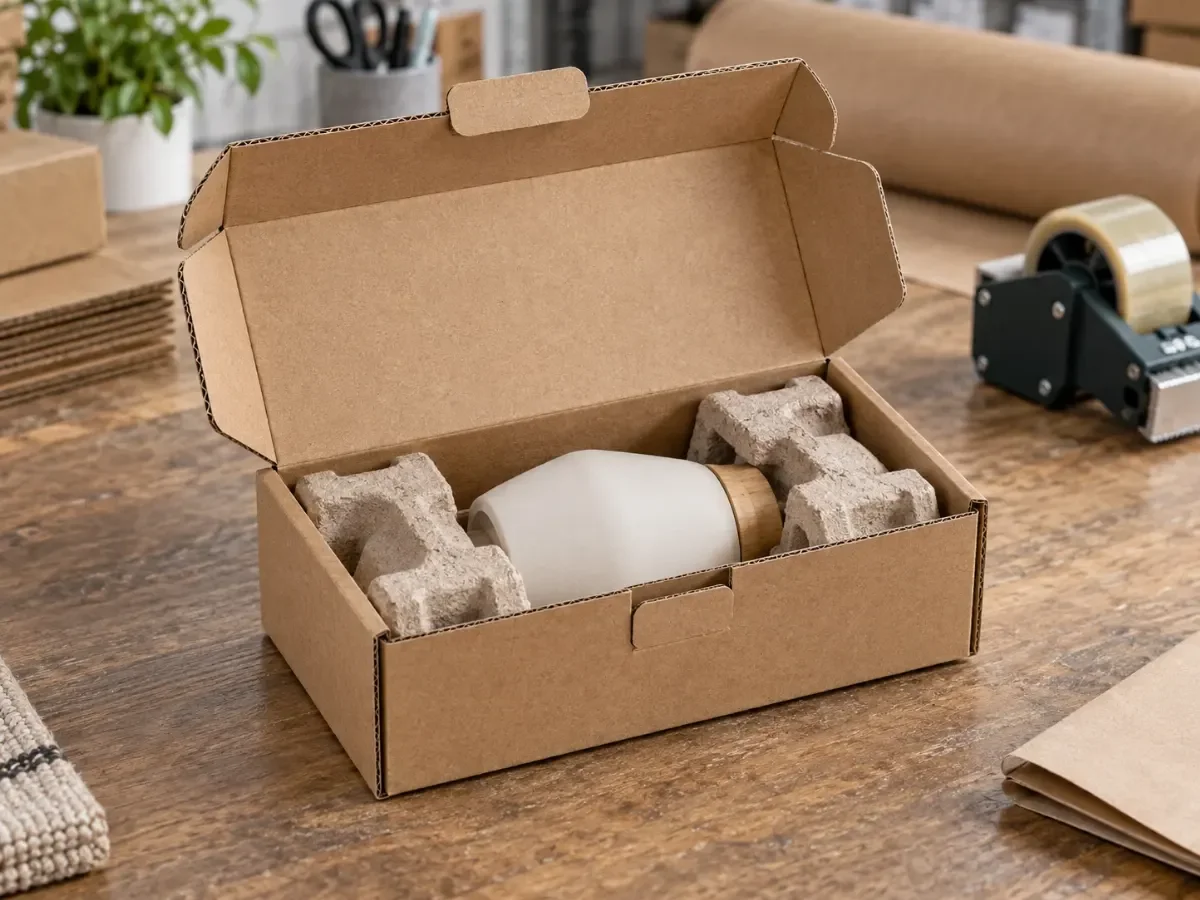
A filled kraft mailer with moulded pulp inserts at a packing bench.
For flexible packaging, confirm early that the film and inks suit the product: barrier, sealing and food-safety requirements vary. Check applicable food, cosmetic or supplement labelling rules before printing.
For barcode labels, ask for a print sample using the intended label material and printer settings, applied to the package in the position proposed for production. A label that sits flat on an empty bag may wrinkle after the product is inserted, so check the packed version. Compare the decoded value with the approved SKU mapping and the actual item inside the package, not merely whether the label scans. Treat one phone-app scan as an early check, not a certificate: it cannot assign a formal print-quality grade, and it cannot promise that the receiver's equipment will accept the batch. These barcode checks are set out in Surmount's label-check guide.
When a supplier sends a carton drop-test report, read it as a document with boundaries: what was tested, which packing revision, how many samples, and what pass or fail meant. Approve only after those boundaries match the packaging you are buying. One passing carton does not cover every SKU or packing line. No universal sample sizes or numeric pass thresholds apply here; agree the pilot method and acceptance criteria with the supplier or inspection provider for the exact packaging, product, destination market and sales channel. Surmount's drop-test review guide covers that before-approval check.
Where the low-volume route stops working
The route stops when the brand needs a new structural shape or a finish that carries its own tool. Rigid boxes, premium multi-stage formats and hand-finished inserts can have higher practical minimums than simple folding cartons. Foil stamping, embossing, window cut-outs, spot UV and custom inserts add tooling or production steps, and those can raise minimums or low-volume unit cost. A short-run folding carton can therefore be practical at a lower quantity than a highly customised rigid box with specialty wrap, moulded insert and multiple hand-finishing stages.
Digital print may avoid a plate, but the die cutting, material purchase, finishing and assembly constraints described above do not disappear. A custom packaging supplier claiming every format can go low-MOQ should be asked what actually changed: the stock structure, the print method, the material, the finish or the assembly. Keep protection, dimensions, material and information requirements as the benchmark. If the lower minimum changes those, use the separate-proposal review from the MOQ section above.
The useful question is which step in this variant sets the floor. The answer can sit in tooling and plates, a material purchase that runs beyond the box count, extra finishing passes, or a structure that is no longer the stock base you priced. The floor can also be set by available finished stock, the size of a production run, decoration or printed packaging. Once the supplier names the step, the quote stops being a black box.
Ask which component or process prevents the supplier from accepting the requested quantity. Also confirm whether the floor is per order, per SKU, per artwork or colour, or per size.
What to send the supplier next
When comparing custom packaging solutions, send a one-line-per-variant quantity sheet: product, size, colour, packaging component, artwork version, requested quantity and expected monthly use. Ask the supplier to state which component or process sets the minimum and whether it applies per order, SKU, artwork, colour or size. Request two prices on the same brief: a stock base with a printed label, card or sleeve, and a custom structure in the same dimensions. Compare total cost per completed shipment and months of inventory, then approve a packed physical sample before a larger run.
Use this as a starting request, and replace the details before sending:
Quantity sheet attached. Please price two builds against the same product, dimensions, protection and information requirements: a stock base with a printed label, card or sleeve, and a custom structure. For every quantity break, state the unit price and the total quantity committed behind the first shipment, plus the months of stock at my expected monthly use. Name the step that sets each variant's floor: tooling, a material purchase, finishing, print setup or the structure change. I want to approve a packed physical sample in the production position before a larger run.
Branding below a custom box minimum still costs money. The difference is that the minimum can sit on a separate component, so the whole packed order's cost can be compared before you commit. For related checks, see Surmount's guide on MOQ by style and colour. The barcode and drop-test guides linked above cover those approval steps.